
Pine needles save: how a mountain village in Tenerife survives.
In the mountain village of La Montañeta in Tenerife, pine needles have historically been an important resource for the survival of local residents, who are now witnessing the departure of young people and the arrival of immigrants.
To survive, people use what nature provides. In San Francisco de la Montañeta (Garachico), pine needles are everywhere. Although they are sometimes prickly and easily flammable, they have helped the residents of La Montañeta (as the place is more commonly known) survive.
This village is located in the heart of the Corona Forestal de Tenerife Natural Park, the largest in the Canary Islands. The park covers more than 45,000 hectares, and the village is located at an altitude of 1,400 meters. About 70 people live here. One might think that this mountain village has nothing to do with Garachico, a coastal town with beautiful architecture and a rich culture, where tourists come every day. They are looking for "one of the most beautiful towns in Spain." But if these tourists saw La Montañeta, they would surely say that it is "one of the most beautiful corners of Spain."
The pine forest here is so tall that you have to crane your neck. And when you go to the square where the chapel of San Francisco de Asís stands, you realize what a magical place it is. The chapel was built in 1956. But crossing the road here is dangerous: due to a sharp turn with poor visibility, a wooden bridge was built in the early 2000s so that people could cross the TF-373. To get to the bridge, you have to walk along a path strewn with pine needles, and a little uphill. It's not for everyone.
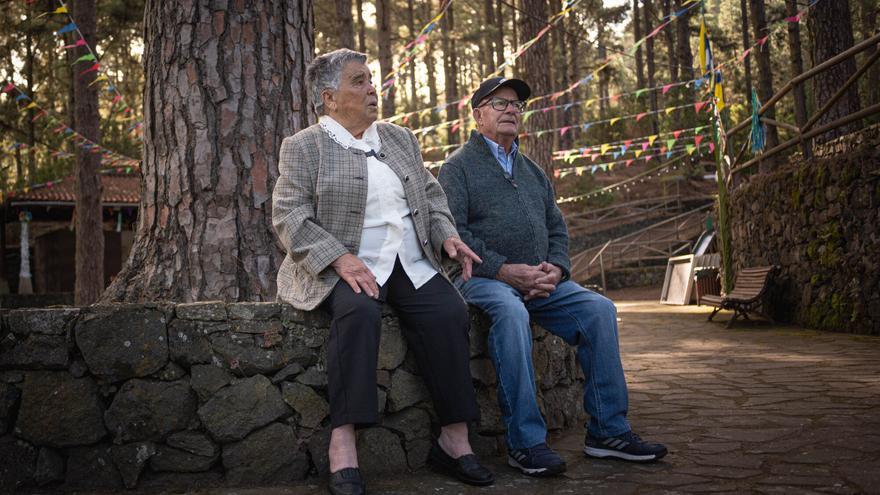
Herminia Gorrín, whose real name is Susana, but everyone knows her as Fifa, is 90 years old and has lived in La Montañeta all her life. She sits on a bench near the chapel with Antonio Delgado, who was also born here. "There used to be a lot of people living here," they say. "But everyone wanted to move to La Culata," Herminia jokes. That's where the cemetery is. That's how she says most of the residents died. Delgado adds that "there are more visitors than locals now. They buy land and build houses."
Antonio has worked all his life, but one thing he remembers most: "I started by collecting pine needles up there. I went to work on El Hierro, doing the same thing. Then I pruned branches in this forest," he says.
For Delgado, the forest and pine needles provided an opportunity to work in his native village, but "there weren't many opportunities back then. I'm talking about the old days, 60 years ago. I started collecting pine needles at the age of 19, with sacks on my shoulders and with my mother," he recalls. He would walk to La Culata, under the cemetery. There he was paid for the pine needles, which were then "bought by resellers and sold to banana plantations, for tomatoes... for everything," says Delgado.
Gorrín also "collected pine needles for the union," referring to banana packaging, which was popular until the mid-twentieth century. "I brought firewood to Garachico so they could cook, because they didn't have kitchens like they do now," she explains. She remembers the wife of Francisco Montes, who "was a doctor. She was like a mother to us, we brought her firewood and she gave us food."
Although there is a lot of land and a good climate in this village, the residents of La Montañeta did not grow many potatoes. Apple and chestnut trees are the most common fruit trees here, but "the land belonged to the rich," says Herminia. They remember the "marquise" estate, where "potatoes and barley were sown. My father," Gorrín continues, "went to Las Portelas, in Buenavista del Norte, for barley." "We used to live in poverty. I ate barley gofio, without sugar or anything," adds Antonio.
People are leaving the village again: "Why should young people stay here?" asks Herminia Gorrín. "There are only four old people left. Young people leave to look for a better life, a job... What will young people do here, up here?" she asks again. Some of the children of these two residents live in La Montañeta.
The village has holidays. On October 4, they celebrate the day of their patron saint, San Francisco de Asís. Then the silence of the mountain village is broken, and Tenerife ceases to be empty. In the 1990s, this place was popular in the Canary Islands because you could camp in the mountains here. But over time, due to the restrictions of the Corona Forestal Natural Reserve, this disappeared. Herminia and Antonio nostalgically recall those holidays when hundreds of people camped for the whole weekend.
Now Brifor employees are preparing the village for the holiday. Also, many employees of the Garachico City Hall are putting the area in order. "In the 90s, this week was very hot," says one of the forestry workers near their base. The forest house is another feature of this magical place, where stone and pine needles merge to cover the ground, transformed into a real mattress.
There is no bar or supermarket in La Montañeta, and the medical center is only open on Thursdays. For Herminia and Antonio, a shopping trip to Icod de los Vinos is not a problem. In this area of Garachico, the highest, there is a Red Cross camp, which currently houses 57 immigrants. Four of them are sitting on a stone wall with pine needles. They don't speak Spanish well, but enough to say hello and say how many people are there now. "They don't bother me at all. They see me, say hello and mind their own business. No one knows where they will end up," say Gorrín and Delgado, showing the tolerance and hospitality inherent in such a friendly and close place as San Francisco de la Montañeta.