
Roseta Lace Declared Canary Islands Cultural Asset, Targets UNESCO Status
"Roseta" lace, a unique Canarian needlework technique, has been officially designated a Cultural Asset by the Canary Islands Government, with advocates now pursuing UNESCO Intangible Cultural Heritage of Humanity status.
"Roseta" lace has officially been declared a Cultural Asset (BIC) in the category of traditional artisan technique. This recognition by the Canary Islands Government was published on October 14. Efraín Medina, an island councilor and strong supporter of Tenerife's crafts, hopes this ancient art will eventually achieve the prestigious status of Intangible Cultural Heritage of Humanity, awarded by UNESCO. Roseta is a unique needlework and lace technique, passed down through generations, and is especially preserved in the south of Tenerife and some areas of Lanzarote.
Medina, who is now the councilor for Employment, Education, and Youth at the Cabildo (Island Council), shared his satisfaction: "We worked for nine years to get roseta recognized as an Intangible Cultural Asset, and now it's finally happened." He explained that roseta is one of Tenerife's original traditional crafts, which then spread and evolved in various parts of the world. Examples include Paraguay with its ñandutí, Venezuela with the soles de Maracaibo, Cuba with its own "soles," and Puerto Rico. "It traveled with immigrants and returned with them," Medina noted.
Medina added that roseta even reached colonial England, where governesses from Tenerife were hired to teach this distinctive and delicate embroidery technique to the upper classes, especially in London. Another journey took roseta to Croatia, where a descendant form of the lace is already recognized as World Heritage. He emphasized, "We also have records and traces of roseta in different parts of the world."
The Tenerife Cabildo is now collaborating with the International Center for Heritage Conservation (Cicop) to submit an application for roseta from Tenerife and the Canary Islands to be declared World Heritage. Medina explained this is "because it is unique, authentic, and truly our own craft." He concluded, "We will, of course, follow all the proper procedures. Professor Francisco Aznar, president of Cicop, is doing excellent work to make this happen."
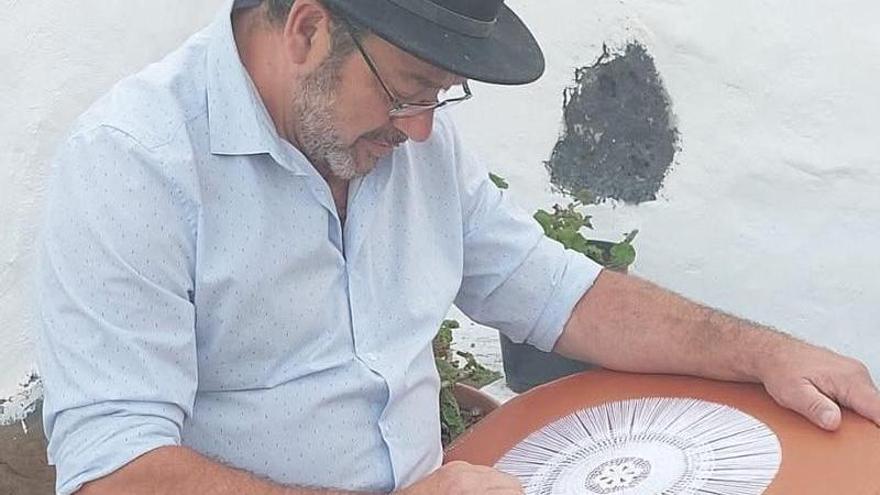
Roseta is a type of needle lace made without a base fabric, making its technique truly unique. It starts on a padded circular base called a 'pique,' where pins are placed according to the desired design. Threads are then interlaced radially (warping) to begin the weaving. Next, the 'weft' is created with a needle, and knots are tied to complete the symmetrical pattern. This meticulous craft holds significant historical, cultural, and ethnographic value, having endured for centuries.
Until recently, however, this technique was at serious risk of disappearing. Fortunately, in recent years, it has seen a strong revival. Experts estimate there are now around 500 students learning the craft across all 31 municipalities of the island. Roseta products, such as jewelry, accessories, and decorative items, are marketed towards the luxury sector. "They are sold and highly valued," Efraín Medina noted.
Medina quoted Enrique Loewe, who once said, "Luxury is everything that has an artisan component." He shared a personal anecdote: "I was watching the series The Leopard, set in Sicily, and I paused the image to look for roseta details on the costumes. I did the same during the last conclave to elect a pope." Francisco Aznar, former regional vice-counselor for External Action, aptly summarized: "Heritage is simply everything from yesterday that shapes today." Roseta is a perfect example.
Tenerife boosted its international recognition efforts last October by hosting an expert forum on the artisan needlework technique, effectively becoming the world capital of lace. Hundreds attended this event held in various locations in La Laguna and Tegueste, solidifying the island's role as a hub for preserving and sharing this textile art. Thirty-two speakers from nine countries across America and Europe participated in a vibrant cultural exchange, sharing knowledge and insights alongside street-level cultural activities.
The forum concluded with two main goals: first, to find ways to protect lace as a symbol of identity and cultural heritage; and second, to explore strategies for better commercialization, strengthening it as an economic activity, especially by leveraging its value for haute couture.
Lace, which appears in various cultures as religious ornamentation, traditional clothing, and even in contemporary fashion, is already recognized by UNESCO as Intangible Cultural Heritage of Humanity in countries like Croatia and France. In the Canary Islands, techniques like "calado" and roseta are vital expressions of island identity and examples of artisan knowledge passed down through generations, representing a productive and forward-looking craft. While roseta, a symbol of artisan tradition and a way of life, is now a Cultural Asset in the Canary Islands, the journey to achieve global recognition continues. It's a Canarian BIC, but with a distinctly Tenerife identity.
In the world of roseta craftsmanship, a notable trend is the increasing involvement of men in what was traditionally a very female-dominated craft. Efraín Medina noted that in the past, "men often hid their work, and their wives received the credit." He proudly stated, "Today, there are male roseta makers in the craft." Antonio Rodríguez from Palo Blanco is a prime example of a dedicated roseta maker.
Antonio grew up surrounded by women – his mother, grandmothers, and aunts – with needles and the 'pique' as their pastime. He described the BIC declaration as "good news and a boost for artisans." He explained his deep connection to the craft: "From my mother, I inherited 'calado,' and from my paternal grandmother, who was from Arona, I learned roseta." As a child, he learned techniques he never thought would become his livelihood. Antonio feels privileged, having worked in various trades, because he believes that "an artisan doesn't usually make a living from their work."
For him, however, it's the opposite; since 2016, his skilled hands have made him a respected professional. In fact, he now teaches classes "all over the Island, from North to South," with between 230 and 250 students, helping to preserve and spread his craft. He summarized his philosophy: "I always say that I want to be remembered for what I create, not for what I take."
Beyond his teaching in Tenerife, Antonio also leads workshops in mainland Spain. He is currently organizing one for December at the prestigious Museum of Costume in Madrid, a hub for the national textile sector. With dedicated artisans like Antonio Rodríguez, the treasures created by their hands have a bright future, both on the island and globally.