
Roque Negro Women Weave Tradition, Endure in Remote Anaga
In the remote Tenerife hamlet of Roque Negro, resilient women continue to weave wicker baskets and share stories of their tough yet content lives, embodying the enduring spirit of their aging community.
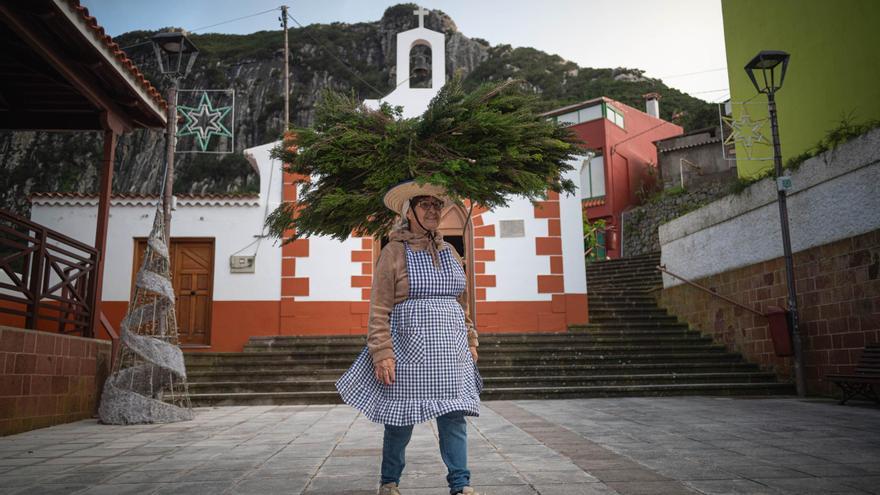
The skilled hands of several women from Roque Negro still expertly weave wicker baskets. This is one of four workshops they hold at the CEIP Sor Florentina y Agustín Cabrera Díaz, a school where the hamlet's last four children study, but which also serves as a cultural hub. These women seem as tough as the basalt stone found in the local walls. Take Severina Siverio Rojas, for example, who, at 79, effortlessly carries a large bundle of heather on her head as she walks through the small village square. She has incredible energy; while she might not lift the heather high, she can throw it with surprising force almost to the edge of the ravine.
Severina sits down next to María Dolores Rojas Perdomo to share her story. As they talk, the setting comes into focus: the hamlet, part of Anaga Rural Park, stands majestically in the shadow of the cliff that gives it its name. Roque Negro watches over them, a silent witness to the enduring traditions of this small community. Siverio and Rojas wear the straw hats and aprons once common for daily work. They are bundled up against the cold wind that sweeps up the ravine. As their conversation begins, one woman gently nudges the other to speak louder.
"My teeth grew in while working, and I lost them while working too," María Dolores Rojas states with a faint smile. Life in Roque Negro was tough, always centered on farming, goats, and cows. An asphalt road didn't even reach them until 1972. It arrived first in Afur, the neighboring hamlet. They recall an old village dispute: Roque Negro residents wanted to charge a toll to those from Afur when the road came, because, as they put it, "they used to laugh at us because the road reached us later on this side."
They brighten the conversation by showing the tools they used for light on the paths before electricity. They made candle holders from empty wine bottles, breaking off the bottom and inserting a candle supported by the neck. "I drink a small glass of wine every day at lunch," Severina Siverio wittily confesses, pointing out that you had to drink the wine first to make the holder. But María Dolores has an even more basic and ingenious lighting device: a potato cut in half, slightly hollowed out to hold oil and a small piece of cloth as a wick. It lights up and stays lit, fueled by the oil. "With this, we would go along the paths to light our way," Rojas explains.
In Roque Negro, it seems only women live, or at least they are the ones who come forward to share their stories and participate in workshops offered by the Santa Cruz City Council. Yes, the Santa Cruz council. Because this remote hamlet in Anaga belongs to Tenerife's large capital city. Who would have thought! Francisca, Juana, and Otilia are the next to sit down and chat. "The City Council gives us nothing," Juana Rojas blurts out with a laugh. "It doesn't even give us the time of day," Francisca (Kika) Suárez adds. Laughter and camaraderie fill the air among the neighbors, with Otilia Siverio joining in the fun. "You'll see that when the votes come, they'll all come around here," Juana warns with a knowing, mischievous smile.
These three neighbors also wear hats and aprons, though beneath their attire, they're warmly dressed for the cold, windy December afternoon. Otilia Siverio enjoys life in Roque Negro: "There's tranquility, few cars. Not much pollution and no noise," she describes slowly, her gestures reflecting serenity. The bus reaches their Santa Cruz community "three or four times a day," they happily report. The five women are content with their lives and don't long for anything different. Juana mentions she once worked closer to the city, cleaning. She shares a funny story about almost buying a car that required a license. "My youngest son told me 'buy it, I'll be the first to sign for you'," she recounts, and they all burst into laughter.
Suárez, who keeps her arms crossed throughout the conversation, explains how they always worked in agriculture and "gathering cisco"—a task mostly done by women, involving collecting plant remains, in this case, heather, for other farming needs. They find it odd to be asked about this. She also mentions "taking charcoal to La Laguna." All these tasks highlight the strength and resilience of Roque Negro's inhabitants, whose homes are spread across the ravines of La Porquera and La Negra.
About 60 people still live there, but 14 have died this year, a significant number for a place like Roque Negro. "We're having a streak of bad luck," the three neighbors lament. The combination of an aging population and people moving away continues to empty places like this. Some of the five women's children left for work. Yet, the women are clear they want to stay: "I go to La Laguna for anything, and I'm already longing to return to Roque Negro, even if it's just right next door," María Dolores Rojas laughs.
The doctor's office is near the Plaza de la Virgen de Fátima, whose feast day is celebrated on May 13th, though Roque Negro's biggest festivals are in August for San Roque. The doctor's consulting room is directly opposite the plaza, and the doctor only visits on Fridays. They also have a small shop and a bar, but for other goods, they go to Las Mercedes. They don't complain and are content with the life they have. Next to the school, there's a court with fallen fences, but this is one of the few signs of disrepair in the hamlet. Houses are scattered across the steep slopes, some seemingly impossible to reach.
Life in Roque Negro shows that humans can adapt to almost any living condition, and that women are the heart and soul, bringing joy to even the most remote corners of Tenerife.