
Rodríguez de León Delivers Spartan Masterclass, Details OCR's Financial Hurdles
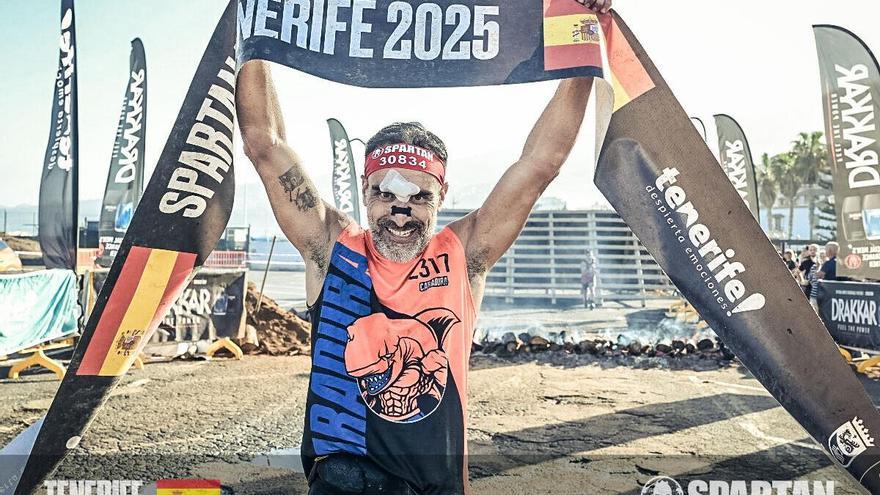
Puerto de la Cruz native Javier Rodríguez de León delivered an endurance masterclass at the Tenerife Spartan Race, securing a silver and a gold medal across three challenging races in just over 24 hours despite sustaining an injury.
In the world of Obstacle Course Racing (OCR), it was already clear in the Canary Islands that Javier Rodríguez de León (born in Puerto de la Cruz in 1984) was a special competitor. He's a seasoned athlete, consistently performs at an elite level, and what he accomplished this past weekend at the Spartan Race proved he's still one of the best. The Puerto de la Cruz native delivered a true masterclass in endurance, setting a new standard for OCR in Tenerife over two incredibly tough days where the weather, terrain, and sheer exhaustion offered no break.
Javier competed on his home turf, in front of his local supporters, and on a course he knows inside out. On Saturday, he immediately showed his strength by finishing an impressive fourth in the Beast race. This was despite battling thick mud, taking an unfortunate fall on an obstacle, and suffering a nasty hit from a chain that required four stitches to his face. On Sunday, he truly showed what he was capable of. He started at 9 AM, earning a silver medal in the 10-kilometer Super Elite race. Just a few hours later, at 1 PM, he became champion of the 5-kilometer Sprint Open.
Regularly competing in OCR events pushes the body to its absolute limit, inevitably causing significant physical strain. According to Javier, the knees, shoulders, and especially the hands are the most affected areas. Even so, he stresses that it's "a sport where you use every single muscle."
So, how does someone manage to complete three incredibly tough races in just over 24 hours? Javier points to discipline, focus, and careful time management. He sticks to a weekly routine of one-hour training sessions from Monday to Friday, making sure not to overdo it. For him, nutrition is also key. He maintains healthy eating habits – nothing extreme – but leaves nothing to chance when it comes to race day. "It's the fuel," he explains, "knowing what you can eat before a race that your body can handle."
But Javier's real secret, what truly sets him apart as an elite athlete, isn't about distance or diet. It's mental control. "The mind is key in all sports, and it's absolutely essential in this one," he notes. The athlete from Puerto de la Cruz uses visualization to prevent physical exhaustion or an overwhelming series of obstacles from getting the better of him. "I usually picture myself crossing the finish line; I visualize that I'm going to finish, and that helps me a lot," he admits. "Brief thoughts also come to me, like images of my family waiting, and I often use that as motivation in my mind."
It's impossible to talk about OCR without discussing the financial cost. Even though the sport is booming, it's becoming professionalized very slowly. This means that, in most cases, the athletes themselves end up paying for almost all the associated expenses.
Javier is very direct about this. He admits he limits how often he competes outside the Canary Islands because "the cost is extremely high." He points to last year's Spartan Ultra World Championship in Morzine, where "the registration alone was 500 euros." That price didn't even cover flights, accommodation, or the special supplements essential for such a demanding event. This clearly shows just how expensive it can be.
According to Javier, the main problem is the lack of a proper federation to organize, support, and fund the sport's competitive growth. However, his situation is not unique. Hundreds of athletes across Spain face similar challenges, fueling their passion through personal sacrifices and their own money.
The Spartan Race itself – organized by a company based in Boston, Massachusetts, and the promoter of this weekend's event on the island – highlights the two-sided nature of modern sports. Javier is open about the commercial side of the event, stating: "It's a sporting event, but it's also a sports business." He explains further: "It's a race I love, but there's a huge amount of merchandise involved. You see the medals; they organize it very well – it's definitely a well-structured business. But it's also true that the cost for someone who just wants to do an obstacle race is quite high."