
Remote Anaga Hamlet Faces Modern Challenges Amidst Natural Beauty
The remote hamlet of El Draguillo in Tenerife's Anaga rural park, once home to many, now faces challenges of isolation and limited services, yet attracts new residents seeking a unique, natural lifestyle.
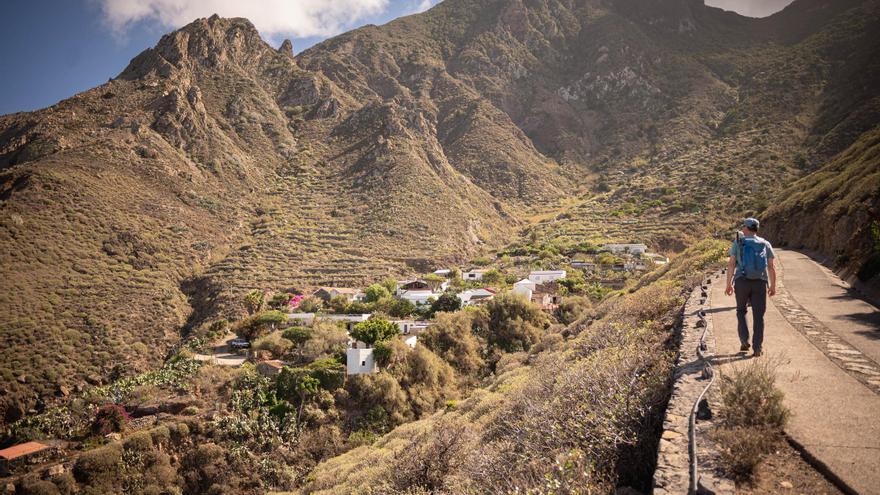
Anaga, a world apart, lies just 29 kilometers and an hour's drive from Tenerife's capital. Leaving the arid roads near San Andrés behind, you enter a different realm, guarded by the León de Taganana rock formation. After passing through a tunnel, you reach the small settlement of El Draguillo. Before that, you'll find Taganana, the heart of the rural park, along with the beaches of Roque de Las Bodegas and Almáciga. Climbing to Benijo and navigating a waterfall (which was dry until recent rains) leads you into the hamlet itself.
Where the paved road ends and a narrow cement track begins, about thirty rental cars are packed together. The rest of the journey feels like navigating a busy street, with hikers carrying walking sticks, wearing boots, and sporting explorer hats. This is where the clash between urban life and nature becomes apparent, a reminder that even paradise faces challenges, though it lacks basic services like an ambulance.
El Draguillo is reached after a sharp left turn onto a dirt track barely wide enough for one vehicle. Nestled in a ravine, about thirty staggered buildings form the settlement. Halfway down, defying the steep slope, Hipólito González Sosa, known as Polo, greets visitors. He's the son of Florentín Jesús and Amelia, who worked the land and raised goats here.
Until five months ago, Polo was the sole resident and caretaker of El Draguillo, looking after its 24 homes. His siblings live elsewhere, and he returned temporarily when his father became ill.
He fondly remembers his childhood walks to school in Almáciga, a half-hour journey that avoided the beach. He recalls buying his father's cheeses in La Laguna and getting bread from Casa Paca in Benijo.
At house number 8 in El Draguillo, Polo explains how the hamlet gradually emptied as residents passed away. Born in 1976, his hands show a lifetime of hard work. Running water arrived forty years ago with the access road; before that, it was delivered by truck.
Polo grows potatoes and other vegetables on his land, but frequent landslides caused by rain can still cut him off. He notes that there have been at least four major rainfalls in the last twenty years.
Most houses lack electricity, except for those with solar panels.
Nearby, Adrián has turned his house into a vacation rental, and further down, a foreign couple bought a property and settled here.
"The TV signal is satellite, and you only get a couple of channels," Polo says, pointing to Rosa's house. A towel from the Hospital de La Candelaria has been hanging there, drying in the sun, for nearly a year.
Across the way is Argelia's house. She's a neighbor around 90 years old who lives in San Andrés. Polo recalls her rescue two years ago.
Begoña Cruz, who divides her time between La Laguna and working nights in Teide, enjoys the hamlet with her husband, José Martín Guillén, who lives at number 1.
"The entrance to El Draguillo was full of rental cars... the firefighters had to come and get her out on a stretcher," Begoña recounts about Argelia's rescue.
Martín arrives, frustrated. "They'd be better off in the Sahara than here," he complains about the road, the lack of electricity, and the broken water pipes.
He also mentions an unfulfilled promise to run wiring through an existing pipe after a storm named Delta. "Every time it rains, we're cut off," he laments. He adds that when the local government's plane sprays for pests, "the rabbits disappear within six days." He clarifies he's not a hunter, but he raises meat animals.
Martín and Begoña begin their journey back to civilization. Polo stays, as always, looking after El Draguillo. The new foreign residents here are even considering starting families.
El Draguillo hamlet is found behind Benijo, within the Anaga area of Santa Cruz. With sunsets that are a once-in-a-lifetime spectacle, this is a registered paradise, currently home to Polo and one other couple.
Begoña Cruz, 52, lives in La Laguna and works as a forest ranger in Teide National Park. She uses her two days off after night shifts to visit the house her husband, José Martín Guillén, inherited from his grandmother. "He's eager to retire so he can come live here," she says. They keep chickens, a rabbit, and a boar there. They also own a house with land in the neighboring Las Palmas de Anaga estate, which they haven't visited since the pandemic due to the difficult access.
Kateřina Honců, 29, originally from the Czech Republic, discovered Anaga during the COVID-19 pandemic, attracted by its beautiful trails. She and her German partner initially settled in a caravan in the south of Tenerife, where prices were too high. He works in apartment maintenance, and she manages properties while also working remotely as a freelance social media specialist. Five months ago, they bought their house, becoming the first new residents in El Draguillo in nearly fifty years.