
Rare Aurora Sighted in Canary Islands Due to Powerful Solar Storm
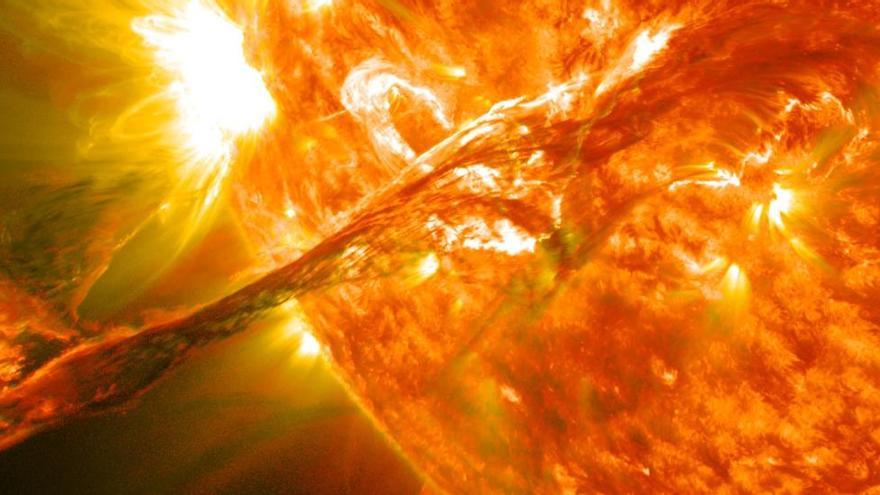
A powerful X5 solar flare and subsequent coronal mass ejections have triggered a severe geomagnetic storm, allowing for rare naked-eye aurora sightings in the Canary Islands.
A powerful solar storm has created a rare chance to see auroras with the naked eye from the Canary Islands.
On November 11, 2025, the Sun unleashed an X5 class flare, one of the strongest seen in the current solar cycle. This flare, originating from a sunspot called region 4274, also sent out massive bursts of plasma called coronal mass ejections (CMEs) directly towards Earth.
These CMEs traveled at high speed, triggering a severe geomagnetic storm, rated G4 – one of the most intense in two decades. Scientists expect this disturbance to last for several days, and it has already caused unusual aurora sightings in the Canary Islands, which are not typically at latitudes where auroras are visible.
An X5 solar flare is a powerful burst from the Sun's surface that releases a lot of radiation and charged particles. When these particles reach Earth, they can disrupt our planet's magnetic field, interfere with navigation and satellite communications, and affect flights, while also creating auroras visible far from the poles.
Héctor Socas Navarro, a researcher at the Instituto de Astrofísica de Canarias (IAC) and director of the European Solar Telescope (EST) Foundation, explained, "The impact of these CMEs is causing auroras to be seen at relatively low latitudes and creating strong disturbances in Earth's magnetic field."
This solar event also produced a Ground Level Enhancement (GLE), a rare occurrence where highly energetic solar particles reach the Earth's surface.
"GLEs happen only a few times in each 11-year solar cycle," Socas Navarro noted. "For them to happen, protons from the Sun need to be accelerated to hundreds of megaelectronvolts and hit Earth."
This particular GLE is comparable to one in December 2006, which was one of the most powerful in recent history, and ranks among the most significant solar events of the past 20 years.
Thanks to this solar storm, people in the Canary Islands have been able to see auroras at latitudes where they are normally only visible in Nordic countries.
"You don't need to travel to Norway to see auroras right now," Socas concluded. "While it shouldn't significantly impact daily life, it's scientifically very interesting."
From a research standpoint, this solar flare provides a unique opportunity to study how particles are accelerated on the Sun and how they interact with Earth.
For the IAC and the scientific community in the Canary Islands, events like this are crucial for gathering valuable data on solar activity and improving systems that predict geomagnetic storms.