
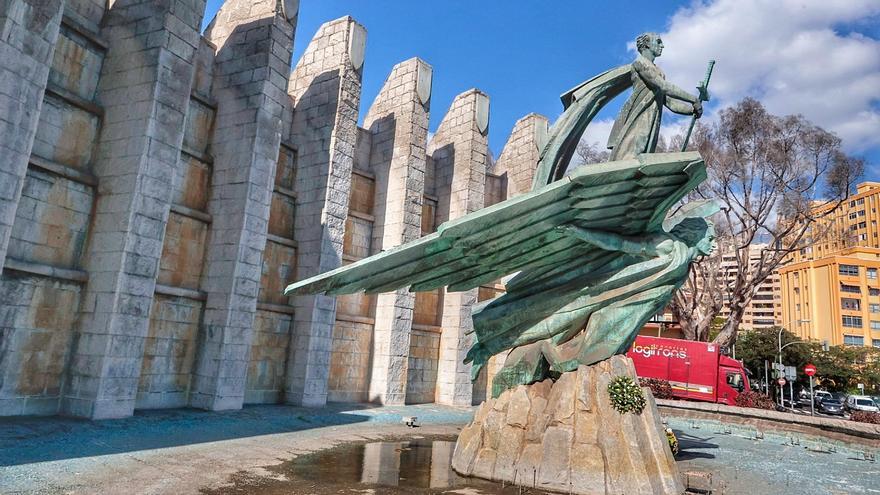
Podemos Reports Santa Cruz Council for Franco Monument Memory Law Breach
Podemos Canarias has filed a complaint with the Provincial Public Prosecutor's Office against the Santa Cruz City Council, alleging a crime for its failure to remove the "Franco monument" in violation of the Democratic Memory Law.
Podemos Canarias has filed a complaint with the Provincial Public Prosecutor's Office in Santa Cruz de Tenerife. They believe the Santa Cruz City Council may be committing a crime by failing to remove the monument known as the "Franco monument." Podemos argues that the council is violating the Democratic Memory Law by not taking action.
The party, which will provide more details about their complaint next Friday, states that a crime is being committed because the council is not acting against symbols that glorify Franco, which remain in public spaces.
During the upcoming press conference, Podemos representatives plan to explain the legal basis of their complaint, the political background of the case, and the potential criminal and administrative consequences for the city officials involved.
The "Franco Monument," located on Francisco Laroche Avenue in Santa Cruz de Tenerife, is one of about 4,000 reminders of the Franco era. These are currently being cataloged by the Spanish Government as required by law. For many years, various groups have called for its removal.
In October 2024, the Tenerife Island Council began the process to declare the sculpture, created by Juan de Ávalos, a "Cultural Asset" (BIC) in the monument category. This decision followed a ruling from Administrative Litigation Court No. 3 in Santa Cruz de Tenerife, which believes the monument qualifies for such protection.
This move came after requests from the Royal Canarian Academy of Fine Arts San Miguel Arcángel and the Association for the Research and Protection of Heritage San Miguel Arcángel. The Tenerife Island Council had previously refused to start this process during the last term, when the PSOE party was in power.
Coalición Canaria and the PP party had previously suggested renaming the monument "Monument for Concord." They wanted to redefine its meaning as "a space of memory that promotes peace and understanding among citizens."
At that time, a report from the Island Council noted that there was "no agreement" on what the monument's imagery actually represents.
For example, a report from La Vanguardia on March 17, 1966, clearly stated that the monument symbolizes "Franco, the brave captain, a symbol of leadership and command. His cross-shaped sword represented a Crusade to defend the nation's core values. The plane that brought them from the Canary Islands was depicted as an archangel, its mechanical wings seen as providential that day. Finally, the waterfall served as a reminder of the heroes who eagerly followed the courageous captain."
However, "other reports" suggest the work is actually called 'Monument to the Peace of Tenerife,' a name found in Juan de Ávalos' own list of works. These reports also argue that the human figure's features do not match Franco's, suggesting it might instead represent "a friar carrying a cross."