
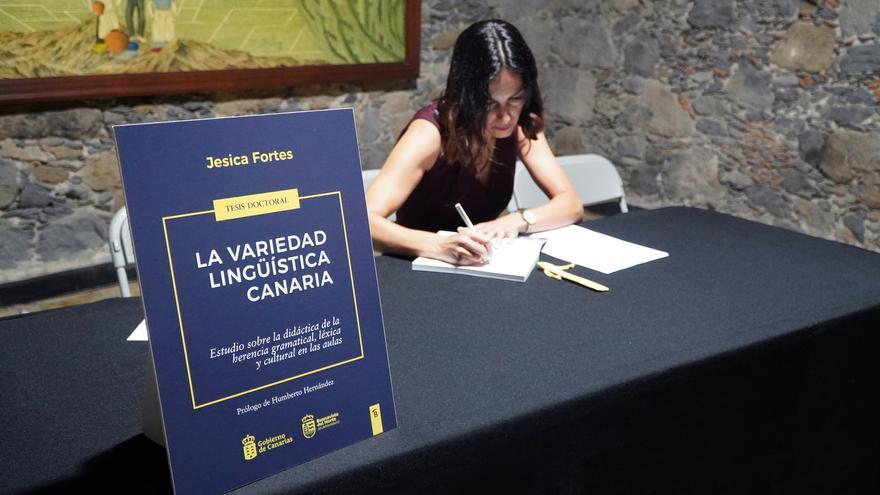
PhD Thesis Finds Canarian Language Missing from School Textbooks
Buenavista del Norte teacher Jésica Fortes published her PhD thesis, which reveals that school textbooks in the Canary Islands largely overlook the local linguistic variety and advocates for its greater recognition.
Jésica Fortes spent a lot of time in Teno Alto with Eloy Regalado González, known as 'Eloyito', and her grandfather Pepe Regalado. During these visits, she learned old songs and stories. This sparked her interest in the unique way people speak in the Canary Islands. Now, nearly 20 years later, she's publishing her PhD thesis titled 'The Canarian Linguistic Variety: A Study on the Teaching of Grammatical, Lexical, and Cultural Heritage in Classrooms'.
In her thesis, the teacher from Buenavista del Norte explores how language is used in schools across the Canary Islands. Her research was inspired by her own experiences as a secondary school teacher, a university lecturer at La Laguna, and as a mother helping her two primary school children learn. Fortes explains, "I noticed that most textbooks and reading materials used here are written in standard Castilian Spanish, not the Canarian variety."
This led to a four-year study, which she presented as her thesis last November. The first year involved extensive research and reading about the topic. In the second phase, she created a questionnaire for teachers in Canarian classrooms. This helped her understand "what resources they used, their opinions on using the Canarian dialect, and which publishing houses were most commonly used in the Islands' schools," she explains.
Based on the teachers' answers, Fortes identified six publishing houses to analyze in her thesis. She examined their textbooks for various subjects: Spanish Language and Literature and Science for third-grade primary and secondary students (at the lowest level), and Biology and Geology, Geography and History, and Spanish Language and Literature for third-year ESO (secondary education).
She explains her research: "I looked at linguistic features, focusing on vocabulary and meaning. I also checked if the books were written in the Canarian dialect, if their content was specific to the Canary Islands, if they began with local examples before moving to broader ones, or if they mentioned Canarian culture."
Her detailed analysis revealed that only one of the six publishing houses had "proper Canarian adaptation." She noted that other books claimed to be locally adapted, even featuring this prominently on their covers, but in truth, they weren't adapted in terms of Canarian language or content. She points out that these books only included references to Benito Pérez Galdós in Literature and the La Palma volcano in Geology, "but those topics also appear in national textbooks," she adds.
Fortes firmly believes that "everywhere, some people speak well and some speak poorly." She states, "I think everyone already knows that Canarian identity is just as valuable as any other dialect, but it's true that there has always been a linguistic inferiority complex, and plenty of evidence confirms this." As an example, she mentions how actors, actresses, and presenters often hide their Canarian accent.
Fortes, who is from Buenavista, is very pleased with how much attention her thesis is getting. She notes that typically, such academic works are simply uploaded to the University of La Laguna's digital archive and "stay there." She gratefully suggests, "Perhaps because my work focuses on Canarian content, and with the current trend to promote local heritage, it was published at just the right time to reach a wider audience."
Speaking about her local area in northwest Tenerife, Fortes acknowledges that "dialect differences exist even between individuals. Everyone has their own way of speaking, but we group together based on similarities and local speech patterns, known as idiolects." She explains that "at a regional level, across the islands, the Canarian dialect is often recognized by its unique vocabulary."
Jésica Fortes' first study, 'An Approach to Agricultural Vocabulary in Northwest Tenerife,' came out in 2007. She describes the Buenavista del Norte area as "very rich in words related to farming and livestock. It's a unique vocabulary not found in many other places." Fortes also notes, "we use diminutives a lot, and our intonation sounds like singing." She suggests that perhaps this way of speaking is the source of the songs from 'Eloyito' and Pepe Regalado – a treasure of four or more verses that capture the song, speech, and sound of the Canary Islands.