
The Virgin Mary of Candelaria will be welcomed in the capital of Tenerife: security will be ensured by 1,300 people.
The Virgin Mary of Candelaria will visit the capital of Tenerife for the third time in a century, where security will be provided by 1,300 people, and medical care will be coordinated by Dr. Pedro López Cabrera, who combines work in the hospital and service to believers.
On Saturday, October 11, the Virgin Mary of Candelaria will visit the capital of Tenerife for the third time in a century. To ensure everything goes well, security will be provided by 1,300 people. And the patron saint will also have her own doctor – 48-year-old Pedro López Cabrera from La Laguna. He already coordinated the pilgrimage in 2018, when the 200th anniversary of the diocese was celebrated, and will now be doing it again.
"Since childhood, I wanted to take care of people," says Pedro. He combines two roles: responsible for the pilgrimage and emergency doctor at the University Hospital of La Candelaria. Although he is more accustomed to a medical gown than a cassock, he understands that both of these occupations are serving people. "Both in the hospital and with the Virgin Mary, I do the same thing: I help those who need it."
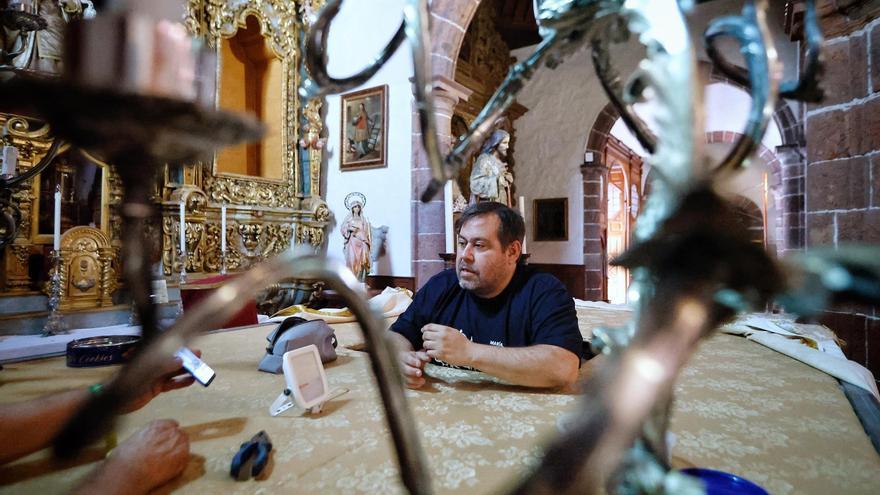
With humor, without taking his eyes off the computer where he is processing accreditations, Pedro says that he was born in Santa Cruz, in the former Quibey clinic (now the Rambla hospital). "But we have lived in La Laguna since birth, and all our lives there." "I love La Laguna, it's my city," he adds, but he's not a fanatic: "I'm not one of those who stubbornly clings to the old. I like that La Laguna is developing and keeping up with the times." He lives on Carrera Street and loves the combination of old and new: "A city open to the world is when a 16th-century building can stand next to modern architecture."
Pedro's connection with the church began during his studies at the School of Dominican Mothers in Genet (La Laguna). "I was in the first class of boys. There were seven or eight of us among more than forty girls." He remembers the teacher, Mother Consuelo, who lovingly and humorously "said that we were the men of Israel." That's where his faith began.
After school, he didn't immediately go to study medicine. "I accidentally became a biologist because I couldn't get into medical school the first time." Pedro began studying biology in order to transfer to medicine later, but he liked it so much that he graduated with two specializations: marine and sanitary biology. "Marine biology was my favorite hobby," he says. But the dream of becoming a doctor did not disappear.
He didn't give up. He went to Italy, to the city of Perugia, where he was finally able to study medicine. "I always say that Spain didn't allow me to study medicine, but Italy did." He learned Italian by watching the Sydney Olympics in the dormitory cafeteria, talking to the staff in August when there were no classes.
After three years in Italy, he returned to the Canary Islands to finish his studies at the University of La Laguna. "Here I felt the difference. In biology, I lived a student life, and in medicine, I lived a disciplined life." He graduated, passed the exam for intern doctors, and in 2009 began his internship at the University Hospital of La Candelaria. "I graduated in 2013 and have been working in the emergency department ever since. Sometimes I say that I chose medicine because I love life, even in the most difficult moments."
"I feel very good in the hospital, although in the emergency department we see a lot of suffering." Pedro speaks slowly and calmly. He believes that medicine without humanity is an incomplete science. "Sometimes a patient asks not to be told about his illness, but to be asked how he feels." Empathy is his main trait. "Many patients and colleagues say that I always joke in the hospital. It's my way of easing difficult moments."
During the pandemic, his character was tested. "It was a very difficult time. We couldn't touch, hug. But I tried to make them feel that I was there, even without physical contact."
Now he teaches young doctors what is not in textbooks: "Before looking at the medical history, look at the person. Take their hand, put your hand on their shoulder if they are crying. It opens all doors."
His connection with the Virgin Mary of Candelaria began in 1997, when she visited La Laguna. "A group of people from the parish of Santo Domingo de Guzmán were helping on the Avenue of the Virgin Mary, and I joined." He remembers that first time as an adventure: "We decided to carry the Virgin Mary on wheels down the Machado slope. We refused the urn. We said that we could carry it ourselves."
With each visit, he participated more and more. In 2009, he actively helped in the organization, and in 2018 he became the main coordinator. "The then bishop Bernardo Álvarez and Antonio Pérez Morales suggested that I continue, and here I am. If they think I'm suitable, I'll continue."
Pedro says that he does not consider himself a boss, but only part of a mechanism. "The most important thing is the team. A boss without a team is nobody, but a team without a boss is also nobody."
He coordinates a large group: "The main team is five or six people, but in total there are about three hundred of us, like in the movie "300", always ready to defend the walls of the basilica," he says laughing. "Only we don't need to defend the walls, but go beyond them."
He believes that the church should be open. "We must show outwardly what we believe inwardly. It's not about being better or worse, but about showing love. More good things are done with faith than bad things."
He does not consider himself a very religious person. "In my brotherhood, the Brotherhood of Mercy, there are two Christs: Christ of the Gaze of Patience and the Deceased Lord. I am not particularly devoted to the Virgin Mary, but her image has always attracted me. She is the mother of Jesus, and as a mother, she takes care of us."
"Being in the hospital enriches me with patients, and being with volunteers enriches me with people. Everything has the same meaning," he says.
During pilgrimages, he likes to be among people, listen to them, stop. "It's not just going to a meeting or speaking from the podium. It's walking next to another volunteer, listening to their life, hugging them when they are tired. No one can be left behind," says the doctor who cares for people both in and out of the hospital.