
New Super-Earth Exoplanet Discovered
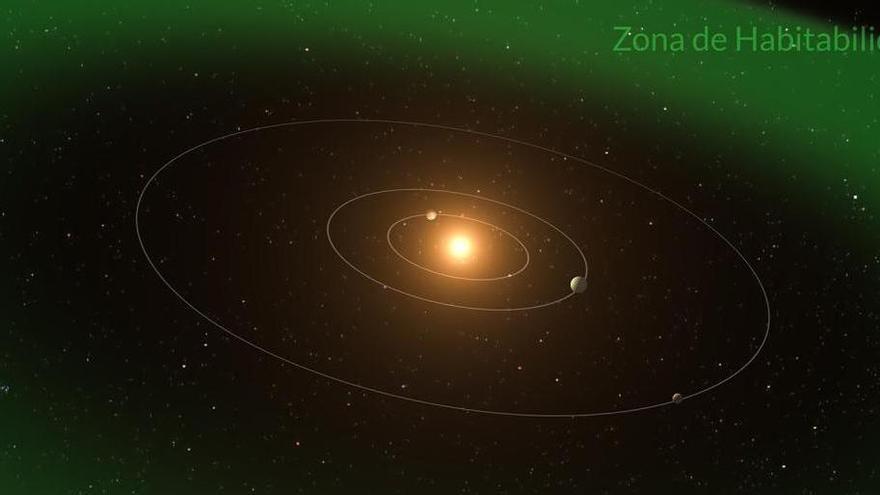
An international team of scientists has discovered HD 176986 d, a new 'super-Earth' exoplanet with a 61.4-day orbit around an orange dwarf star 91 light-years away, making it the third planet identified in that system.
Scientists have found a new 'super-Earth' – a planet bigger than Earth but smaller than gas giants. This discovery is a big step forward in understanding planets far away from our solar system. It also means there are now three confirmed planets orbiting the star HD 176986, showing how challenging and precise modern astronomy can be.
The Instituto de Astrofísica de Canarias (IAC) led an international team that found this new planet, called HD 176986 d. It's about 91 light-years away from Earth. What makes it special is that it takes 61.4 days to orbit its star – quite a long time for a planet of its size, which is no more than seven times the mass of Earth. This makes it the furthest of the three known planets in that system. It also joins a small group of only about a dozen exoplanets that take more than 50 days to orbit their star and have similar masses.
The star it orbits, HD 176986, is an orange dwarf star, a bit smaller than our Sun. Scientists have been studying it since 2018. Back then, another study, also involving the IAC, found two other planets: HD 176986 b, which orbits every 6.5 days, and HD 176986 c, which orbits every 16.8 days.
Scientists found HD 176986 d using the 'radial velocity method.' This technique works by looking for tiny wobbles in a star's movement, caused by the gravity of orbiting planets. Because planets like HD 176986 d are small and take a long time to orbit, their signals are very faint, requiring a huge amount of observation. The team spent over 350 nights gathering data. They used advanced instruments called spectrographs – HARPS and ESPRESSO in Chile (at La Silla and Paranal observatories), and HARPS-N in La Palma (at the Roque de los Muchachos Observatory).
A big challenge was figuring out if the signal they saw was really from a planet or just from the star's own activity. To be sure, the researchers ran many strict tests and used advanced analysis tools like YARARA. These tools help clean up the star's light data and fix any possible interference. After all these checks, the signal remained consistent, confirming the new exoplanet. The details of this discovery have been published in the scientific journal Astronomy and Astrophysics. This success highlights how important it is to observe stars for long periods to find the many different kinds of worlds beyond our own solar system.