
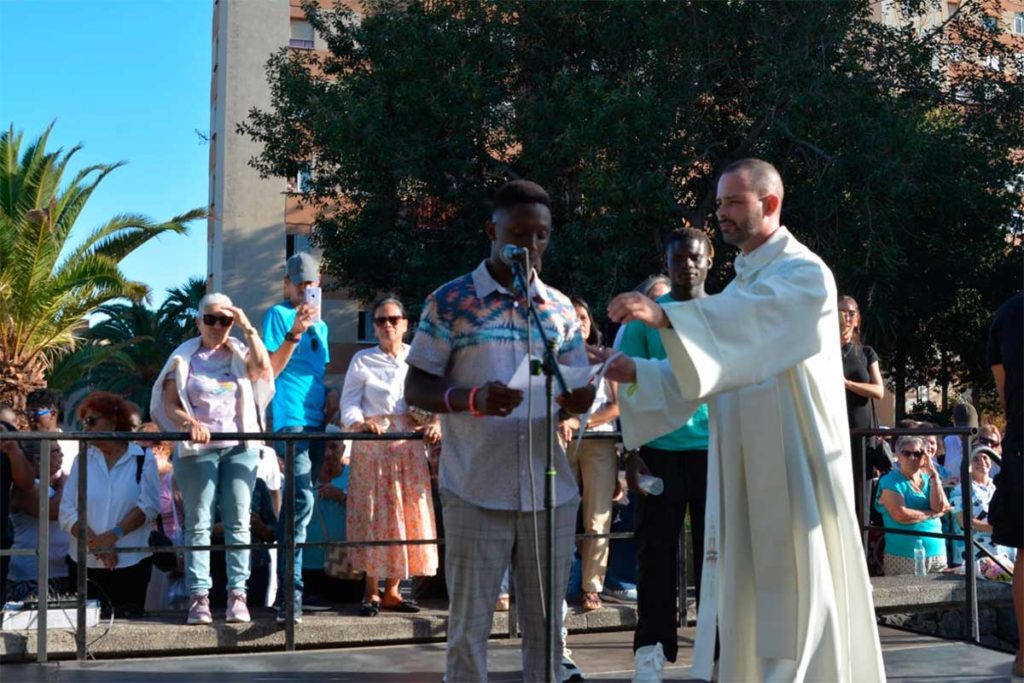
Migrants in the Canary Islands pleaded with the Virgin Mary for the fate of those seeking refuge in Europe.
Young migrants who arrived in the Canary Islands appealed to the Virgin of Candelaria for protection and support in their search for a better life, emphasizing the difficult trials of the sea voyage and their hopes for the future.
On Saturday, young men who arrived in the Canary Islands by boat appealed to the Virgin of Candelaria. They said, "You, as a mother, understand our pain. Hear the silent cries of sons and daughters who sail the sea for hope, fleeing from hunger and war."
In the silence of hundreds of believers who followed the Virgin of Candelaria to Santa Cruz de Tenerife, the young men – Abibo, Usman, Mor, Mbaque, Brit, and Paul – laid flowers at her image. Three of them read an appeal because, in their words, "we feel you near and want to give you not only flowers and songs."
These young men are immigrants who are helped by the "Good Samaritan" foundation. It was founded by a local priest, José Félix Hernández, who is known to everyone as "Padre Pepe" from Añaza and Los Gladiolos.
When the Virgin Mary was brought to Los Gladiolos, these young men took the floor. They called themselves "travelers without a home" in this sea, "which you know, Mother." After all, according to legend, the image of the Virgin of Candelaria was found on the shore of Tenerife by shepherds from the Guanche tribe.
"This sea sees your children sailing on the water and has become a border of pain. We cross the sea in boats, and this journey does not always end with a return," they said before the image. They added that "we left everything for the sake of dreams, for the sake of an opportunity that did not exist in our country."
In their speech, they recalled: "We arrive tired, confused, with wounded hearts, but full of dreams. Some are lucky enough to survive this journey, and some are not. How many names have been lost at sea? How many mothers do not know if their children are alive?"
And yet, "we continue to arrive because hope is stronger than fear," they emphasized.
One of the young men, Abibo, said that he crossed the sea by boat "not for fun, but out of need." In his country, "there was no work, no future."
"I left my mother, brothers, family, my land, but I took with me faith, hope, and the desire to live." The journey was "very difficult," many days without food, without water, and with the fear of not reaching the destination.
But here he found the Canarian "Good Samaritan" foundation with "good people who helped me." Especially Father Pepe, "who accepted me and did not ask about my religion or my country. The first thing he asked was how I was feeling."
Abibo recalled that at that time he "spoke Spanish poorly." At the foundation, he learned it, as well as "many good things that helped me not to lose enthusiasm. Gradually, I see that I can fulfill my dreams with the help of many people."
He added that he is Catholic, but most of "my friends" are Muslim. "But we all feel accepted and loved. I feel, and we feel like a family."
"Thank you to this land for accepting me, for giving me an opportunity, for looking at me and at us with the eyes of the heart," Abibo concluded.
One of the priests who was at the event asked the Virgin Mary to protect those who leave their land and for doors to open to share "bread" and for communities to become "home."
In his speech, he recalled that Jesus of Nazareth was also a "refugee, a foreigner," and prayed that no one would have to flee in order to have the opportunity to live.