
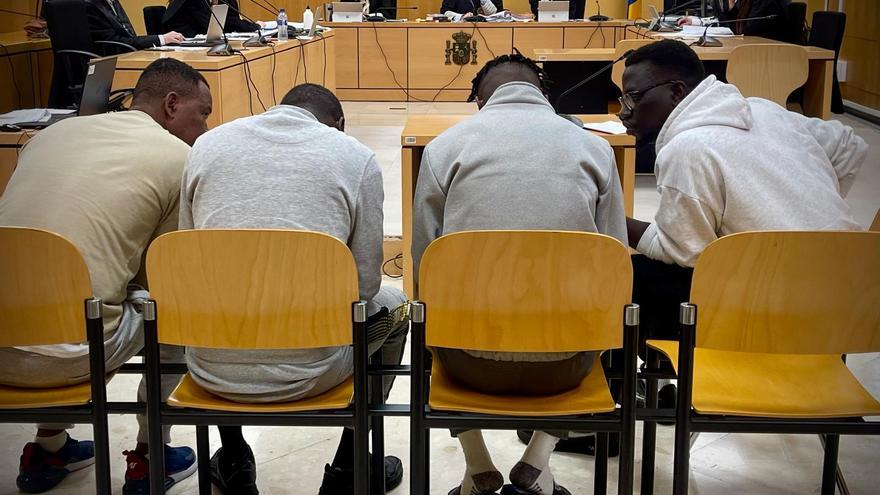
Migrant Claims Police Offer in Tenerife Boat Trial
During the trial of three migrants accused of steering a canoe to El Hierro, a witness claimed police offered "better treatment" for identifying the steerers before denying knowledge, contradicting police reports and prompting defense lawyers to seek dismissal.
A migrant who arrived on the island of El Hierro on June 24, 2024, in a dugout canoe carrying 47 survivors and one deceased person, claimed on Monday that a police officer offered him "better treatment." This offer was made if he helped the investigation into the journey's conditions and identified the people who steered the boat from Nouakchott, Mauritania, to La Restinga pier.
During the trial at the Provincial Court of Santa Cruz de Tenerife, where three migrants are accused of steering the boat, this witness denied seeing who was in charge during the journey. He explained that from his seat, he couldn't see who was at the back near the rudder and engines, if anyone had a GPS, or if anyone had better conditions than others. However, this statement goes against police reports, which claim he had "recognized the three accused" both from photos and in person.
In the same court session, another migrant gave evidence by video link. He stated that he didn't pay anyone on the boat. Instead, he paid "an older man" at the Mauritanian port, who then told him where to find the canoe that would soon leave for Europe.
When this second migrant was questioned in El Hierro, he spoke of a "great captain" leading the canoe, along with three assistants. He added that these four were the only ones wearing life jackets. A defense lawyer asked him if the police had offered him any special treatment for his testimony. He firmly denied this three times, recalling, "They just told me to tell the truth, because I was obliged to do so."
The defense lawyers asked for the case to be dismissed. They argued that essential evidence was missing, only a small number of people had been questioned, and some witnesses had identified individuals other than the accused.
A forensic expert concluded that the migrant's death was caused by dehydration, hunger, and cold. The body had many ulcers and weighed only 50 kilograms. Lawyer Sara Rodríguez highlighted these details, arguing that the travel conditions were not the main cause of death, but rather the victim's pre-existing poor health.