
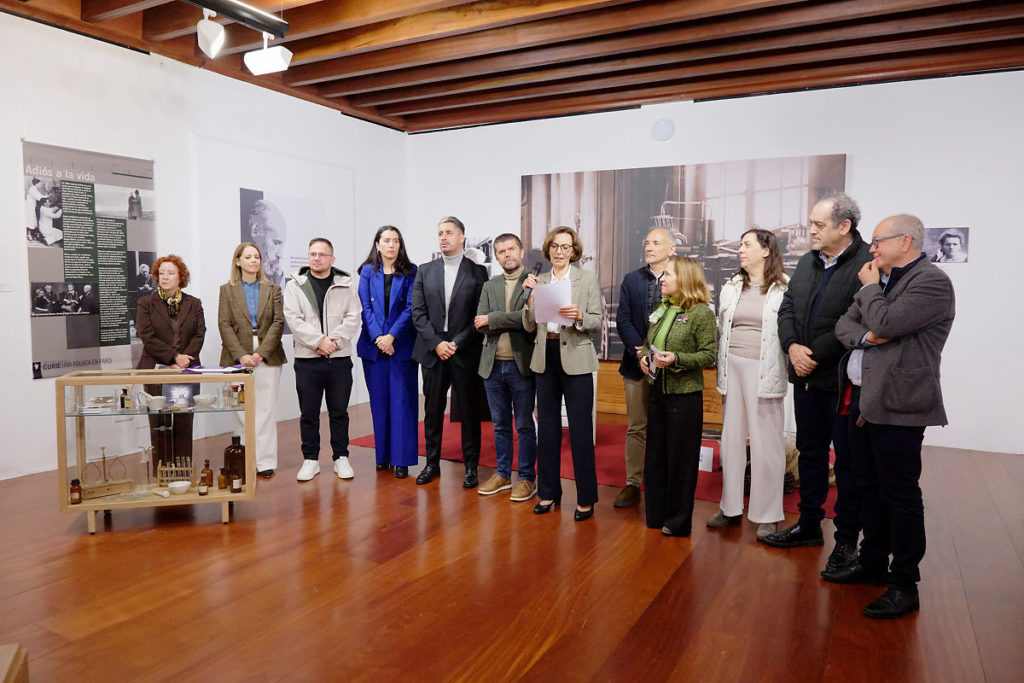
Marie Curie Exhibition Opens in La Laguna
An educational exhibition titled 'A Pole in Paris,' exploring the life and scientific legacy of Marie Skłodowska-Curie, has opened at La Laguna's former Convent of Santo Domingo Guzmán, organized by the University of La Laguna's Faculty of Sciences.
An educational exhibition about Marie Skłodowska-Curie, titled 'A Pole in Paris,' recently opened at the former Convent of Santo Domingo Guzmán in La Laguna. The Faculty of Sciences at the University of La Laguna, through its Cienci@ULL program, organized the event.
According to Sonnia L. Rivas-Caballero, one of the curators, the exhibition aims to introduce visitors to the life, scientific work, and lasting impact of Marie Skłodowska-Curie. She was an incredibly influential Polish-French scientist. The display follows her story chronologically, from her early life and education in Poland to her move to Paris. There, she studied at the Sorbonne University, built most of her career, and became a leading expert in radioactivity.
Across two exhibition halls, visitors will find historical and biographical panels that highlight key moments in Curie's life and work. These are complemented by display cases filled with documents, laboratory equipment, photographs, original paintings, coins, and stamps. Explanatory panels also help put these different periods into context.
Many important guests attended the opening ceremony. These included Francisco García, the university's rector; Luis Yeray Gutiérrez, the mayor of La Laguna; Javier Franco, director of the Canarian Agency for Research, Innovation and Information Society; María del Mar Afonso, dean of the ULL Faculty of Sciences; María Candelaria Sánchez, dean of the Official College of Chemists of the Canary Islands; Julio Brito, managing director of the ULL General Foundation; and Daniela Postiglione Ten-Hoever, People Director of Cajasiete.
In his speech, the rector, Francisco García, spoke about how important it is for universities to bring such significant exhibitions to the public. He praised Marie Curie not only as an outstanding scientist but also for her dedication to society and humanitarian causes. During the First World War, for example, she championed the use of mobile X-ray units to help treat the wounded. He also highlighted her as a powerful role model for women in science, inspiring generations to follow her research legacy.
The mayor of La Laguna, Luis Yeray Gutiérrez, stressed the value of partnerships between the city and the university, which help introduce important historical figures to a wider audience. He pointed out that the exhibition allows visitors to look at Marie Curie not just as a scientist, but also from a social viewpoint. He particularly highlighted her experience as an immigrant woman who moved to France for education and new opportunities – a story that still resonates today.
Key highlights of the exhibition include Curie's discovery of the elements polonium and radium, along with her Nobel Prizes in Physics (1903) and Chemistry (1911). There's also a recreated version of her laboratory, using simple items to help visitors understand the basic conditions she worked under.
The exhibition also explores her three trips to Spain, where she visited cities, gave talks, and met Canarian scientist Blas Cabrera in Madrid. The tour finishes with a section on the 'Curie saga' – the family with the most Nobel Prizes in history.
Curator Belén Yuste explained that Marie Curie is a figure who really connects with people. With this exhibition, the goal is to reveal the person behind the legend and her two Nobel Prizes, showing her more human side.
After the opening, the curators led a guided tour of this traveling exhibition, which is visiting the Canary Islands for the first time. They highlighted Marie Curie's pioneering role as a woman in a field traditionally dominated by men, discussing the challenges she faced and how she helped open doors for future generations of women in science.
The exhibition is supported by the Spanish National Research Council (CSIC), the Polish and French embassies, and the Curie Museum in Paris. It will be open to visitors until March 4.