
Los Realejos Marks 70th Anniversary of Contentious Town Merger
Los Realejos commemorates the 70th anniversary of its unification, a merger of Realejo Bajo and Realejo Alto driven by historical tensions, political climate, and a devastating fire, ultimately shaping the municipality's identity despite lingering divisions.
Looking back at the history of Los Realejos, one key event stands out: the joining of the town councils of Realejo Bajo and Realejo Alto. This merger, driven by the dictatorship and other factors, created the municipality we know today. This Friday, October 17th, a special meeting will be held to celebrate the 70th anniversary of this unification, which laid the foundation for a strong community identity.
The official decree merging the two towns was published on January 6, 1955. This unification happened after several previous attempts had failed. The first attempt was in 1814, following the approval of the 1812 Constitution. According to Manuel Hernández, a historian from Los Realejos, records from the Realejo Alto Town Council show their desire to unite the towns. Unfortunately, a fire in the Realejo Bajo municipal offices in 1952 destroyed any related documents.
Due to the political climate and unrest of the time, this union didn't last, even though it was officially formed in 1823. It only lasted nine months. There were more attempts in the years that followed, and one notable event involved the dictator Primo de Rivera. He visited Los Realejos in 1925 and suggested a merger, even proposing to rename the town Los Realejos del Rey.
Hernández believes that the devastating fire in the Realejo Bajo Town Council on February 21, 1952, was the turning point that finally led to unification. Less than a month after the fire, the Realejo Alto council started the process to propose the merger. Ten days later, the Realejo Bajo council did the same.
However, the process stalled between 1953 and 1954. Steps were taken to get it moving again, including writing a letter to the Minister of the Interior, Blas Pérez González, from La Palma. Finally, in April 1954, the Cabildo de Tenerife (the island's governing body) gave the final push to combine the two towns in a meeting.
The merger wasn't easy. Local researcher Isidro Felipe Acosta describes it as a challenging process. Conditions were set to reach an agreement, especially regarding administrative matters. Realejo Alto requested that the capital of the municipality be located there, which was granted. They also wanted the main municipal offices and specific details for the new town's coat of arms to be established. The initial agreement also included how to divide the town into districts. Realejo Bajo asked for certain services, such as a post and telegraph office and a regional court, but these never materialized. They also requested the rebuilding of the El Carmen sanctuary.
Both historians agree that the negotiation process was constantly changing, and each side fought for what they wanted. From the official date of the merger, January 6, 1955, until the first meeting of the new Town Council on February 13 of the same year, there were many developments, and ultimately, not all the initial agreements were fulfilled.
Los Realejos has a history of rivalries. You can still see this today in the fireworks displays between El Sol street and El Medio street. Competition over water and religion is also part of the town's history. The controversy surrounding the merger between Realejo Bajo and Realejo Alto still exists, but it's not as strong as it once was.
According to Isidro Felipe Acosta, there's still a slight sense of division, especially in Realejo Bajo. He believes this is because the requests of this area weren't met during the negotiations. Manuel Hernández points out that younger generations don't identify strongly with one area or the other; they simply consider themselves to be from Los Realejos.
Nicolás González del Carmen was the driving force behind the union of Los Realejos. The first mayor, unexpectedly appointed, was Domingo Luis Estrada, who served until 1966. He hadn't been a council member in either of the two towns before. It was expected that González del Carmen would become the first mayor after the merger, but the civil governor decided on Luis Estrada after a management committee was formed.
In a twist of fate, the man who promoted the merger didn't follow in his family's footsteps: González del Carmen's father was the mayor of Realejo Alto when Primo Rivera visited and proposed the union of the two towns.
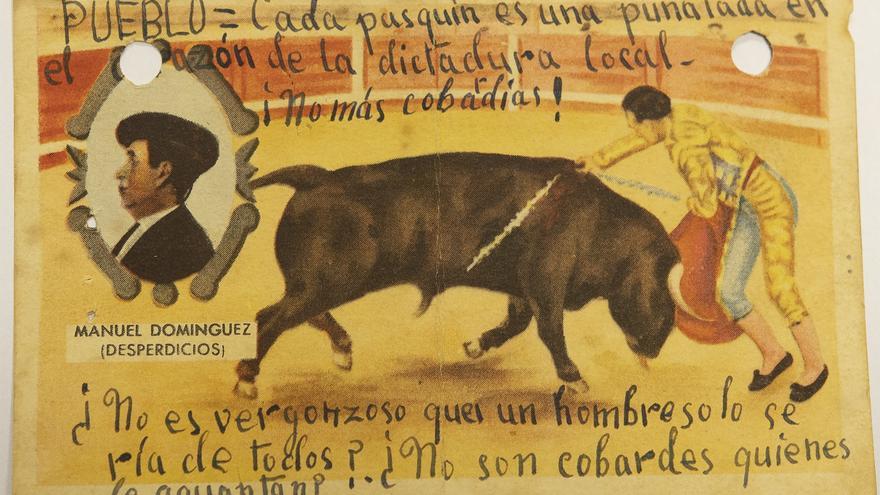
Many residents of Los Realejos weren't fully aware of what was happening between the two areas. It was a political matter that took place during the Franco dictatorship. However, there was some opposition to the merger. Opponents expressed their disagreement through postcards and cards with slogans. One card, featuring a bullfighter named Manuel Domínguez 'El desperdicio,' read: "People = Each pamphlet is a stab in the heart of the local dictatorship. No more cowardice!" The Civil Guard even recommended that Nicolás González del Carmen, the key figure in this process, carry a gun.
Protests against the merger continued until the late 1980s. A small, organized political movement still requested separation, and several letters were published in the newspaper El Día under the pseudonym 'Yo soy pueblo' (I am the people).