
Los Carrizales: Tenerife Hamlet Thrives in Remote Ravine
In Tenerife's Teno Rural Park, the remote hamlet of Los Carrizales thrives with twenty resilient residents who navigate daily challenges from its deep ravine location and limited services.
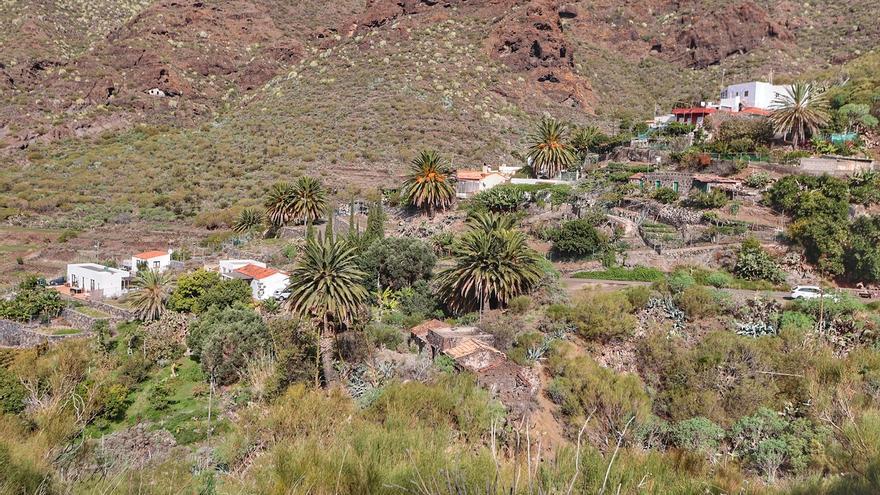
Life can indeed thrive in a ravine. The hamlet of Los Carrizales, in Buenavista del Norte, is a perfect example. It's like a deep chasm in the middle of paradise, nestled at the very top of a ravine that shares its name. The hamlet is divided into two areas: Upper Carrizal and Lower Carrizal.
Around twenty people call this rugged part of Teno Rural Park home. Among them are siblings Idaira, 34, and Omar Dorta Rodríguez, 32, who are energetic and full of life. Idaira is the mother of the only two children living in the hamlet, making them the youngest residents apart from her kids. She says, "My children don't want to leave here; they love it and are happy. Life is good." The children attend school in Buenavista del Norte's La Cuesta neighborhood, a 20-minute journey by school bus.
It's a beautiful, sunny day, with strong winds hinting at the high altitude and western location. In the distance, the sea stretches out, with the island of La Gomera visible between the ravine's reddish-brown walls. The scene evokes both the challenges of life here and the peace of a kestrel gracefully soaring. "You picked a good day," Idaira remarks from behind her dark sunglasses.
Omar and Idaira both work in the south of Tenerife. Getting to central Buenavista del Norte takes them about the same time as reaching Santiago del Teide. However, the drive home is tougher. They explain, "We use the Masca road. Going to work early in the morning is fine, but coming back is very complicated." The nearby village of Masca suffers from severe tourist overcrowding, which impacts Los Carrizales residents on their commute home.
"This is an unspoiled place," Idaira notes, contrasting it with Masca. Los Carrizales has only five holiday rentals, meaning tourism exists but doesn't overwhelm the area. She adds, "The tourists who come here don't cause any problems. They come to hike and find peace, which we have in abundance." A German voice drifts into the conversation from afar. It turns out several Germans have bought homes here, seeking a quiet life away from the city.
The Dorta Rodríguez family has deep roots in Los Carrizales. Omar, with his striking blue eyes, explains, "Almost everyone here is related – half-family, second cousins, or my parents' cousins." While the twenty current residents aren't always constant due to people moving in and out, Omar remembers his father saying that "when he was a boy, about 180 people lived in Los Carrizales." He adds, "Back then, families often had seven, eight, or even nine children," which boosted the population. Census data shows 45 people lived in the hamlet in 2000; 25 years later, that number has nearly halved.
"Many people have sold their homes, others only visit inherited ones on weekends, and some convert them into holiday rentals. Living here isn't easy," Omar admits. His words reflect the hamlet itself: a beautiful place clinging to a cliff, yet its tranquility comes with significant challenges. They chose to stay "due to circumstances. We inherited property from our parents," he explains.
The last house sale happened in 1985, before Omar and Idaira were born. That house, charmingly renovated, is still known as 'El Casino,' with the name clearly visible on its front. Los Carrizales lacks basic services. Residents voice concerns about poor public lighting, bad roads, restrictions from living in a rural park, and a general lack of support from local and regional authorities.
Residents are resourceful, finding their own solutions, such as preventing power outages, which are common during bad weather. "Look at the cables on those electricity poles," Idaira says, pointing. A stick or taut object can be seen separating two of the power lines. She explains, "If those two cables touch, the power goes out. So, several neighbors put that there to stop it."
Farming used to be a primary way of life here, with onions, potatoes, sweet potatoes, and yams being key crops grown in the hamlet's fertile soil. Omar Dorta still cooks yams. He explains, "During December and January, I cook them for Christmas. I simmer them for about 12 hours in large stainless steel pots. If they need more, sometimes they're in the water for up to 20 hours – whatever it takes." Goat farming was also important, though less so than agriculture.
Strolling through Upper Carrizal's narrow, very steep streets reveals a mix of neglect and careful preservation. Traditional Canarian houses, some looking sad and abandoned, stand alongside others of the same style that are beautifully maintained. Some have clearly been looked after better than others. Despite this, the walk is enjoyable, and the kestrel that greeted them continues to soar gracefully. It's a truly idyllic place.
The hamlet's main street has a small square and a hermitage. In June, they celebrate festivities for Saint John. The Dorta Rodríguez siblings explain, "The residents built the hermitage themselves." Both the chapel and the square sit on land donated by the community. It's a lovely place to pause after hiking some of the trails that wind through the hamlet.
Descending into Lower Carrizal feels like dropping deeper into the ravine. It's hard to imagine life taking root and surviving in such a fractured, steep landscape. Yet, it does. Another cluster of five or six houses clings to a small outcrop, seemingly pausing for breath, but mostly, just surviving. What incredible resilience!