
Lomo de Mena: Tenerife Village's Quiet Decline and Enduring Heart
Lomo de Mena, a historic village in Tenerife, grapples with depopulation, the loss of local services, and a changing community dynamic, despite residents' efforts to preserve its unique identity and peaceful way of life.
It's almost noon. The bell of the Church of the Holy Cross rings loudly, announcing the time. Five minutes later, it chimes the hour, setting the peaceful pace of life in Lomo de Mena, a village in Güímar, southeast of Tenerife. Only a few cars pass, with two dogs barking non-stop as they head up the steep slope leading to the church.
Divided by the main southern road, the TF-28, this small village was founded in the early 16th century by Gonzalo de Mena, which is where its name comes from. It stretches from the mountaintop to the coast, holding on to the land to avoid being forgotten due to people moving away. Around 200 people live here, in houses spread out along the ridge. José Pérez Castro is one of them.
His tanned skin, likely from his retirement, matches the blue sky and bright sun he enjoys. "The warmth is nice now," he says, "because mornings and evenings are very cold indoors." Pérez Castro is a native, as were his parents and grandparents. He has two sons. One chose to renovate a family home and stay in Lomo de Mena – a rare choice, as most young people leave. His other son lives in Santa Cruz and works in La Laguna.
José explains that people with no connection to Lomo de Mena are buying houses and moving in, especially in the lower part of the village. "Many are from Venezuela, for instance. But it's a shame most don't mix with others," he observes, missing the old community spirit. He often sees people he can't greet because he doesn't know them, which feels odd in such a small place. He also mentions that several homes are now holiday rentals. When asked if this makes the village livelier, he complains, "These are people who don't actually live here."
Pérez Castro used to be an environmental agent, so he knows the area very well. He only ever left Lomo de Mena for work, spending several years on La Palma for his job.
The conversation flows easily. "At the end of last year, we lost our last shop and the bar at the cultural center," he says sadly. "Now, if we're home and urgently need something, there's nothing nearby. We have to go to La Medida, the next village over, which still has a small shop," he explains. He also remembers another closure from about ten years ago: the El Calvario agricultural cooperative. This cooperative was central to farming in the area, with "five hundred members from Agache and the Güímar Valley. It sold most of Agache's tomatoes and potatoes, and also provided fertilizers, seeds, and other farm supplies at lower prices to local farmers," according to Octavio Rodríguez Delgado, Güímar's official historian, in his book 'Notes for the History of Lomo de Mena (Agache Region, Güímar)'.
There's no doctor here either. Pérez Castro goes to the medical center in Güímar, but appointments are also available in the nearby area of El Escobonal. Another daily routine that takes him out of the village is "going to buy bread in the morning, and I pick some up for other neighbors too," he says, showing a friendly community spirit.
The cultural center and the village square stand as symbols of unity, built by the residents themselves. José remembers how "everyone worked together" on the three-story cultural center, built in 1991. "The City Council provided materials, but we did the rest ourselves." Today, it hosts yoga and craft classes. Pérez Castro proudly notes that the cultural center received a silver medal from the Güímar council for its vibrant activity over the years.
Behind José Pérez Castro stands the old school, a two-story building from 1960 that served as a school until 1998. In its early days, nearly 50 children attended. "Back then, there were enough children to fill both floors – boys on one, girls on the other. Now, there are very few left," he says, counting them off by where they live. He can't even name ten. But he vividly recalls all the children who lived near his house when he was young: "We were four siblings, but the house next door had seven, the one above had eight, and the one next to that had another seven," he recounts, showing how many people lived there back then.
Despite these changes, José is clear: "Life is good here. It's peaceful. A typical day for me in Lomo de Mena involves going to my small plots of land. I grow a few things for myself and my children. Then, I meet up with friends for a chat, and that's about it," he summarizes. Farming is a hobby now, but in José's childhood, it was a necessity. "My father was a bricklayer, but he also plowed and sowed. They expected us children to spread the manure," he recalls.
"Before, we had goats, and some cows, though not as many, but now none of that is left," he states. Rural life is largely gone, even though some people in Lomo de Mena still tend their plots. "But they don't live here; they come, do their work, and leave. That person who just drove by lives in Santa Cruz," he says, gesturing to a driver he'd just spoken with.
When it comes to farming, his explanation for why it's been abandoned in villages like Lomo de Mena is straightforward: "If there are 88 municipalities in the Canary Islands, each with an agriculture councilor, plus about seven agriculture ministers, why is only 33% of the Canary Islands' land suitable for farming?" he asks, highlighting the contrast between the number of officials and the lack of agricultural development.
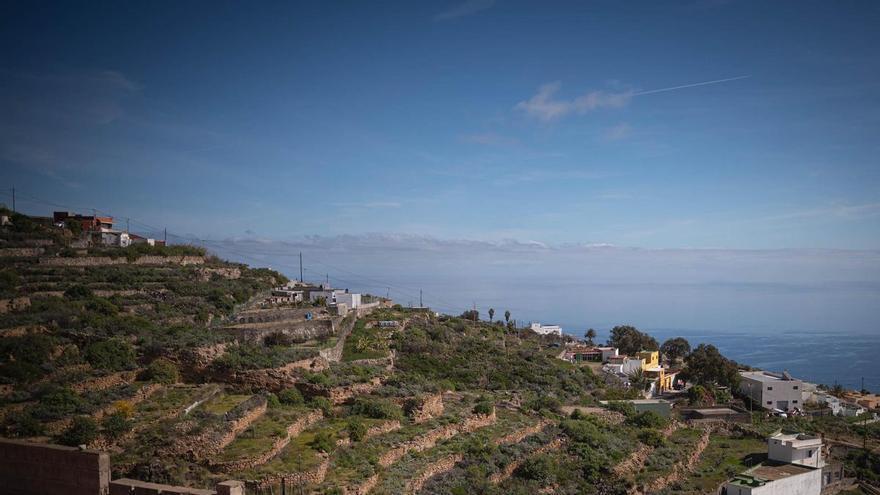
Lomo de Mena's terraced landscape shows how it adapted to the land. Small, ochre-colored rock terraces, once farmed, now stand uncultivated, a clear sign that agriculture has been left behind. This is often one of the first things visitors notice and remember.
When asked about the village's needs, José recalls a story about installing water pipes. "We had to fix them ourselves because no one else would come," he says passionately. "We only managed to do one section with a grant, and even that was a huge struggle. Every day they asked for more paperwork, until one day they told us the file was lost," he laughs.
Pérez Castro is happy in Lomo de Mena, even if it means traveling to other places for a doctor, to buy bread, or even to get this newspaper to read a story about the land where he was born and raised.