
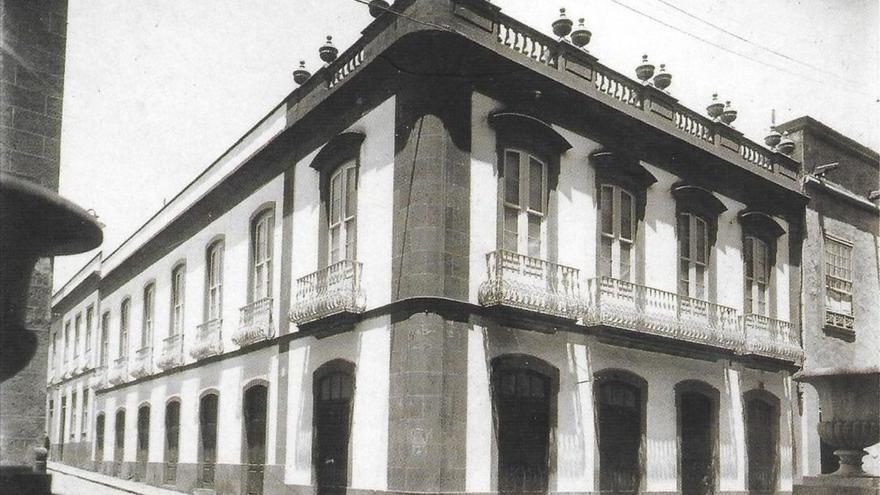
In Tenerife, the "Cabinet of Instruction" became a center for the development of the city and education in the 19th century.
In Santa Cruz de Tenerife, in 1869, the literary society "Training Cabinet" was founded, which for 32 years played an important role in the cultural and intellectual life of the city, contributing to the development of education, science, and public discussion.
After the revolution of 1868, also known as the Glorious or September Revolution, which overthrew Queen Isabella II, Spain entered a period known as the "Democratic Six Years." During this time, various associations were allowed to form, and the country saw the emergence of many societies, clubs, and interest groups.
In the city of Santa Cruz de Tenerife, a group of young people with diverse views (liberals, republicans, conservatives, Catholics, and even Freemasons) decided to unite. Their main goal was to develop their city and educate its residents. They created a literary society called the "Study Cabinet." It was a place where people could gather to discuss different ideas and share their thoughts.
This society was founded on May 9, 1869, at the home of Elías Zerolo Herrera. The initial members included priest Ireneo González Hernández, Luis Benítez de Lugo (Marquis de la Florida), Miguel Villalba Hervás, Eduardo Domínguez Alfonso, Darío Cullen y Sánchez, Rafael Calzadilla Dugour, Gabriel Izquierdo y Azcárate, Ramón Gil-Roldán y Ríos, José Desiderio Dugour, and José Tabares Bartlett.
The first meeting took place on July 24, 1869, at their office on Calle del Norte (now Calle Valentín Sanz, where the Hotel Príncipe Paz is located). The meeting was chaired by Juan de la Puerta Canseco.
Initially, the "Study Cabinet" had 40 members, which later grew to a hundred. To become a member, one had to present their work or express their opinion on a particular issue. It was also required to donate several books to the society, which allowed them to build a large library.
For 32 years, the "Study Cabinet" was a place where people learned to speak publicly and share their ideas. It was a place where beginners who wanted to learn oratory or recite their own works could try themselves. The society also provided advice on city development issues and helped organize cultural events.
In 1876, the "Study Cabinet" was closed because the authorities did not trust the opinions freely expressed by the members of the society. However, it was reopened four years later with the support of General Valeriano Weyler and the famous pianist Esmeralda Cervantes.
After that, the authorities began to monitor the society's activities more closely. Public meetings discussed scientific, literary topics, as well as issues of trade, agriculture, and education. The conclusions from these discussions were sent to the relevant authorities.
In January 1881, at the initiative of the local council, a series of debates took place on free ports and benefits for the Canary Islands. Various societies and editors of major newspapers were invited to participate.
In 1899, two members of the "Study Cabinet," Manuel de Cámara and Dr. Guigou, drew attention to the unsanitary conditions in some areas of the city. They called for the demolition of old buildings and the construction of decent and healthy housing for workers.
At one of the meetings, Dr. Guigou proposed the creation of a children's hospital, and this idea was soon put into practice.
The "Study Cabinet" played an important role in the cultural life of Tenerife. In 1883, it hosted events dedicated to Cervantes (April 23), Galdós (May 10), the Telegraph Cable holiday (December 6), and other events.
The society also organized other events open to everyone, such as educational lectures for women, an English and French language school, and preparatory courses in law.
The "Study Cabinet" became the basis for the creation of other groups and societies. The first meeting of the Society for Mutual Aid and Free Education, as well as the Society for Buildings and Urban Reforms, took place in its premises.
The Trade and Agricultural Union and the El Pensamiento Trading Society were created. The Santa Cruz Secondary Education Institution, the first educational institution of this level in the city, was also founded.
The "Study Cabinet" ceased to exist in 1901. A tax inspector discovered that three stamps were missing from the accounting books and opened a case.
The society was fined 5,000 pesetas, but they did not have the money to pay it. Therefore, it had to close.
Some members of the "Study Cabinet" later became mayors of Santa Cruz, such as Anselmo de Miranda, Bernabé Rodríguez, José and Carlos Calzadilla, Emilio Serra, Febles Campos, García-Ramos, Suárez Guerra, and others.
Other members of the society managed newspapers and magazines, including Alfonso Dugour, Claudio F. Sarmiento, Elías Zerolo Herrera, José M. Pulido, Juan de la Puerta Canseco, Miguel Villalba Hervás, Ramón Gil-Roldán, and others.
The names of many members of the "Study Cabinet" can be seen on street signs in the city: Domínguez Alfonso, Costa y Grijalba, Ireneo González, Dr. Guigou, José Manuel Pulido, Puerta Canseco, Valentín Sanz, Villalba Hervás, Tabares Bartlett, and others.