
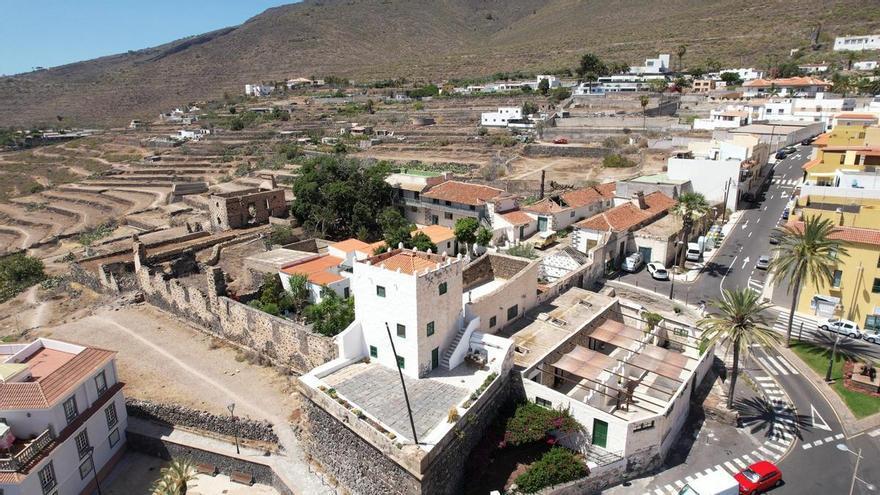
Legal Setback Stalls Expropriation of Tenerife’s Historic Casa Fuerte
The Adeje City Council’s efforts to expropriate and restore the historic Casa Fuerte in Tenerife have been stalled again following a court ruling that cited procedural errors in the notification process.
Efforts to protect historical heritage in the Canary Islands are once again stalled by legal and bureaucratic hurdles. The Adeje City Council has suffered a new judicial setback, forcing them to pause the expropriation of the Casa Fuerte—a site crucial to understanding Tenerife’s history after the Castilian conquest. A court ruled in favor of one of the property’s owners, citing errors in the notification process. This means the Council must now restart the paperwork and bring the matter back to a plenary session.
This delay is the latest in a struggle that has lasted over 30 years. Mayor José Miguel Rodríguez Fraga’s administration wants to turn the site, which was declared a Property of Cultural Interest (BIC) in 1986, into a public heritage site and interpretation center. However, the property is split among more than 100 heirs across 11 different families, creating a legal maze. The Council’s offer of 1.6 million euros has been rejected by half of the owners, who oppose the government takeover.
Manuel Luis Méndez, head of Urban Planning, points out the irony of the situation: because the site is a protected monument, the land has no real urban development value, as any changes to the structure are strictly prohibited. Despite these challenges, the Council remains committed to the expropriation. They argue it is the only way to properly preserve the 7,200-square-meter complex, which has been deteriorating since a 1902 fire and requires urgent, careful restoration.
The Casa Fuerte is historically significant beyond its architecture. Built in the 16th century by Pedro de Ponte y Vergara, it was the center of a major sugarcane and maritime trade operation. De Ponte, a powerful local official, used the excuse of defending against pirates to fortify his estate, all while maintaining secret trade deals with privateers like John Hawkins.
The site’s history is well-documented in archives now held at the Museo Canario in Las Palmas. These records, including wills and trade logs, are invaluable for studying the history of slavery in the islands. They reveal how enslaved people from Africa were treated as assets alongside livestock and land. Today, local surnames still reflect this painful history.
While the Casa Fuerte was removed from the Hispania Nostra "Red List" in 2024 after opening for guided tours, its future remains uncertain. Experts agree that any future work must focus on scientific conservation rather than speculative reconstruction. For the City Council, the mission is both legal and ethical: to preserve a site that served as an economic hub, a fortress, and a witness to one of the island's darkest chapters.