
La Orotava Science Fair Engages Record Crowds
The 22nd La Orotava Science Fair attracted a record 12,000 attendees with dozens of interactive outdoor labs and exhibits from numerous research centers, inspiring both children and adults with local scientific discoveries.
Eight-year-old Mario Hernández is no stranger to science. Dinosaurs, planets, and volcanoes fill his books, drawings, and even his pajamas. But his recent trip to the La Orotava Science Fair truly made an impression.
It's not every day someone tells him he could become "one of the best astrophysicists in the Canary Islands." With a huge smile and bursting with excitement, he rushes over to his grandmother, who has been watching him, to share his adventures inside the tent set up by the Canary Islands Astrophysics Institute (IAC) in the town's main square, Plaza de la Constitución.
Inside, he had to compare the light from different chemical elements and guess what they were. "I figured out all of them, even though I'm colorblind!" he proudly declared, not yet realizing the significance of his words for his future.
Mario was just one of thousands of children who visited the La Orotava Science Fair today. This traditional science event, now in its 22nd year, brought the town to life with dozens of outdoor labs for both kids and adults to enjoy.
About 12,000 people attended – 2,000 more than last year. They enjoyed a unique Sunday out, learning from experts who study the Canary Islands' environment, volcanoes, skies, and ocean.
This popular event packed the venue with more research centers and activities than ever. "We've used all the available space; activities are spilling out from the main square," said science journalist Juan José Martín, the fair's main organizer. He expects the fair to grow even more next year. "Next year, we'll also take over Escultor Fernando Estévez street," he announced.
A new attraction could be found on one side of the square, on Liceo Taoro street: giant floats shaped like whales and dolphins found around the island. This display is part of the CanBio project, a joint effort by the two Canary Islands universities and Loro Parque Fundación. Its goal is to raise awareness about how human actions harm the ocean and these marine animals.
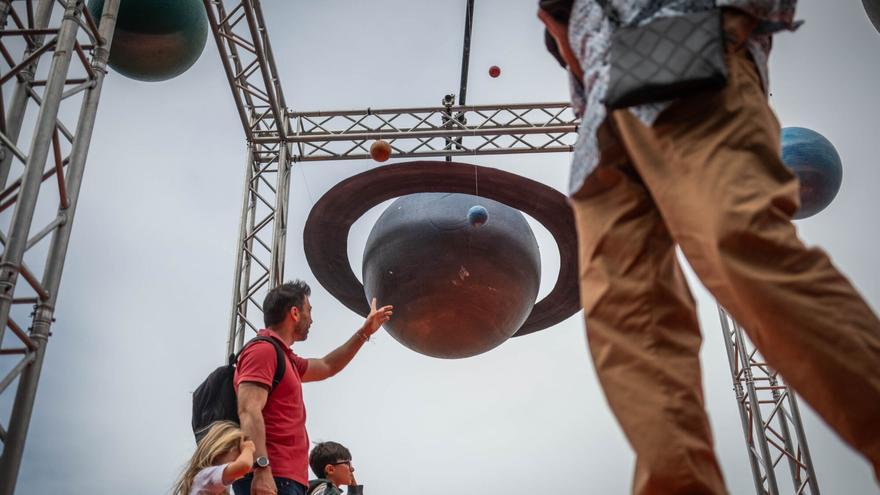
Higher up in the square, visitors were met by a display of planets from our Solar System, all hanging in proportion. "That one there is Jupiter," a mother told her son, pointing to a large ringed planet. The child, knowing better, quickly corrected her: "No, Mommy, that's Saturn." They both laughed at the mistake before heading into the main square, where over 22 scientific teams and institutions from the Canary Islands were gathered.
"We simply ran out of space," Martín confessed. This year, registrations for research centers were supposed to stay open until November 3rd, but "we had to close them early because there was no more room." "Many couldn't get in," the journalist noted. He added that, over the years, the Canary Islands' oldest science fair has achieved something special: "Many scientists want to come because they know this fair is different; people don't just glance at the stands or wander by, they really get involved."
Many of the participating centers were returning favorites, including the National Geographic Institute (IGN), the Telesforo Bravo Foundation, the Official College of Biologists of the Canary Islands, the Spanish Association Against Cancer (AECC), the Museum of Natural Sciences of Tenerife (MUNA), and the Volcanological Institute of the Canary Islands (Involcan).
However, more and more diverse organizations and researchers are now eager to take part.
Both children and adults often spent several minutes at each themed tent, which this year were named after constellations.
At the University Institute of Tropical Diseases and Public Health of the Canary Islands' stand, young Martín peered closely at jars filled with what looked like spaghetti and Petri dishes with colorful spots.
"What's this?" asked the five-year-old. "They're germs," explained Cristina González, a researcher from the center. "They're like tiny bugs in the air."
The boy looked confused, so González clarified: "Not all of them are bad. We breathe them all the time and don't get sick."
His eyes lit up as he realized this explained why he sometimes caught a cold. "I get sick!" he exclaimed. González smiled: "Exactly, you probably breathed in a little bug that made you feel unwell."
While the fair aims to inspire young people in science, many adults also take the chance to learn about the research happening in the Canary Islands.
One of the busiest stands belonged to the AChem (Applied Analytical Chemistry Research Group) from the University of La Laguna (ULL), which focuses on analyzing microplastics.
Researcher Cristina Villanova showed visitors what washes up on the Canary Islands from the sea, emphasizing that "there are no borders."
In front of her were jars containing microplastics in various forms: pellets, tiny volcanic fragments, or direct litter. But what really caught 13-year-old Clara's eye was a book filled with labels from products found on Playa Grande (La Graciosa) and El Porís (Tenerife) beaches.
"Did this really come from Egypt?" she asked, surprised. "I didn't know that was possible," she admitted, with the wide-eyed wonder of someone discovering unexpected scientific truths.