
La Orotava Archive Preserves Town's Rich History
Serving as a vital guardian of local memory, the La Orotava Municipal Archive meticulously preserves nearly 20,000 documents and over 84,000 photos, spanning from the 15th century to the present, through extensive digitization and community engagement.
In an old house with yellow walls, time seems to stand still, but in a way that helps preserve history. This is where the La Orotava Municipal Archive is located. Inside, among tall shelves, you'll find photographs, town records, and even old festival posters.
One photo shows men butchering a pig. Another captures a group of women posing together. There are images of grape harvests, religious parades, dirt roads, and faces that never knew they would one day be part of the town's story.
These photos, taken between the 1940s and 1950s in the La Florida area, don't just show everyday life in rural La Orotava. They are also some of the archive's most precious historical items. It’s a place where memories live on because, as Lucas Castañeda and Antonio González, who look after this historical treasure, put it, someone decided "not to throw an old box in the trash."
The La Orotava Town Council's Municipal Archive has been at 1 San Sebastián Street since 2000. It moved there after being in two other places. Originally, the archive was in the Casa Díaz Flores-Brier. However, a huge fire on June 2, 1841, destroyed all the documents, forcing a move to the basement of the town hall itself. "The archive was in the basements of that house. There was an immense amount of paper, and it was lit with oil lamps. Everything burned," Castañeda explains. This fire is why no town documents from before the 19th century still exist.
Despite that loss, the archive now holds nearly 20,000 documents. "If we were to place all the boxes side by side, we would have almost three kilometers," González points out. Most of these collections were gathered by the town council and cover the period from the 19th century up to 2024. The archive also has many private documents from donations, with some items dating back to 1472.
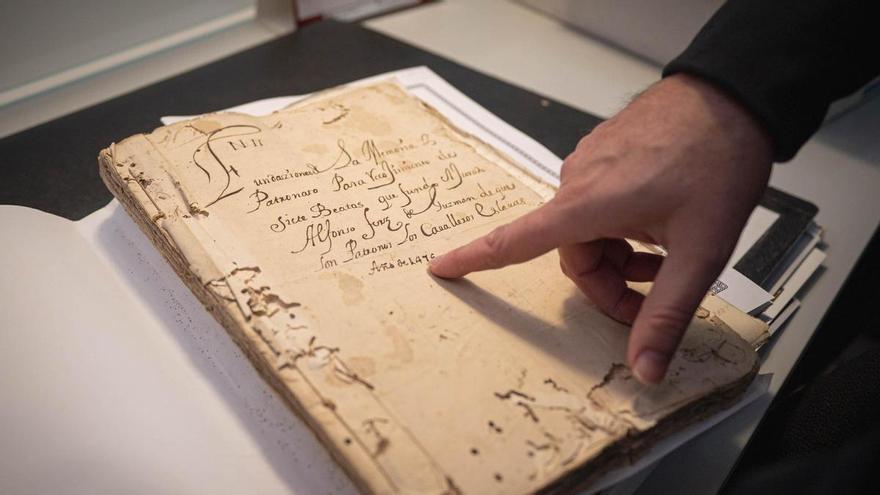
The oldest town treasure, from the 15th century, came from a donation. It's not specific to La Orotava but contains general information related to convents, legal documents, wills, and baptism records. "It is general cultural documentation, but it is invaluable for understanding the era," Castañeda notes. Among these private collections, the Lugo-Viña y Massieu collection is the most important, covering a wide period from 1476 to 1959. It includes wills, letters, accounts, and court documents from the Canary Islands and mainland Spain.
Next to it is the Nepomuceno family collection, which was luckily found in an abandoned plot and brought to the archive in 2019. Its documents, from 1655 to 1944, show the rise of a new wealthy class in La Orotava in the early 19th century. Its cataloging was finished in 2024. Another important collection is from the La Orotava Casino, a club founded in 1853, whose documents tell the story of over a century of social life in the town.
The archive also keeps 4,714 administrative books, 7,908 posters, 3,137 programs and brochures, and 2,276 videos and audio recordings. It has a library focused on local history and archiving. Additionally, it safeguards old rubber stamps and various items used by the Town Council over time, such as pens, typewriters, mimeographs, cyclostyles (early printing machines), and old cameras.
However, one of the most valuable collections is the photographic one. The Municipal Archive holds 84,190 photos, most of which have been digitized. For many years, this collection was very small. "When we started, more than thirty years ago, there were almost no photographs. We depended entirely on donations," recalls Antonio González. This shortage explains the great importance of the La Florida images, as it's the archive's largest donation, with over a thousand photos showing daily life in a rural neighborhood between the 1930s and 1950s.
"We have many photos of the historic center because it was the most striking, but practically nothing of other neighborhoods," González explains. The La Florida images help us see farming tasks, family scenes, and ways of life that otherwise would have been lost from the town's visual history. Another large donation came from local history enthusiast Domingo Luis, whose family gave nearly a thousand photos of the old town.
Among the most unique items are photographic plates made by a German military photographer in the late 19th and early 20th centuries. He used advanced technology for the time, requiring long exposure but producing incredibly sharp images. "We even have the catalogs of his orders and know that he developed the photos in his own home," Castañeda points out. Some of these plates show religious parades in La Orotava, while others document the building of a railway in Namibia.
The oldest image in the archive dates from around 1860 and is a portrait of a woman. Its age was determined by the photographer's stamp and the studio's address, which was only open for two years. This cataloging work goes hand-in-hand with constant efforts to preserve the documents. Some documents are on parchment, made from kidskin, and others on vellum, an even finer material. Many show signs of insect damage or harm caused by old inks with high iron content, which have oxidized and broken the paper over time.
Conservation efforts have led to an ambitious digitization project. For example, municipal registers, which are frequently consulted for historical research and current administrative needs, are being scanned. In the last year, between 30,000 and 40,000 pages have been scanned, completing the 19th-century registers. "There are documents that can no longer be opened without breaking, which is why we are digitizing them," explains González.
But the archive isn't just about documents and photos. It's a pioneer in the Canary Islands for collecting oral histories through interviews about farming and daily life. It also handles requests from researchers and families who can ask for copies of files or records through the website. "Recently, a historian from mainland Spain contacted us; he was doing work on salt flats and needed documentation that we had," Castañeda recounts. Schools and institutes also visit, where students learn to write with pen and ink and discover how historical documents are preserved.
To connect the archive with younger generations, the Town Council plans to launch a "Sponsor a Document" project for local schools. Children will be able to choose a historical document, symbolically "sponsor" it, and receive a copy. It's like sponsoring an animal, but for historical heritage. The goal is to build a connection, awareness, and respect for history from an early age.
Because that remains the biggest challenge. "It's most common for documentation and photographs to end up in the trash," laments Antonio González. Many people don't know what they have or can't take care of it. Therefore, digitization, sharing information, and educational projects have become crucial tools to prevent further losses.