
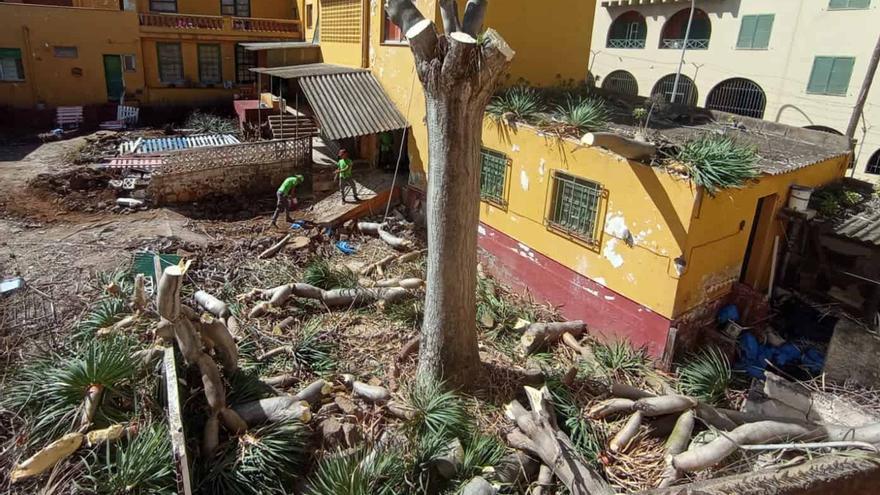
La Laguna Activates Tree Council, Eyes Private Land Intervention After Dragon Tree Felling
Following a dispute over a cut dragon tree, La Laguna City Council unanimously activated its Tree Council and committed to exploring legal ways to protect special heritage trees on private land.
A dispute over a dragon tree cut down on Mazurca street in the Lora y Tamayo area has led to important changes. The main outcome is the activation of La Laguna's Tree Council. Additionally, the City Council has promised to explore legal ways to intervene on private land when "special" trees are involved, such as those important for their heritage, age, or other unique qualities.
This agreement was unanimously approved after two proposals were brought to the La Laguna council meeting in December. One came from Carmen Peña of the Drago Verdes Canarias party, aiming to "protect the Canary Islands dragon tree in San Cristóbal de La Laguna." The other was from Idaira Afonso of Unidas se Puede, seeking "to establish measures that improve the protection of trees and ornamental Canary Islands flora."
These two proposals were combined into a single document, with further suggestions from the ruling parties (PSOE-CC), the PP, and Drago. The first point of the agreement states: "The San Cristóbal de La Laguna City Council reaffirms its dedication to protecting and enhancing Canary Islands plants and trees, especially those that are environmentally, visually, or historically significant."
The document also mentions that a municipal list of unique trees and groves is currently being developed as part of a Special Planning Plan, which is undergoing an environmental review. This list already includes protections for special trees on both public and private properties.
Furthermore, the Environment Department is asked to continue creating and regularly updating this list, working with the Cabildo de Tenerife and the Government of the Canary Islands. This will ensure that island and regional records are consistent. The council will also encourage private owners to voluntarily help identify, preserve, or move important Canary Islands plants when environmental, heritage, or safety reasons require it, always respecting private property laws and local government powers.
Other measures adopted include: running campaigns to raise awareness about the value of native plants and promoting the use of Canary Islands species in gardens and public spaces; continuing to plant local species in city green areas; and improving coordination between different government bodies regarding native plants and plant heritage.
The Popular Party (PP) also contributed by suggesting to "reorganize and activate the San Cristóbal de La Laguna Tree Council." The goal is for this council to allow citizens to participate and "gather ideas for maintaining, preserving, managing, and sustainably planning urban trees."
Beyond the initial text, the Drago party added three more actions to the final agreement: ensuring that the technical advice from the Parks and Gardens Department takes priority when protecting plants during the installation of Christmas lights; starting a collaboration agreement with the universities of La Laguna and Las Palmas to support scientific studies on native Canary Islands plants (especially the Canary Islands dragon tree); and making sure that the council's decisions from December 12, 2024, regarding urban tree protection and coexistence are followed.
The final and significant point states: "To explore the legal ways that allow the city council to act on private properties when dealing with species identified as special or unique, whether due to their historical value, age, or similar reasons."
The motion from the Drago party highlighted the history of the dragon tree, which sparked the entire discussion about tree protection. It emphasized that the dragon tree "is a cultural and natural treasure of the Archipelago."
The document notes that dragon trees are found in only two parts of the world: the west coast of Africa, and Macaronesia and Morocco.
The text adds: "It is a species of immense importance to the islands' culture and was chosen as the plant symbol of Tenerife in 1991."