
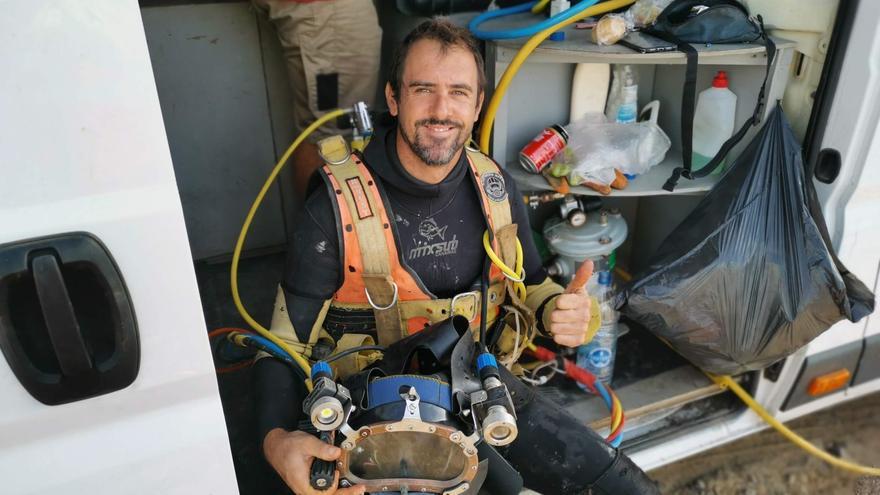
Industrial Diver Navigates Atlantic's Dangerous Depths
Murcian industrial diver David González Hernández, based in Tenerife, has spent 22 years performing high-risk underwater construction and port expansion work, primarily in Las Palmas's Port of La Luz.
Working deep under the Atlantic Ocean is a rare job, but David González Hernández, originally from Murcia and now living in Tenerife, is one of the few who does it.
David is an industrial diver, a high-risk profession he has been doing for 22 years. He first came to the Canary Islands in the summer of 2000, specifically Fuerteventura, for his military service. A friend studying for a diving qualification told him about the career, and David didn't hesitate. "I was 20 years old back then and didn't know what to do with my life," he shared. "So I took the professional diving course and have been doing it ever since." Similar training is available in Tenerife and other parts of mainland Spain.
Today, a professional diving qualification takes two years to complete. However, when David trained, it was "one year of study, three months of internships, and three months for a project." After finishing, he started working, though he notes, "there isn't much job availability. There's much more work in Las Palmas," which is where he always works, despite living in Tenerife.
An industrial diver's routine, like David's, demands careful planning. When they arrive at a job site, the first step is to prepare all the equipment: helmets, which weigh about 17 kilos, umbilical cords, and other tools. "Then, the team leader goes through a checklist to make sure everything is in perfect condition," David explained. "After that, we have a briefing with all colleagues, which is a document outlining the work plan."
A minimum diving team consists of five people: a team leader and four divers. David says the team leader usually stays on the surface. "He controls the gas panel, monitors video feeds, and directs the entire diving operation," David summarized. "There's also a dive plan, another detailed document. Everything, including the work to be done, is planned out there."
The work of an industrial diver leaves little room for improvisation. "We plan everything very carefully, but we always end up improvising in some way because problems can arise underwater," David explained. He clarified that "it depends on the job. Some tasks are the same every day, a routine. But for others, unexpected things come up, and site management gives new instructions and proposes changes." So, while there's a plan, there's also variation.
Regarding physical fitness, David says industrial divers don't need any special preparation. "Technique is much more important than physical conditioning," he added. "For example, if there's heavy lifting, the strongest person does it. If it's technical work, the most skilled person takes it on. It varies. We compensate for each other."
Every dive carries significant risk. David has worked at a maximum depth of 48 meters. Decompression is necessary even at depths of 10 to 12 meters. "The longer you spend at the bottom, the more time you need for decompression," he explained. "This also affects the level of risk. You have to follow the safety curve, as it's called." He added, "At the Reina Sofía and Nelson Mandela docks in the port of La Luz, we work at 27 or 28 meters deep. There, we use special tables and then do about 5 to 10 minutes of decompression."
Fear is often a part of the job for the diver from Murcia. "Yes, sometimes there's some fear," he admitted. He once suffered a severe diving accident. David began to experience back pain and "started to lose sensation in my belly. Slowly it got worse until I couldn't feel my waist or legs. I couldn't walk." He spent five hours in a hyperbaric chamber. He was able to walk out, but "I was left with some very minor lasting effects."
"Being an industrial diver is risky, especially because of decompression issues and the heavy machinery and materials we work with," he pointed out. They are currently working with 18-ton blocks. "A chain could break, and if you're to the side or underneath, you risk being hit. You must always position yourself to the side or above, never underneath. You also shouldn't get caught between the load and a wall," he explained.
The port of La Luz is a crucial location for his work. As an underwater worker, David's tasks include port expansions, building docks, breakwaters, outfalls, and general underwater construction. "We also clean ship hulls, but I personally don't do that kind of work. Anything that involves underwater construction, we do," he clarified.
For David, Las Palmas is the hub of this activity. "There's much more work there than in Tenerife because the port of La Luz is much larger and handles a lot more projects," he said. Currently, he's working on building the Zamakona ramp at the Gran Canaria port. "We're in the shipyard area, where ships are brought out of the water, demolishing the old structure to build a new one," he explained.
According to David, the port of La Luz is constantly expanding. "This year, we completed several projects: a berthing area for cruise ships, where we built some masonry docks. We also extended the Nelson Mandela breakwater, which involved 300 meters of work," he listed.
David González Hernández isn't entirely passionate about his profession. "Well, in the end, there's nothing else," he concluded. "I've always done this, and I don't feel like looking for another job. During the economic crisis, I worked as a waiter, and honestly, I didn't like it. I've been doing this for 22 years. It was my first job at 23, and I'm already 45."