
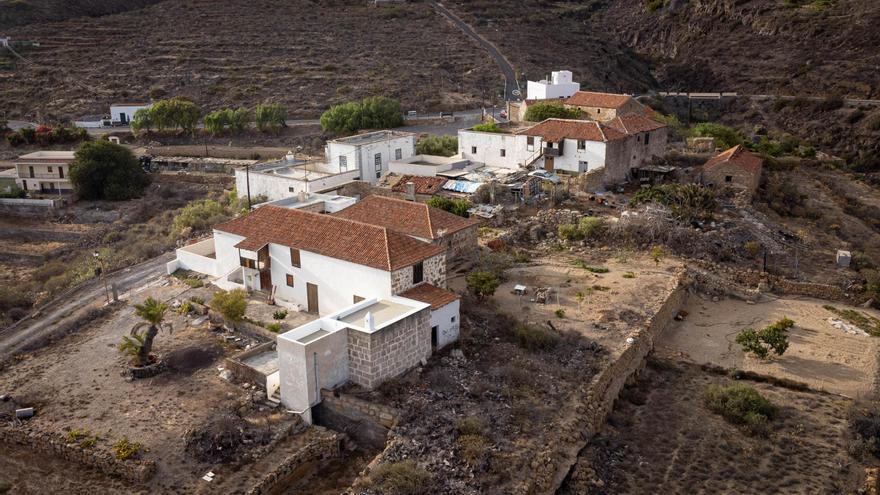
A couple from Madrid is saving the abandoned village of Icor in Tenerife.
A couple from Madrid is reviving the abandoned village of Icor in Tenerife, facing bureaucratic obstacles and calling on the authorities to take action to preserve cultural heritage.
Preserving historical heritage is an important task for any government. In the case of the village of Icor, in the municipality of Arico, this mission has been taken on by the couple Estrella Medina and Nacho Fuertes. October 12 marked the 7th anniversary of the day they accidentally drove into Icor while traveling around the island. Their daughters were fond of rock climbing, and that's what brought them to these lands. After seeing an advertisement for sale, the Madrid residents decided to buy almost half of the then-abandoned village.
Now Icor is a place where you can feel the spirit of the past: the hard work of stonemasons, the smell of pine resin, the echoes of goat bleating, and the wise architecture, nurtured by the winds. All this is being revived thanks to the efforts of Nacho, Estrella, their daughter Vanessa, and her partner Kevin, who share the story of Icor's transformation on social media. Only four people live permanently in Icor – them. Their closest neighbors live 50 meters away, on the old southern road TF-28. And in the very heart of the village, which received the status of an object of cultural interest in 2005, only they live.
Juana Marrero Delgado and her brothers, Emelina and Paulino, no longer live in Icor, but they come here every week. "There is nothing here, but the peace is boundless," says Juana, laughing. Her father was a goatherd and took care of livestock from the age of five. "We kept goats down in Abote, where the solar panels are now. I started working early so as not to be late," she recalls, although she misses her lost childhood.
Icor is a contrast between the past and the present: on the one hand, a 16th-century village with its unique architecture, and on the other, modern windmills and solar panels that bring profit to a few.
Juana, Nacho, and Estrella complain about the bureaucratic obstacles created by the local authorities when it comes to any changes in the village. The status of an object of cultural interest complicates any action. "The mayor of Arico, Olivia Delgado, cares about us. Every time she sees me, she asks how things are going here," says Nacho, and Estrella adds: "She cares, but does nothing." Juana agrees with her: "They do nothing. Everyone just talks, but does nothing. The village is not just abandoned, it is very abandoned."
Nacho does not understand why no one takes up the cause: "We do not understand why nothing is being done. They must have resources, because there are many windmills and solar panels here. So the money is coming in." Complaints from local residents and those connected with the village are constantly heard. They have united in a WhatsApp group and a neighbors' association to demand changes for the better. "There was such an association recently, and we are now trying to revive it in order to have more influence," he says.
Nacho, Estrella, Vanessa, and Kevin are focused on preserving the buildings in their original form. "We are trying to restore everything as it used to be, without modern additions. My son-in-law likes to work with wood and wants to restore old doors, not install new ones," says Nacho. They also found an oven for baking bread in one of the caves, which they cleared of weeds. There is also a wine press where wine was once made.
It is always cool in these rooms, and time seems to have stopped here. Old copper sprayers, a typewriter, a bottle of beer from 1939, stone tools, counters and showcases of an old shop, pine needle sieves, barrels, ceramic dishes, and even "clay products that we were told may be from the time of the aborigines," Nacho shows. "There were representatives of the authorities, archaeologists, and experts who gave us information, but that's where it ended," he adds.
This part of Nacho and Estrella's estate is a place for family recreation and entertainment. Sitting in the shade of one of the caves, they say that the municipality of Arico "spent two years issuing a permit" to restore the roof of the house with a balcony, one of the most famous buildings in the village. "They spend more time than Cabildo Tenerife." They believe that the permit was obtained only thanks to a publication in the media. "We were given it the day after the publication. If it wasn't for the article, we wouldn't have received it," they admit.
The passion and enthusiasm of this couple for Icor is impressive. They were not born here and have lived here for less than ten years. On October 24, they will receive the Gánigo Award from the Center for Initiatives and Tourism of Southern Tenerife at the proposal of the municipality of Arico. The award is well-deserved, but perhaps more important than recognition are urgent actions. Icor's heritage has guardian angels, but they are not government institutions.