
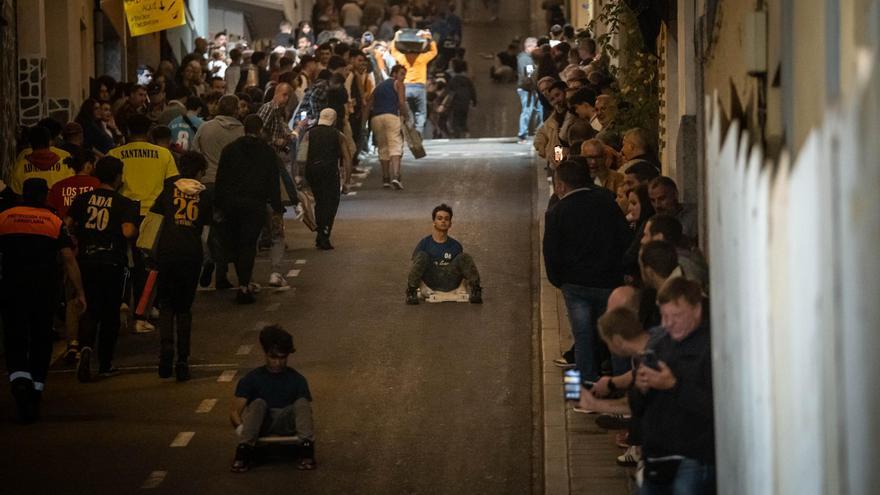
Icod Plank Draggers Demand Safety Overhaul, Cite Council Inaction
The 'El Caballero 2000' club is demanding improved safety measures, including fencing and collective insurance, for the popular San Andrés plank dragging event in Icod de los Vinos, citing "inactivity" from the City Council amid overcrowding concerns.
Every year in late November, the streets of Icod de los Vinos fill with the smell of wood and celebration as wineries open their doors for new wine tastings. This coincides with the traditional San Andrés plank dragging event. However, participants in this popular tradition, specifically the 'El Caballero 2000' club – who launch a large tea wood plank down El Plano street with eight people – are calling for better safety measures.
The 'El Caballero 2000' club has taken to social media to propose nine safety measures. They state these are necessary due to the "inactivity and lack of commitment" from the Icod de los Vinos City Council. These nine proposals were first presented to the local government (then a minority government of Alternativa Icodense, now allied with the PSOE) two years ago, both before and after the festival.
Their first suggestion is to fence off the entire street with a barrier that won't injure participants or spectators. They explain that this would involve placing a wooden barrier about three meters from the sidewalk, with a crowd control barrier behind it. Security personnel would need to be present at all times to manage these barriers.
Secondly, they propose limiting the number of spectators and using a rotating access system. They argue that letting too many people enter the street at once reduces the space for the planks, making the event less safe and harder to manage. To further improve safety, they want to ban people from crossing the designated dragging streets, a problem that often occurs on El Plano street. They believe this ban is "fundamental to prevent run-overs" (people being hit).
The club also calls for a collective insurance policy, calling it "essential" for providing proper coverage for both participants and attendees. They suggest that such insurance should also require participants to wear safety gear like knee pads, helmets, and elbow pads.
To prevent overcrowding, they propose stationing security personnel at the start, end, and along the entire route of the planks. They question how, in the event of an accident or incident during the dragging, there is currently no one in place to stop the planks.
The finish line for the plank dragging is typically a wall of tires. For El Plano street, the club suggests reducing the number of tires and moving them closer to San Agustín street. They also want to prevent spectators from standing behind the tires, claiming that the City Council currently "prioritizes the visibility of spectators over the safety of those of us who slide."
El Caballero 2000 also emphasizes the importance of clear communication about the tradition. They want to promote the event while also improving safety through street signs providing clear information on rules, safety, designated and prohibited areas, and emergency procedures. They also suggest setting up information points about the tradition's history and safety measures, encouraging "dynamic interaction among attendees."
Finally, they ask for a ban on glass containers at all related events and during the plank dragging dates. They point out that the symbolic uncorking of the first wine of the year and other events involve people drinking from glass cups, which poses "a serious risk to the safety of participants."
The club's proposals stem from "the growing concern of many citizens who feel unsafe and want to know what measures are being suggested," as stated on their social media. Their social media post highlights the current issues of the tradition, mentioning words like "run-overs," "insecurity," "danger," and "crowds."
They also note that the City Council currently holds no civil liability for incidents during the plank dragging. This is why one of their key proposals is for the City Council to arrange collective insurance. They acknowledge that the City Council does play an active role by closing streets, installing lights and rubber barriers, and promoting the tradition.
The club argues that the safety issues are made worse by the conditions of the streets used for the dragging. They explain that streets like El Plano, a main route for the planks, have a steep slope and a noticeable bump in the middle, making them "prone to a high probability of run-overs." Overcrowding, especially on the night before San Andrés (November 29), creates dangerous conditions for both participants and spectators. They also point to "misinformation among visitors and a lack of effective security."
The Icod de los Vinos City Council, for its part, states that as a public body, it must follow the safety measures outlined in the official Security Plan and by the Local Police. It also has a duty to share recommendations from the Association of Pediatrics, particularly concerning children participating in the dragging on some streets. The council also confirmed that they previously met with the club members to discuss their suggestions.