
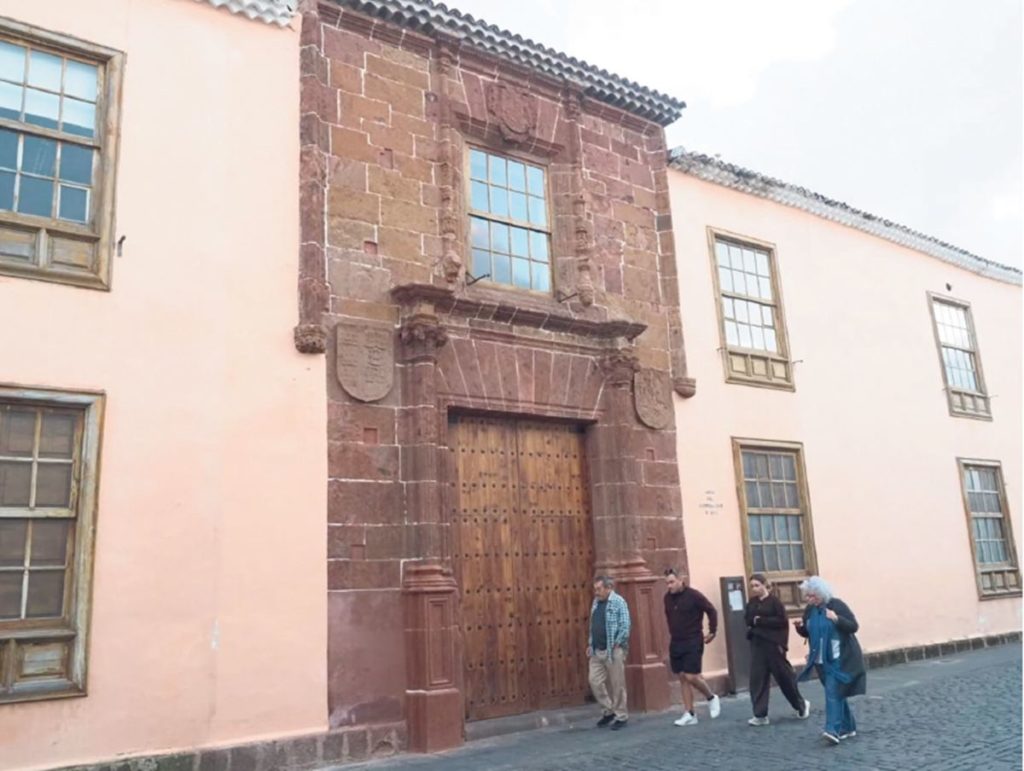
Historic Casa del Corregidor Façade Unveiled in La Laguna Following Restoration
The historic 16th-century Plateresque façade of the Casa del Corregidor in San Cristóbal de La Laguna has been unveiled following a meticulous nine-year restoration project led by the University of La Laguna.
The restoration of the Casa del Corregidor’s façade in San Cristóbal de La Laguna is more than just a building repair; it is a major achievement for Canarian heritage. After being hidden behind scaffolding for nine years, the façade—the oldest example of Plateresque architecture in the Canary Islands, dating back to the early 16th century—has finally been unveiled.
The 133,750-euro project was funded by the La Laguna City Council and managed by the University of La Laguna (ULL). A multidisciplinary team, led by Professor Fernanda Guitián and architects Fernando Saavedra and Fernando Botel, worked alongside experts in chemistry, stone analysis, and sculpture. The restoration was delicate work: the original red volcanic stone was crumbling, and past repairs using incompatible cement had caused further damage. The team had to carefully remove these harmful additions by hand to stabilize the structure.
Historically, the Casa del Corregidor was the center of administrative power, serving as the home of the royal representative on the island. The building features three significant coats of arms—those of Emperor Charles V, the city, and the Sotomayor family, who oversaw the building's completion between 1540 and 1545. To make these symbols more accessible to the public, replicas have now been placed in the building’s lobby.
The restoration followed international standards, which require that new repairs remain distinguishable from the original stone. Since the original quarries are now closed, the team created specialized mortars that match the color and durability of the volcanic rock. Additionally, the entrance has been updated with a ramp to ensure the building, which currently serves as a municipal office, is accessible to everyone.
At the unveiling ceremony, Mayor Luis Yeray Gutiérrez and ULL Rector Francisco García praised the project as a successful example of how public institutions and universities can work together to protect cultural history. By preserving this façade, the city has not only restored a vital monument but also highlighted the importance of academic research in keeping La Laguna’s architectural legacy alive.