
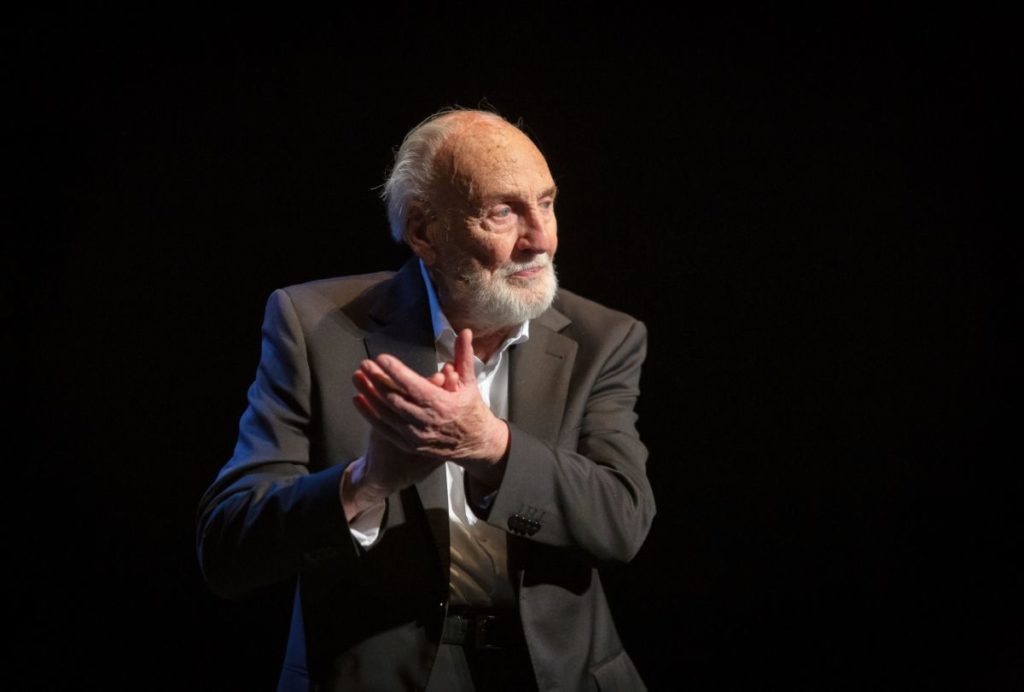
Héctor Alterio, Acclaimed Argentine Actor, Dies at 96
Acclaimed Argentine actor Héctor Alterio, a Goya of Honor recipient celebrated for his extensive career in Argentina and Spain, died yesterday in Madrid at 96.
Héctor Alterio, the acclaimed Argentine actor, passed away yesterday in Madrid at the age of 96. His family announced that he had lived "a long and full life dedicated to his family and art, remaining professionally active." In a 2024 interview with DIARIO DE AVISOS, Alterio reflected on his passionate career, saying, "The most gratifying thing is to feel the audience; I am already 94 years old and have little time left, but I have done a lot."
Just before his passing, Alterio had been planning to travel to Tenerife. He was scheduled to perform in Una pequeña historia (A Small Story) on August 8th at the Veranos del Taoro Festival in Puerto de la Cruz. This play was written and directed by his wife, Ángela Bacaicoa, with music and piano by Juan Esteban Cuacci.
Born in Buenos Aires on September 21, 1929, Alterio became one of the most celebrated actors of his time in both Argentina and Spain. He built an impressive career, earning the Goya of Honor from the Academy of Cinematographic Arts and Sciences in 2004 for his contributions.
His life took a significant turn when he was forced into exile. In the mid-1970s, Alterio went to Spain for the San Sebastián Film Festival, where he was presenting La tregua (The Truce, 1974). This film, directed by Sergio Renán, was based on Mario Benedetti's novel. La tregua was the first Argentine film ever nominated for an Oscar for Best Foreign Language Film, and Alterio starred as Martín Santomé, alongside Ana María Picchio as Laura Avellaneda.
After the festival, as he prepared to return home, his wife called with a grave warning. She informed him that the far-right paramilitary organization, Triple A, had placed him on a blacklist and that his life was in danger. Returning to Buenos Aires was no longer an option. So, in 1975, he began a new life in Spain, not returning to Argentina for another eight years.
"I couldn't return to Argentina, but there were people who helped me out of that difficult situation," Alterio told DIARIO DE AVISOS. He specifically remembered the late Spanish actor Juan Diego (1942-2022), who "moved heaven and earth" to help him get established. "I keep that among my memories, and it still helps me even today," he said. He also vividly recalled his family's arrival: "My wife arrived in Spain with my daughter Malena, just a few months old, in her arms, and my son Ernesto, about four years old, clinging to her skirt. They came to be with me during such a challenging time, to face an unknown future together."
Alterio's acting career began in 1948 with Alejandro Casona's play Prohibido suicidarse en primavera (Forbidden to Commit Suicide in Spring). After completing his drama studies, he co-founded the Nuevo Teatro (New Theater) company, which played a key role in modernizing Argentine theater in the 1960s.
Despite his stage work, Alterio gained widespread fame through cinema. He made his film debut in 1966 with Todo sol es amargo (Every Sun is Bitter), directed by Alfredo Mathé, and went on to star in many acclaimed films by emerging Argentine directors.
He was the father of actors Ernesto and Malena Alterio.
During his time in Spain, Alterio worked with notable directors. He collaborated with Jaime Chávarri on A un dios desconocido (To an Unknown God, 1977), earning him the Silver Shell at the San Sebastián Festival. Other Spanish films included Pilar Miró's El crimen de Cuenca (The Cuenca Crime, 1980) and Jaime de Armiñan's Oscar-nominated El nido (The Nest, 1980). Once he could return to Argentina, he also starred in many films there, such as Camila (1984), the Oscar-winning La historia oficial (The Official Story, 1985), and El hijo de la novia (Son of the Bride, 2001).
His final film, Due uomini, quattro donne e una mucca depressa (Two Men, Four Women, and a Depressed Cow) by Italian director Anna Di Francisca, premiered in 2015. The year before, he had appeared in Kamikaze, directed by Álex Pina.