
Garachico's 450-Year-Old Fort: A History of Pirates, Volcanoes, and a Living Warden
Garachico's 450-year-old San Miguel Castle, a former defense against pirates, now serves as a popular tourist attraction showcasing military history and unique artifacts like a gunpowder-burned 18th-century flag.
Garachico is lucky to have Tenerife's oldest fort, the San Miguel Castle. This 450-year-old building, which reached that milestone on July 25th, was built in 1575 to protect the area from pirates. Back then, Garachico was the capital and main entry point to Tenerife, thanks to its busy port.
The castle sits next to the El Caletón natural pools and is still in good shape. It needed some minor repairs after a fire in 1697. It also survived the Trevejo volcano eruption in 1706, partly because it wasn't directly in the lava's path. However, the eruption buried the port, and the castle lost its purpose as the town's protector. Garachico also stopped being one of the archipelago's most important towns.
Today, the castle is a popular attraction for visitors. Andrés Manuel Lorenzo Expósito, who works for the Town Hall and is a military history enthusiast, helps run cultural activities there. He also occasionally recreates an 18th-century guard corps. Recently, he participated in events celebrating the castle's 450th anniversary.
The castle's simple, square stone design is the first thing you notice. It's not as big as some other castles in Spain.
Andrés explains that these aren't actually castles, but fortifications. Unlike castles, the San Miguel fortification doesn't have a drawbridge, moat, or keep. This is because cannons became powerful weapons that could easily break through walls. Fortifications needed thicker walls to withstand cannon fire.
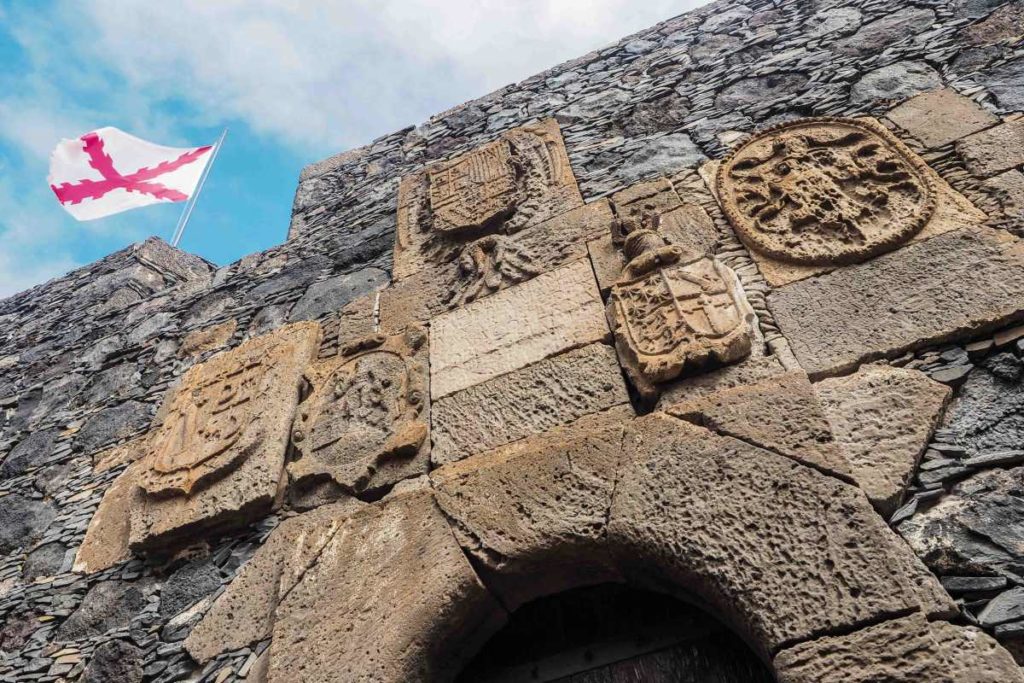
Inside, the castle has two large rooms with arched ceilings instead of a typical parade ground. One of the most interesting features is the five heraldic shields – more than any other fortification in the Canary Islands.
These shields represent important figures in the castle's history. One is from King Felipe II, who approved the construction of a larger, better-equipped fortress. The others belong to knights and nobles who helped build the castle by providing money, land, or approvals.
A narrow staircase leads to the combat platform, which offers stunning views of the volcanic landscape that created the El Caletón pools. You can also see part of the historic center and the hills above. A flag displays the cross of San Andrés, a symbol associated with the cross on which the apostle Andrew was said to have been crucified.
The original flag is kept inside the castle. It reads "Garachico regiment" and dates back to 1760. The local militias carried it during the attempted British invasion led by Admiral Horacio Nelson in 1797. According to Andrés Lorenzo, it's one of the best-preserved flags of its kind and even has gunpowder burns.
The flag is usually kept at the Military Museum of Almeida in Santa Cruz. The museum and the Bishopric of Tenerife must give permission to bring it to Garachico for display in the castle.
A militia uniform is also on display, showing the blue and red colors that were standard for Spanish Army soldiers at the time. Andrés notes that the uniforms were often leftovers from soldiers or lower-ranking regiments.
The cannons outside the castle were brought by a former mayor, Lorenzo Dorta. They were discovered during roadworks in Santa Cruz, where they had been used to reinforce the ground. These cannons date back to the late 17th century because they don't have shields, which would indicate they were older.
Three years ago, Andrés discovered that the castle had a senior warden, a position dating back to the Middle Ages. The warden was appointed by the governor to oversee the castle's defense.
The first warden, Fabián Viña Negrón, was appointed in 1579. He paid for part of the construction and, in return, was granted the governorship of the fortress for life, as well as the right to pass it on to his descendants.
However, after his death, his relatives fought over the position. The last appointment was made by the Town Hall in 1975 to Francisco Gutiérrez Hernández, who still holds the title. Andrés believes he may be the only warden in the Canary Islands and Spain. High-ranking military personnel who have visited the castle are surprised that this position still exists.
Until 1959, the castle belonged to the General Headquarters of the Canary Islands Command. Since it was no longer needed for military purposes, the entity sold it to the Town Hall for 2,719.26 pesetas. Teodoro Velázquez y Velázquez was the mayor at the time. The Town Hall made improvements and turned it into a museum and Heritage Information Center. Today, it hosts temporary exhibitions and remains a valuable piece of architecture. Andrés Lorenzo jokes that "they don't build them like this anymore. The builders back then were very skilled."