
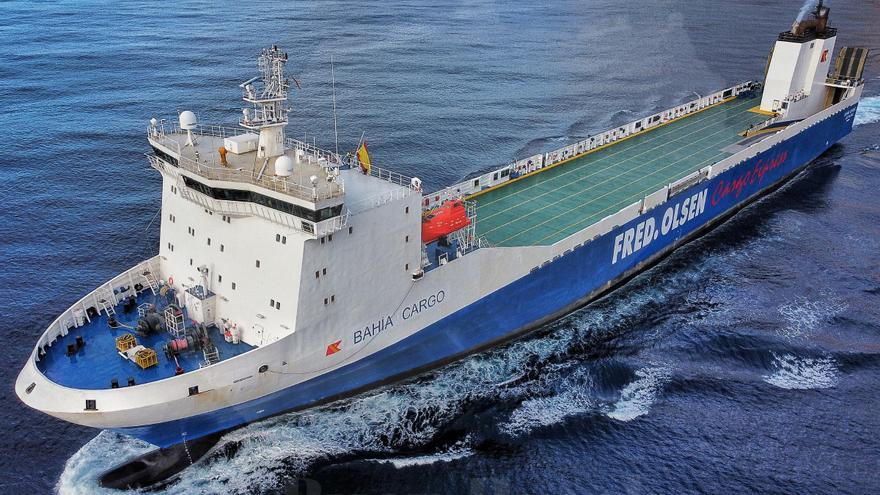
Fred. Olsen Express Cargo Marks One Year of Island Connectivity with Bahía Cargo
Fred. Olsen Express's Bahía Cargo has successfully transported over 100,000 linear meters of cargo in its first year of service, highlighting the company's commitment to reliable and efficient logistics for the Canary Islands.
The Fred. Olsen Express's Bahía Cargo has been linking the islands for a year now. Since it started on November 12, 2024, it has carried 100,700 linear meters of cargo. The ship has made 841 trips, covering 54,396 miles. This shows the shipping company's dedication to its logistics service, which began in 2024 with the purchase of two RORO ships. The service is known for being reliable, efficient, and able to adapt to the needs of island businesses.
Currently, Fred. Olsen Cargo Express uses three ships solely for cargo: Bentayga Cargo, Bahía Cargo, and Breñas Cargo. This allows the company to offer four daily sailings between Gran Canaria and Tenerife. There's also one daily trip from each port connecting Gran Canaria, Fuerteventura, and Lanzarote. Additionally, three weekly services run between Tenerife and La Palma. The company also connects the islands to the mainland, specifically to Huelva.
Juan Jesús Dionis, who heads Fred. Olsen Express's cargo department, stated that "during these first twelve months, providing excellent service has been our main focus, just as it is in all parts of our company." He noted that "bottled water is among the most frequently transported goods, with 28 tons moved. Following that are food products at 15 tons, soft drinks at 12 tons, glass containers at 5 tons, and general parcel deliveries at 2 tons."
Juan Ignacio Liaño, the fleet director for Fred. Olsen Express, commented that "the figures show steady growth in our cargo service and the trust our clients have in us. It's been a year of establishing ourselves, during which we've improved our routes and offered more efficient logistics solutions. This service is designed to ensure supplies reach the islands and to meet the unique demands of island life."
The Bahía Cargo can carry 1,800 linear meters of cargo and weighs 9,000 tons. It's 160 meters long and travels at an average speed of 20 knots. It can transport all kinds of cargo, including dangerous or oversized items. The Bahía Cargo is identical to the Bentayga Cargo, and together they handle the cargo routes for Fred. Olsen Cargo Express.
Fred. Olsen Express is the leading shipping company in the Canary Islands, providing connections between the islands for over 50 years. Its first journey was in 1974 with the Ferry Gomera, sailing between San Sebastián de La Gomera and Los Cristianos in Tenerife. Since then, the company has remained committed to advancing maritime transport in the archipelago. They are known for using modern ships and focusing on comfort, punctuality, speed, and flexibility.
Staying true to its commitment to supporting the local economy, Fred. Olsen Express employs nearly 1,000 people from the Canary Islands. The company currently operates a fleet of eight high-speed ferries, two mini-ferries, and three cargo ships. These vessels connect the archipelago across seven islands. They run seven inter-island ferry routes and one coastal route on the south of La Gomera. Additionally, they link the Canary Islands to the mainland via the route from Gran Canaria and Tenerife to Huelva.
Fred. Olsen Express is the top provider of inter-island transport. They make about 22,500 trips annually, carrying over 3.7 million passengers, 66,000 pets, 1,000,000 passenger cars, and 1,300,000 linear meters of cargo each year. This cargo volume is equivalent to roughly 100,000 freight transport vehicles. Since the company began, more than 89 million passengers have chosen their services.
In line with the UN's Sustainable Development Goals and the Canarian Agenda for Sustainable Development 2030, Fred. Olsen Express uses its 'In Harmony with the Sea' program to incorporate innovation into all its operations. This aims to reduce its environmental impact.