
Former Güímar Mayor Rigoberto González Reflects on Political Career, Teaching, and Passion for Naval Modeling
Former Güímar mayor and teacher Rigoberto González González, now retired, dedicates his time to woodworking and naval modeling while hoping for a naval museum in Tenerife.
Rigoberto González González is proud to call Güímar his hometown, having been born, raised, and served as its mayor for eight years across two terms. Before and after his time in local government, he also worked as a schoolteacher whenever his political duties allowed. Now retired from both teaching and politics, he stays busy in his home workshop, still hoping that Tenerife will one day get the naval museum it has long desired.
He became an orphan at the age of two and lost his father at fourteen. He and his sister were then raised by their paternal family. Rigoberto studied to become a teacher at the University of La Laguna, finishing his studies around 1971. His first teaching job was in the La Salud neighborhood, followed by a thirteen-year stint in Arico, where he also served as the director of the Nuestra Señora de la Luz school for five of those years. He also taught at the Hernández Melque school in Güímar until it closed. Politics eventually took over, and he left his director position in 1987 to enter municipal politics.
His first term on the Güímar City Council was from 1987 to 1991. He started as the second deputy mayor and became the first deputy mayor after Gonzalo Noda left. From 1993 to 1995, he served as mayor, though he didn't have an absolute majority. He admits that a political misstep occurred when a socialist politician, Manolo, ran with an independent group. Fourteen months later, a motion of no confidence was brought against Rigoberto, supported by the PP, CC, and Manolo.
Following that motion, he returned to teaching, not as a director, but as a regular teacher. He then returned to the mayor's office in 1999, this time in a coalition with Coalición Canaria. He describes that four-year term with Néstor Marrero and Javier Mederos as a good one. He remembers working well with leaders from neighboring towns, Domingo Calzadilla from Arafo and Rodolfo Afonso from Candelaria, to develop the industrial estate and create jobs.
Among the issues he still finds unresolved, he mentions problems with aggregate extraction. He speaks of "a decade of protests" against operations that lacked the necessary municipal licenses. He insists the City Council never issued a license and points to other authorities as being responsible for authorizing regeneration plans in the ravines.
Looking back at his time as mayor of Güímar, he highlights the development of facilities such as the post office, a covered sports hall, a wrestling ground, and an expansion of the health center. He is particularly proud of the restoration of the Church of San Pedro. When he first saw it, it had no roof. Despite limited resources, they began the work, and the town contributed significantly, with donations reaching "up to one million pesetas." He believes it is Güímar's most important monument.
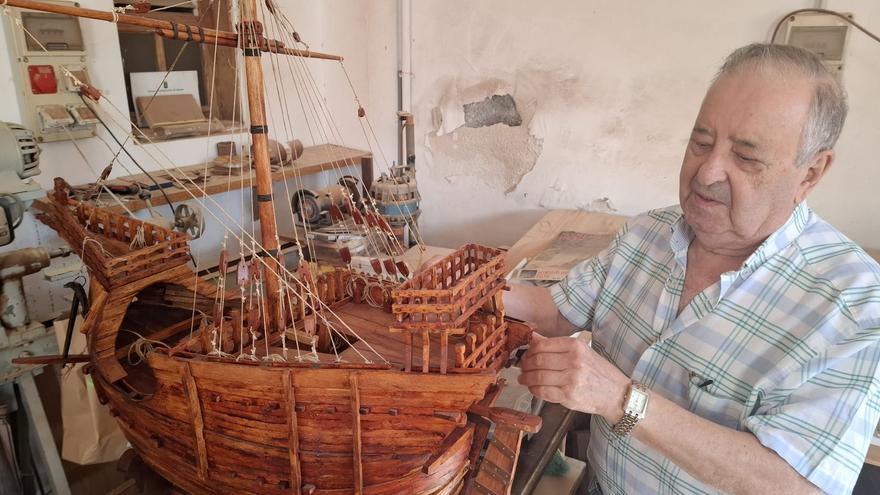
Alongside his political career, Rigoberto has a deep passion for woodworking and naval modeling, a skill passed down from his uncles who were cabinetmakers. He started working at a workbench at the age of 11 or 12. He learned to do all the carpentry for his own house, including windows and doors, when his uncle had to leave and the work was unfinished. Over the years, naval marquetry has become a significant part of his life. He has created 47 models, with Nelson's HMS Victory taking him nearly two years to complete, even including the interior details of the bathrooms. He has only sold one model. Currently, he works on institutional commissions, such as making Columbus's caravels for the Cabildo, though payment for these projects is still pending.
Public life can leave its mark. Rigoberto recounts a legal case that lasted 21 years, stemming from a complaint about a house whose construction was halted. Expert assessments later proved that the involved surveyor had followed regulations. He laments that "almost all of us were implicated" and recalls being subjected to insults and accusations of theft during that difficult period. He admits that politics is all-consuming, to the point where he had to put his marquetry aside. "You don't have the capacity for anything else," he explains.
Rigoberto is 76 years old, turning 77 in January, and he shares this with a smile. He jokes that he would never return to public service, though he did enjoy municipal politics. He does miss some aspects of his time as a teacher, especially his years in Arico. After leaving the mayor's office, he found it difficult to supervise recess in his final years of teaching, where he taught fifth and sixth grade.
He reflects that politics consumes you, but once you leave, you question why you were involved. He finds more joy now with his boats and his granddaughter, who enjoys doing small projects with him. He is currently making her a small boat to assemble together during her visits.
Before parting, Rigo, as he is known locally, offers a final thought: "Now they are paving streets that were paved 30 or 40 years ago." He adds that Güímar had its productive periods with Vicenta Díaz ("Tita"), Víctor Pérez, and himself, stating that "in three terms, what needed to be done was done."
He returns to his current reality, which brings him closer to his family and his workshop. He finds that making models requires him to read about history, and in doing so, he continues to learn.