
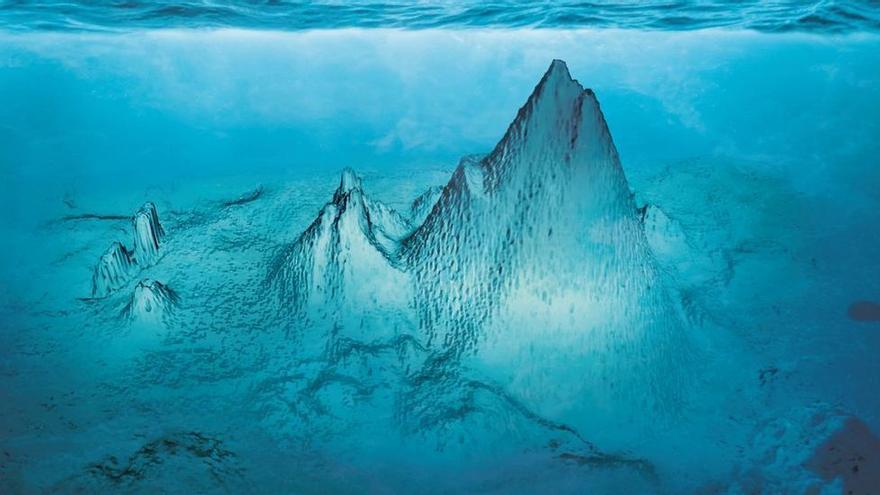
First Hydrothermal Activity Found on Enmedio Submarine Volcano
The Spanish Institute of Oceanography (IEO-CSIC) has discovered the first evidence of hydrothermal activity on the Enmedio submarine volcano between Tenerife and Gran Canaria, enhancing understanding of deep-sea ecosystems and volcanic processes.
A new study, led by the Spanish Institute of Oceanography (IEO-CSIC), has found the first evidence of hydrothermal activity on the Enmedio submarine volcano. This volcano is located more than 1,600 meters deep, between Tenerife and Gran Canaria. The discovery, published in the journal Bulletin of Volcanology, helps us better understand underwater volcanoes in the Canary Islands and how they affect deep-sea life. It's important to note that this activity is different from a volcanic eruption.
Hydrothermal activity happens when seawater seeps through cracks in the Earth's crust. It gets heated by the planet's internal warmth and then flows back out, hot and full of minerals. While this kind of activity is common in oceans worldwide, scientists hadn't studied it much on the Enmedio volcano until now, according to Eugenio Fraile, an IEO-CSIC researcher who co-authored the study.
The Enmedio volcano gets its name because it's located roughly in the middle, about 25 kilometers from Tenerife and 36 from Gran Canaria. Its base is 3.5 kilometers wide and sits between 2,140 and 2,350 meters deep, while its peak is 1,600 meters below the sea surface. Researchers found a large crack running north-south across the volcano and a dip on one side. These geological features help the hot fluids escape into the sea.
The findings, a result of teamwork with Geociencias Barcelona, the Institute of Marine Sciences, the University of Salamanca, and the University of La Laguna, confirm that these fluids are actively moving. Rafael Bartolomé, an ICM-CSIC researcher, pointed out that this hydrothermal activity directly affects the chemical and biological processes in the deep ocean around these islands. Adelina Geyer, a GEO3BCN-CSIC researcher, explained that rock samples from the area show changes, with lots of iron oxides and tiny thread-like structures. These suggest biological activity common in cooler hydrothermal spots.
It's important to stress that this activity does not mean a volcanic eruption is about to happen, nor is it linked to the recent small earthquakes recorded in Las Cañadas del Teide. This study is important because underwater volcanoes, which make up most of the world's volcanic activity, play a key role in global nutrient cycles, marine biodiversity, and how the deep ocean works overall.
The research was part of several projects led by the IEO-CSIC. It used data gathered during ocean trips on the ships Ángeles Alvariño and Sarmiento de Gamboa.