
Europe's Longest Cave Unearths Unique Species, Ancient History
Tenerife's Cueva del Viento, Europe's longest volcanic tunnel, is a 27,000-year-old biological hotspot and fossil site, revealing unique cave-adapted species, ancient animal remains, and Guanche artifacts.
The Cueva del Viento, or Cave of the Wind, in Icod de los Vinos, is an incredibly important site with a history spanning over 27,000 years. It's the sixth-longest cave in the world and the longest in Europe, stretching 18.5 kilometers. What also makes it special is its complex, maze-like structure with multiple levels and connected tunnels.
This volcanic tunnel was formed by lava flows from the Pico Viejo volcano. It's also a biological hotspot, home to many unique cave-dwelling animals. These species are perfectly adapted to life inside the cave. Some are found only in Tenerife, and others are unique to this specific cave system. Esther Martín González, a paleontology and geology expert at the Museum of Nature and Archaeology of Tenerife (MUNA) and the cave's scientific director, explains this.
In total, 190 species have been identified in the cave, with 44 of them being cave-dwellers.
According to the Cueva del Viento's official website, "among these species that must live in darkness, 15 have been new discoveries for science, such as the eyeless cockroach Loboptera subterranea or the ground beetles Wolltinerfia martini and Wolltinerfia tenerifae."
The expert notes that all species living here are remarkable because they have adapted to extreme conditions, such as losing their eyesight.
This makes sense, as the underground environment is defined by complete darkness, very high humidity, and a constant temperature. Food is scarce, so adapting to find sustenance is crucial. Over time, evolution means getting rid of organs that aren't needed.
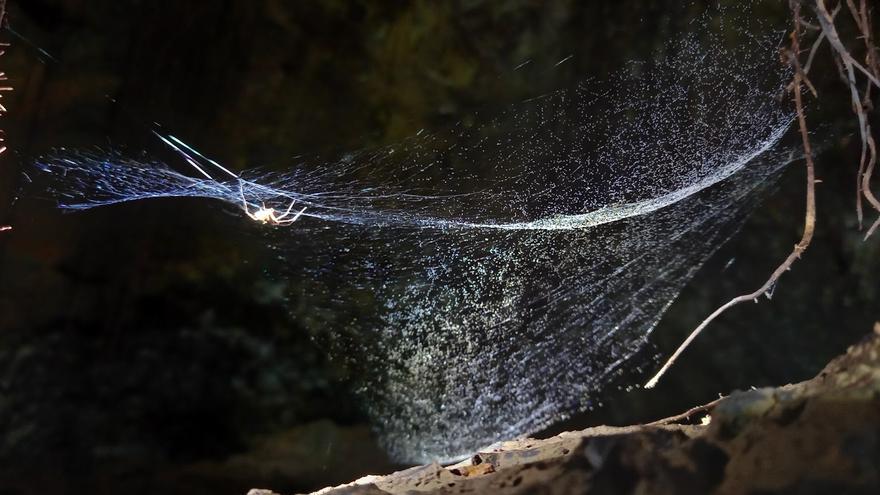
Among all the animals in the cave, Esther Martín finds spiders particularly interesting due to their wide variety and how well they've adapted.
For example, there are several species of dysdera spiders both inside and outside the cave. However, those that have evolved inside tend to be much lighter in color, have lost their pigmentation, and can no longer see.
Their joints and antennae are also typically longer than those of spiders living outside. "These are adaptations to total darkness," the expert explains.
Another key feature of the Cueva del Viento is that it's an excellent place for fossils. Martín explains that the "very stable environmental conditions" mean that "fossil remains are preserved very well." In fact, remains of the giant rat and giant lizard of Tenerife have been found inside, along with small birds that had lost the ability to fly.
Esther Martín also highlights the discovery of houbara remains. This bird species is now found in Lanzarote and Fuerteventura, but it's known to have once lived in Tenerife.
Beyond animal remains, the volcanic tube has also yielded artifacts from Guanche history.
The cave's first discoverers in the 18th century found aboriginal items like pottery and tools.