
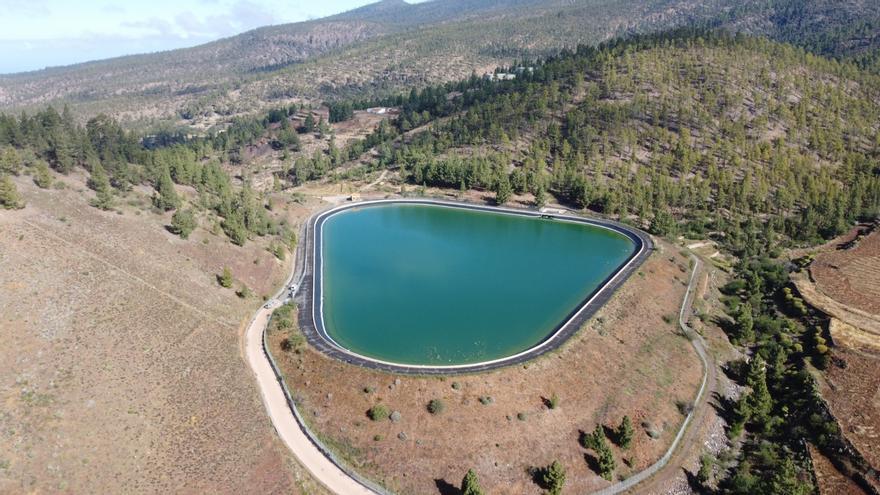
Tenerife exits the drought emergency but risks remain for farmers.
Tenerife ends the water supply emergency with the best reservoir filling levels in three years, but farmers still risk facing water shortages by the end of 2025.
Tenerife is still suffering from drought, although not as severely as before. The water emergency ends on October 31. At the end of September, the island's reservoirs are 28% full. This is the best figure in the last three years, but the risk to agriculture remains until the end of 2025.
Compared to last month, there is 8% less water (from 1,748,355 to 1,410,383 cubic meters). The last time the situation was normal was on October 1, 2022, when the reservoirs were 35% full (1,764,413 cubic meters).
The drought is still felt, but not as much as last year, when there were only 950,863 cubic meters of water in the reservoirs. Thanks to hydraulic engineering works and other measures taken during the emergency, it was possible to survive a difficult summer. But the emergency ends on October 30 and will not be extended. Although the reservoirs are 28% full, which is the best figure in three years, farmers still risk running out of water for irrigation until the end of 2025.
This 28% means that there is almost 9% less water than in August, despite the authorities' efforts to provide farmers with water. At the end of August, the reservoirs held 2,392,136 cubic meters of water. That is, between July and August, there was almost 13% less water. And this trend continues.
The rains in March and April helped to build up supplies for the summer, but now we need to hope for rain again in the autumn to replenish water supplies. The hydrological year (from October 1, 2024 to September 30, 2025) was not very successful.
October 2025 begins with 1,410,383 cubic meters of water in the reservoirs, which have a total capacity of 5,043,692 cubic meters. The authorities believe that this is the best figure in the last three years. But the problem is that this figure is still quite low compared to previous years.
The Councillor for Agriculture, Valentín González, says that "thanks to the measures taken during the emergency, we were able to provide farmers with water for irrigation this summer." He also added that the situation is "optimistic for the autumn, as there are water reserves."
He emphasized that "usually, from October onwards, water consumption for irrigation decreases significantly due to lower temperatures. This allows the reservoirs to replenish until spring." And he added: "Of course, if there is rain." It is important that there is rain, and that there is no heat. The beginning of the month is not very encouraging, as the Azores anticyclone is blocking the arrival of cyclones from the Atlantic.
In the northeast area (La Laguna, Tegueste and Tacoronte) there is almost 50% more water than last year. In the Icod-La Guancha area, there is 24% more water. In the south (Las Galletas-Valle San Lorenzo), the reservoirs are 23.3% full, which is more than 17% in 2024. In the Vilaflor area, the reservoirs are 20.8% full, which is 12.4% more than last year. Overall, in the north, the reservoirs are 30.6% full, while in the south, they are only 23.2% full (reclaimed water) and 22% (clean water from wells).
The water emergency was declared on May 29, 2024 for six months. In November, it was extended for three months (until the end of February), and then for another eight months (until the end of October 2025). The Island Drought Bureau will meet on Tuesday, which has not met for four months (since June 13).