
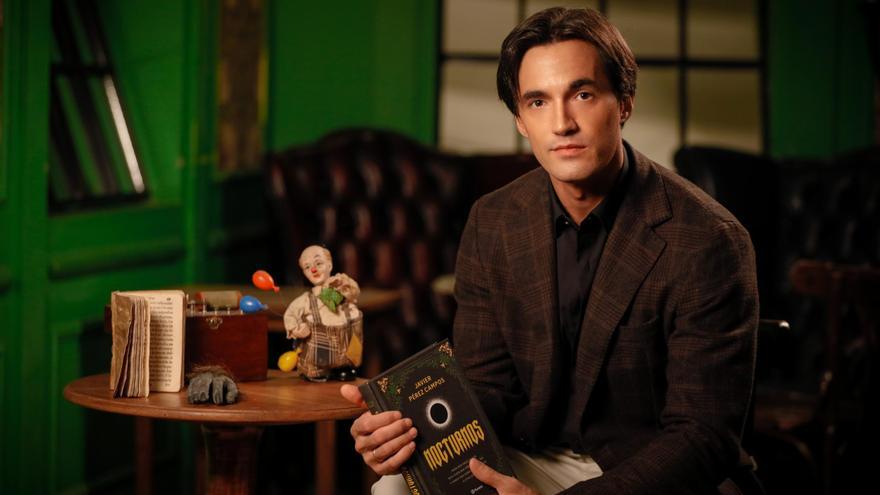
"Cuarto Milenio" Writer Javier Pérez Campos Unveils "Nocturnos," Explores Nighttime Fears
Spanish mystery writer Javier Pérez Campos, known for his work on TV and online, will discuss his new book "Nocturnos," a collection of nocturnal explorations, at the Casa de la Parra Cultural Space in Los Realejos this Tuesday.
Javier Pérez Campos, born in Ciudad Real in 1989, has spent over a decade exploring mysteries in his writing. You might know him from TV shows like "Cuarto Milenio" and "Horizonte." He also connects with fans online, boasting 29,000 followers on Instagram.
This Tuesday, he'll be at the Casa de la Parra Cultural Space in Los Realejos at 8:00 p.m. to talk about his new book, "Nocturnos" (published by Planeta). He wrote the entire book at night. "That's why I suggest readers read it at nightfall, in a quiet place and, if possible, alone," he says at the start of an interview. They also discussed Halloween, scary clowns, and the recent time change: Could this be the last time Spain changes its clocks?
"I wrote it feeling like a kind of 'bat writer' and I hope the readers are also a bit nocturnal [laughs]."
He focuses more on mystery than outright fear. "Humans are drawn to nighttime because we see it as dangerous. 'Nocturnos' explores this: Why are we so afraid of the night? Why do we feel so vulnerable? Why did so many characters in the book act in the dark while everyone else slept?"
"In some cases, yes [silence]. Our survival instinct connects us with a very sharp sense, something that has been the case for thousands of years... You only need to feel harassed by a predator, which usually goes out hunting at night, for fear to enter the body. Who hasn't ever heard a creak or a noise that has kept them awake all night? That happens during the day and goes completely unnoticed, but at night it's another story."
"Controlled fear has been in our lives since we were children, just when our parents told us the story of Hansel and Gretel [work by the Brothers Grimm, 1812] before we went to sleep. It was an unreal risk, very similar to the one that surrounds the night."
"Yes, something associated with fear that helps us learn that there are roads that we cannot take as soon as daylight fades or phone calls that we should not answer in the early hours of the morning... Nocturnos is a manual to avoid the dangers of the night."
"It has a very brief instruction manual in which I explain how to read it. You just have to do it at nightfall. It is a catalog of beings that have been woven for many centuries of darkness. What I propose to readers is a journey through the night and darkness."
"Nocturnos" even includes a chart showing how many hours of daylight there are each month. "If you look at the November section, you'll see when it gets dark and when the sun comes up in a few days... Be warned! We're entering the darkest and most dangerous time of year. The sun is further away, and light is scarcer. Many cultures believe that the line between the living and the dead becomes thinner at the end of the year. It starts with Halloween, but soon we're at Christmas."
"Many psychologists have looked into why so many people are afraid of clowns. Some phobias make sense, like fear of heights or predators, but it's strange to fear someone who just wants to make kids laugh. One study suggests that coulrophobia, the fear of clowns, is very common. Some people blame Stephen King, whose "It" is back on HBO. The novel, inspired by serial killer John Wayne Gacy (who dressed as a clown to kidnap and torture young people), portrays clowns as evil and terrifying. He had the basement of his house, where he lived the normal life of an almost model neighbor, full of corpses of boys who disappeared in the middle of the darkness."