
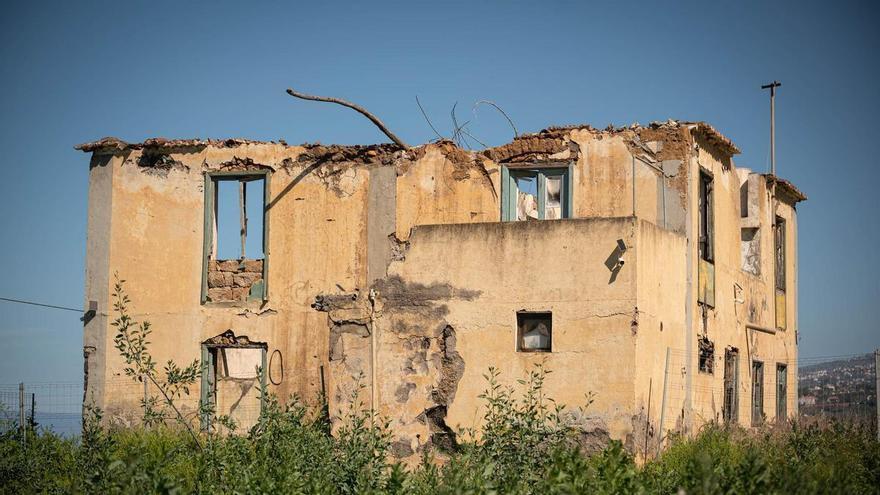
Council Orders Repairs for Decaying Casa Amarilla Scientific Landmark
The dilapidated Casa Amarilla in Puerto de la Cruz, a historically significant site of Wolfgang Köhler's groundbreaking chimpanzee experiments, faces an uncertain future despite a council order for urgent repairs and renewed calls from the scientific community for its full restoration.
The Casa Amarilla, a building in Puerto de la Cruz, is back in the spotlight. Declared a site of cultural interest in 2011, it's known as one of Europe's most important scientific locations from the 20th century. The local council's Urban Planning department has now ordered the owner to carry out urgent repairs and conservation work to stop the building from falling apart. This move has reignited a call from the scientific community that has been going on for decades.
Between 1913 and 1918, German psychologist Wolfgang Köhler conducted groundbreaking experiments with chimpanzees at this Canarian house. His work changed how we understand animal intelligence. Köhler showed that great apes could solve problems not just by trying different things until something worked, but through a sudden understanding, or "insight." This discovery proved that chimpanzees could reason, narrowing the gap between human and animal minds. It also helped establish Gestalt Psychology and put Tenerife on the world's academic map. Professor Hipólito Marrero from the University of La Laguna (ULL) highlights the importance of these studies, which supported evolutionary theories and challenged the idea that only humans possessed higher mental abilities.
Despite its historical importance, the Casa Amarilla today has no roof, its walls are exposed, and it's steadily falling apart. Architect Pedro González, a supporter of the property's preservation, warns that while it doesn't look like it will collapse soon, the decay is getting worse. He says the walls need to be strengthened and the roof rebuilt to save it. The biggest hurdle is that the property is privately owned. While its status as a cultural asset protects its historical value, it doesn't automatically require a full restoration; that depends on the owner. The Daltre group has now bought the land and plans to build a hotel complex nearby. The owner has removed previous occupants, secured the site (which had been a squat), and promised to submit a technical plan for maintenance. However, the building's long-term future is still unknown.
The call to restore Casa Amarilla is not new. Professor Marrero notes that people have been asking for its rehabilitation for over forty years. In 2016, a group including the Consortium for the rehabilitation of Puerto de la Cruz, the ULL, and the Cabildo de Tenerife even suggested building a Neuroscience Center on a nearby council plot. This center would have been linked to Köhler's work, hosting conferences, attracting international researchers, and highlighting the area's scientific past. Academic groups in Germany and England showed interest, but the project never went ahead.
Both Marrero and González believe the council's recent order is a necessary first step, but not enough on its own. They caution that without clear leadership from institutions and public funding, it will be hard to move forward with a proper plan for Casa Amarilla. For now, what was once the world's first center for studying primates remains largely unknown to most people. González and Marrero point to the lack of public and academic awareness as proof of how little its huge historical and scientific importance is recognized.