
Christmas Lottery Fifth Prize: Document Shared Tickets to Prevent Disputes
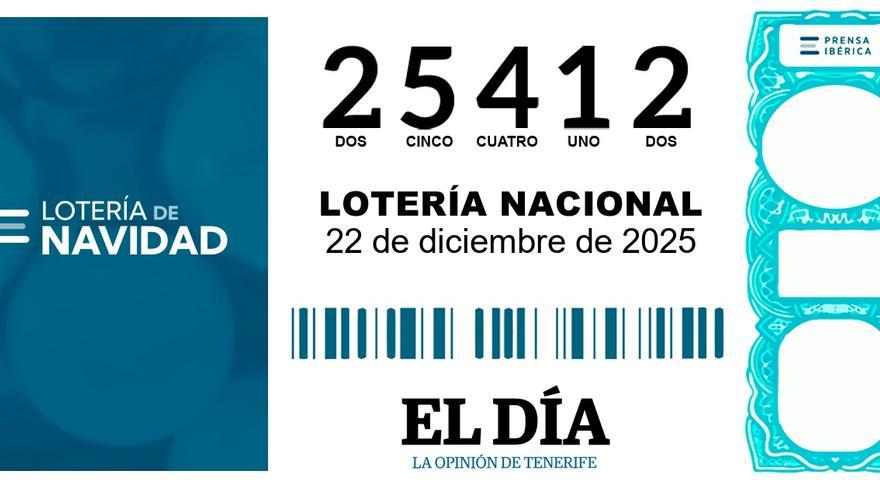
The number 25412 won a fifth prize of 60,000 euros per series in the 2025 Spanish Christmas Lottery, with winning tickets sold in Madrid, Malaga, Almeria, Salamanca, Morón de la Frontera, Zaragoza, and Maracena.
The number 25412 has won the fifth prize in the 2025 Christmas Lottery. This winning number was sold in Madrid, Malaga, Almeria, Salamanca, Morón de la Frontera, Zaragoza, and Maracena. It pays out 60,000 euros per series, which means 6,000 euros for each ticket.
The announcement of El Gordo, the top prize, took place at 10:45 AM (Canary Islands time). This traditional draw was held at the Royal Theatre in Madrid, where children from the San Ildefonso school sang out the winning numbers, as is customary. The event was broadcast live by EL DÍA.
Every year, the Spanish Christmas Lottery Draw brings excitement to thousands of people across Spain, who often share tickets. Whether among friends, family, or co-workers, this long-standing tradition can create unforgettable moments if luck is on their side. However, it can also lead to legal disputes if basic precautions are not taken.
While sharing a lottery ticket might seem informal, the risk of misunderstandings grows significantly if a large prize is won. For this reason, both the Organization of Consumers and Users (OCU) and the National Police stress the importance of putting any sharing agreements in writing.
The first thing to understand is that a lottery ticket is a bearer document. This means that, in principle, the prize is collected by whoever physically holds the ticket. If that person decides to keep the entire prize without any proof that it was meant to be shared, the other participants could end up with nothing.
The OCU's advice is clear: if you share a lottery ticket, make a photocopy for each person involved and have everyone sign it. This simple step can prevent numerous legal problems and ensures that all participants are protected in the event of a prize.
In the digital age, many people share photos of lottery tickets via WhatsApp or email. This method can serve as valid proof. The National Police recommend that the ticket holder sends a clear image of the ticket with all visible details and the names of the participants. It's also wise to save these messages in case they are needed for legal proceedings.
The OCU points out that while these messages can be used as evidence in court, they can also be disputed if manipulation is suspected. Therefore, in sensitive situations, an expert report confirming the authenticity of the evidence can strengthen its validity.
If you buy a ticket online, the electronic receipt issued by the platform has the same legal value as a physical ticket. Platforms like Loterías y Apuestas del Estado provide detailed receipts that clearly show the number played and the buyer's information.
If a ticket wins, it's crucial to follow certain steps to avoid misunderstandings and tax issues. Failing to identify all participants can have serious tax consequences. If the ticket holder distributes the money later without proper justification, it could be seen as a donation, which means donation tax would have to be paid.
Furthermore, the Tax Agency automatically taxes 20% of any prize money exceeding 40,000 euros. For example, if a ticket wins El Gordo (400,000 euros), the first 40,000 euros are tax-free, but the remaining 360,000 euros are taxed, which reduces the actual amount received.
One of the most common scenarios for conflict involves relationship breakups. If a couple wins the lottery and disagrees on how to divide the prize, the situation can become very complicated.
In any case, the recommendation remains the same: document it in writing.
Occasionally, a disagreement can lead to lawsuits. One notable case occurred in 2019, when the Supreme Court acquitted a woman accused of keeping a winning ticket worth 1,170,000 euros for herself. The woman had distributed several tickets among colleagues, but there was no clear agreement on how to divide the prize money. The court concluded that, due to insufficient evidence of a specific agreement, it could not be considered a crime.