
Candelaria Unveils Canary Islands' Largest Mural
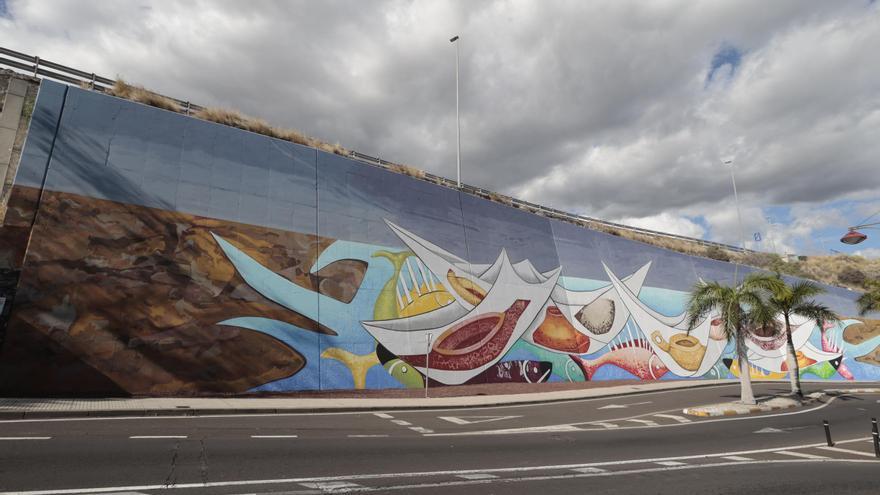
Candelaria now boasts the Canary Islands' largest mural, a 1,100-square-meter artwork based on Pepe Dámaso's 2004 designs, located at the town's main entrance.
Candelaria is now home to the largest mural in the Canary Islands. You can find it at the main roundabout leading into the town, on one of the retaining walls of the TF-1 Highway. This roundabout directs traffic towards Plaza de Teror and Santa Ana. The mural, which covers an impressive 1,100 square meters, is based on original designs by Canarian artist Pepe Dámaso. Its huge size makes it one of the biggest public murals ever created that is linked to Dámaso's work.
The mural draws its inspiration from sketches Pepe Dámaso made in 2004. Back then, he envisioned a series of images representing pilgrimage, fishing, and pottery for the town's entrance, but the project never happened until now. Alejandro Tosco directed the project, while mural artist Irene Morales and her colleague Roy Reta brought it to life. They carefully respected Dámaso's original vision, adapting it to suit the massive scale and urban environment.
Irene Morales described the process as long and complicated. "The proposal reached me in January, but they have been working on the project for years," she explained. For a long time, it was uncertain if the mural would ever be created, but approval finally came in September. Painting began on the highway wall on September 22nd, and the mural was completed and presented to the public on December 18th.
The team faced several challenges while working on the mural, both technical and weather-related. For instance, the lifting machine they used to reach the upper parts of the wall broke down, meaning they could only paint from the ground. They also battled bad weather, including strong winds and rain. "They delayed us quite a bit, and it was a struggle," Morales said, "but we achieved it, and we are very happy and proud of the final result."
The design itself also changed from the initial plans. "The sketch that is depicted is not the initial one," Morales revealed. The first idea used the white of the wall as part of the design, playing with the empty space. However, they decided to change it, opting instead to fill the entire wall. Morales stressed how important it was to adapt the artwork to create a strong visual impact on such a large surface at a main entrance to the town.
Ensuring the mural's long-term durability was another crucial part of the project. This meant using special materials and techniques. "The most important thing is the base; once we have a good base, the material lasts," the artist explained. She also highlighted the expert advice they received to choose paints suitable for the local climate and the mural's exposed location. Despite its size, the painting was done by a small but well-coordinated team: "We always had two people painting and two others providing support."
This mural brings to life a project first envisioned over twenty years ago. It has strong ties to Pepe Dámaso's 2004 work, "La luz del Peregrino" (The Pilgrim's Light), which was also inspired by Candelaria. In 2023, the City Council purchased the mural's sketches and several other pieces from this collection for 30,000 euros. They also secured the exclusive rights to use the artwork. This acquisition solidifies an important artistic legacy, now prominently displayed at one of the town's busiest entry points.