
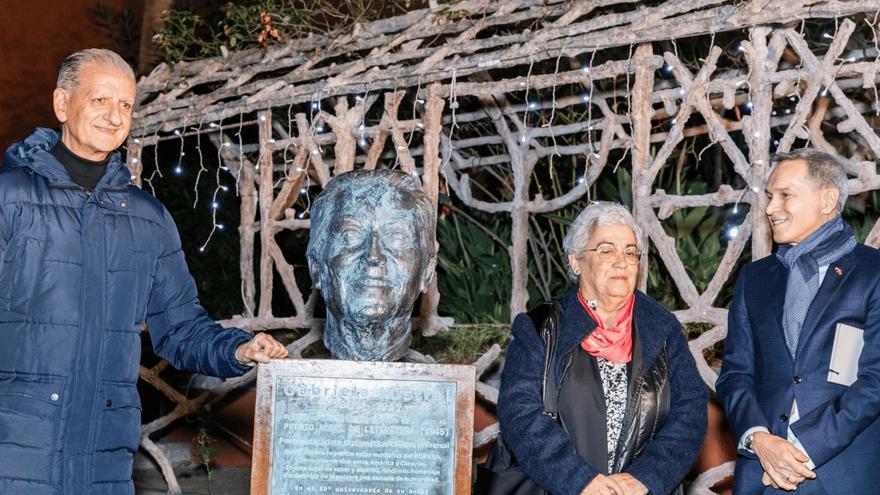
Canary Islands Unveil Mistral Bust, Propose Chile Valley Twinning
A bust of Nobel laureate Gabriela Mistral was unveiled at the Liceo de Taoro in the Canary Islands, marking 80 years since her Nobel Prize and initiating a cultural dialogue to symbolically twin the La Orotava Valley with Chile's Elqui Valley, her birthplace.
The unveiling of a bust of Gabriela Mistral at the Liceo de Taoro on December 10 was more than just a tribute. It was held to mark 80 years since the Chilean poet won the Nobel Prize in Literature in 1945. But it also sparked a new cultural conversation between the Canary Islands and Chile, inspired by a unique idea: linking the La Orotava Valley (Canary Islands) with the Elqui Valley in Chile, where Mistral was born, both geographically and culturally.
The bust, created by Puerto de la Cruz sculptor Francisco Hernández Díaz, was unveiled during an official and cultural ceremony. It took place on the main staircase of the Liceo de Taoro, a busy area that will now permanently feature the poet's image. Mayor Francisco Linares García of Villa de La Orotava, Carmen Leyes Trujillo (President of Liceo de Taoro), and Rafael Montero del Pino (Honorary Consul of Chile in Santa Cruz de Tenerife) jointly unveiled the bust. The sculptor himself and other guest speakers were also present.
During the event, Candelaria Pérez Galván, an expert on Mistral's writings, shared an idea that shaped the day's discussions: the two valleys share symbolic and landscape similarities. The La Orotava Valley, with its Atlantic and volcanic character, and the Elqui Valley, Andean and bright, both connect deeply with nature, silence, words, and spirituality. These themes are central to Gabriela Mistral's poetry, going beyond just their physical geography.
Adding to this, writer Fuensanta de la Cruz, who came from Fuerteventura for the event, spoke about Mistral's literary and personal life. She emphasized how relevant Mistral's words still are and how they inspire modern creative work, particularly for women.
After these talks, the idea was put forward for the Liceo de Taoro to lead a cultural trip to the Elqui Valley. The goal would be to officially 'twin' the two valleys, not just as places on a map, but as shared cultural landscapes. This twinning would link two regions on the edges of their respective continents, both open to the world through reflection and literature. It would also strengthen the long-standing human and historical connections between the Canary Islands and Chile.
Also suggested was a new poetry contest, held annually around the date Mistral received her Nobel Prize. This would keep the cultural conversation going and give a platform to new poets, especially young ones.
The event began with a moving musical performance by Canarian musician Joséle del Pino. Known for playing the timple, he instead used a contra – a larger, traditional plucked string instrument. Its warm, deep sound set a reflective and beautiful tone for the start of the day.
The day felt like a founding moment, connecting the past with hopes for the future. The bust of Gabriela Mistral isn't just a memorial; it's a living symbol. It will be part of the Liceo's cultural life, a reminder that words can build bridges across coasts, mountains, and oceans.
Now, Gabriela Mistral's figure stands at the entrance of the Liceo de Taoro, marking the start of this dialogue. It's a conversation between two valleys far apart geographically but close in spirit – two places that, through poetry, see each other as sisters.