
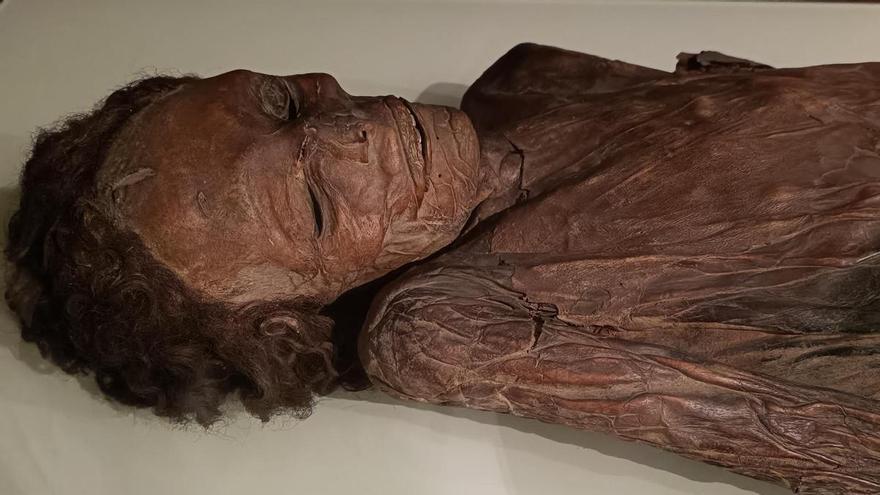
Canary Islands Threatens Legal Action Over Repatriation of Ancient Guanche Mummy
The Canary Islands government is threatening legal action against the Spanish Ministry of Culture over the continued failure to repatriate an 850-year-old Guanche mummy currently held in Madrid.
Tensions are rising again between the Canary Islands government and the Spanish Ministry of Culture over the management of historical heritage. As reported by El Día, the regional government has stepped up its pressure on the state following a lack of response regarding the return of a 850-year-old Guanche mummy currently held at the National Archaeological Museum (MAN) in Madrid.
Miguel Ángel Clavijo, the Canary Islands' Director General of Cultural Heritage, has formally demanded a report on the mummy’s condition, a technical inspection, and an official meeting to move forward with its repatriation. The regional government has even suggested it may take legal action if the state continues to ignore its requests.
The mummy, an adult male measuring 1.62 meters, was sent to Madrid in the 18th century as a gift for King Charles III. Since 2015, it has been on display at the MAN. The Canary Islands government argues that, under the principle of cultural heritage unity, they should have authority over the protection and management of these archaeological assets. Although Culture Minister Ernest Urtasun previously promised to support the transfer, little progress has been made.
The regional government believes the Museum of Nature and Archaeology (MUNA) in Tenerife is the appropriate home for the remains, as it has the specialized facilities required for their preservation. The archipelago has successfully repatriated other human remains in the past, including those returned from Argentina in 2003 and the Complutense University of Madrid in 2011. However, the central government has remained silent on this latest request, failing to provide information on how the remains are currently being stored and cared for.
This dispute highlights a broader conflict between decentralized cultural management and the slow pace of state institutions. While MUNA currently displays a replica of the mummy, local authorities are determined to end a relocation process that has spanned more than two centuries. For the Canary Islands, the return of the xaxo is not just about archaeology; it is a matter of identity and the need for clear, respectful protocols regarding the handling of ancestral remains.