
Canary Islands Rescue Teams Face Extreme Dangers
The Canary Islands Government's Emergency and Rescue Group (GES) conducts perilous air and sea rescues using powerful helicopters and highly trained teams, often facing extreme conditions and the emotional toll of saving lives, with costs sometimes passed to those rescued due to recklessness.
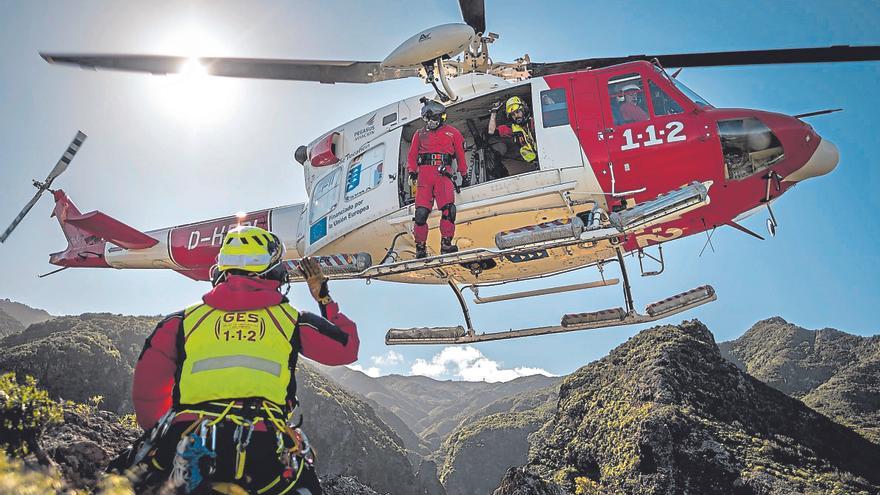
The powerful engines of the Bell 412 EP helicopter create strong currents that stir everything below its rotors, like a mini-tornado. This makes circular, rainbow-colored waves in the sea. The force is so strong that people nearby must wear helmets to protect their eardrums.
On a clear, windless morning, the sun shines brightly on the green areas in the north, left by recent rains, and on the snow covering Mount Teide. Even in these perfect conditions, which aren't always available, the rescue operations are very difficult. The crew must land on steep cliffs or hover in the air, like a hawk hunting, to complete a rescue.
To truly understand the dangerous work they do, you just need to join the professionals from the Canary Islands Government's Emergency and Rescue Group (GES) during one of their weekly training sessions. Even with regular training and their team's experience, unexpected problems always arise. These can include strong winds in ravines, loss of power at high altitudes, or the vulnerability of the person being rescued, who suddenly finds themselves hanging from a steel cable up to 75 meters in the air before being pulled into the helicopter. And, of course, there's the adrenaline.
The GES is one of the most vital emergency teams in the Canary Islands. They have bases on all islands except Lanzarote and a staff of 82 people. This includes 26 pilots, 12 hoist operators, 26 rescuers, two air coordinators, 12 mechanics, three coordinators, and a service chief.
At the Tenerife base in La Guancha, 49-year-old Gabriel Pérez, a coordinator and pilot from Gijón with military experience in Lebanon, explains why the GES is so adaptable and crucial. "We use a very powerful and flexible helicopter that can perform land and sea rescues in many different situations," he says. "We also help fight fires, move equipment and people, control pollution, and search for missing persons."
The white and red helicopter can reach the most remote areas very quickly. During the training for this report, it moved easily between the rocks of the Los Silos highlands and the cliffs near San Marcos beach in Icod. Using traditional methods, by land or sea, it would have taken hours to reach these spots. By helicopter, it takes no more than 20 minutes.
The Bell 412 EP, with a capacity for 15 people and able to lift 5,400 kilograms, is well-equipped. The one in Tenerife, known as M-41, carries a rescue hoist, a first-aid kit, a stretcher, flotation devices for sea rescues, a mobile phone locating system, an infrared and normal camera that sends live data and images, and even a helibucket for dropping water on fires.
Above the Teno massif, the helicopter hovers just a few centimeters from a ledge to drop off a rescuer during a stretcher hoisting drill. Communication becomes intense among the five crew members: pilots Gabriel Pérez and Hugo Asensio, hoist operators and rescuers Juan Ramón Alfonso and Michael del Castillo, and rescuer Diego Ferrero. Over the radio, you hear phrases like, "Hook in," "Checks. Request permission for stretcher," "Passing hook to rescuer," "Stretcher procedure ready," "Preparing hook," "Left clear but don't bring in the tail," "Rescuer out the door," "Lowering rescuer. 20 feet, 30... Hold, right clear. Fluctuating a lot. Stop right. Rescuer on the ground, hold... Tail clear. Hoisting hook. Got it..." Only they fully understand this specialized language.
After several turns, with the stretcher and rescuer safely inside, the helicopter heads back to the La Guancha helipad. Now more relaxed, Hugo Asensio, a 49-year-old pilot from Tenerife who served with Gabriel Pérez in a military helicopter unit and on a peace mission in Lebanon, points out pigeons to the right and comments on the excellent weather. "Look at that little house over there," he says, pointing. "It's amazing how it could have been built on such a steep ravine."
In real rescue operations, there's usually no time to relax. And there are many such operations throughout the year across the Canary Islands. For example, in 2025, they rescued 244 people (201 on land and 45 at sea), carried out 328 services (212 land rescues, 111 sea rescues, and 5 firefighting operations), and flew for 411 hours.
Although they report to the regional government's General Directorate of Emergencies, these life-saving helicopters are actually operated by a private company, Pegasus Aviación. The regional government pays them 10.5 million euros annually. The current contract ends in 2027. While the government is happy with the service, there are still some improvements planned.
It's clear that these professionals risk their lives because they are dedicated to their work. This dedication is evident even in their training exercises, where they follow strict procedures. Every drill requires a flight plan, equipment checks, coordination with Tenerife North airport and the 112 emergency center, and a thorough review of safety measures. This is especially important when a journalist and photographer are with them to document their work: following crew instructions, staying clear of the rotors, covering eyes and securing belongings when engines start, fastening seatbelts and safety harnesses, and knowing where emergency exits and first-aid kits are.
During the briefing, Gabriel Pérez and Hugo Asensio emphasize the importance of constant training. "Because these operations are so demanding, the teams must always be ready, and coordination must be perfect," they explain. "This is achieved through continuous training. Each person has their role, but everyone must understand what others do." They add, "Every second is vital, but we must act without rushing because safety, for both those being rescued and the rescuers, is most important."
That's why everything is carefully planned, simulating different situations they might face: "red 1" for the first communication, "red 2" for starting the operation, "red 3" for arrival and assessing the area, "red 4" for finding and rescuing the person, and "red 5" for returning to base. This is also why regulations require each team member to rest 20 minutes for every hour of flight.
Their missions are varied: injured or lost hikers in dangerous areas, paragliders, cyclists, missing persons, fires, and even transporting medical supplies, as they did during COVID. At sea, they rescue surfers, fishermen, and tourists swept away by rogue waves.
Some operations are unforgettable, especially those involving children. No matter how often they happen, they always leave a lasting sadness. For example, in 2024, a wave swept away a child and his father in Rojas (El Sauzal). Asensio remembers, "When we arrived, we saw the father's body floating and the son calling for help." He adds, "We went for the child, but we never saw the father again."
Juan Ramón Alfonso, a 43-year-old hoist operator and rescuer from Tenerife with 14 years in the GES, says that empathy is crucial in these critical moments. "The person affected is someone who went out to enjoy an activity, got into trouble, and suddenly finds themselves being lifted by a cable into a helicopter in a stressful and sometimes painful situation." He explains that the advantage is, "there's so much adrenaline that usually the person just wants to be taken out of there by any means necessary." "When do problems arise? When the person still has strength and is conscious. Sometimes you have to negotiate, like when a surfer wants to save their board. And that's not possible."
Michael del Castillo, a 41-year-old rescuer and operator from Tenerife with 11 years of experience in the GES, recalls the phrases they repeat most often. "They will always feel the rescuer's support. 'Calm down,' 'you're safe now,' 'everything will be alright,' we tell them. They don't fully understand what's happening, but we are there to bring them calm and security."
Another islander in the group, Diego Ferreiro (rescuer, 37 years old, 11 years in the GES), notes that "there's a bit of everything." "Some let themselves be carried, others you tell not to grab something and they grab it, some break down and cry, some stay silent and say nothing... You never know how they will react."
The helicopter takes off again for sea training. It uses seven liters of Jet A-1 fuel per minute, the same fuel airplanes use. Each liter costs between 0.5 and 0.8 euros. They lower Diego Ferreiro, dressed in a wetsuit this time, on the hoist cable near the cliffs of Icod. The waves crash fiercely. A lone fisherman watches in amazement from his small boat, rod in hand. Michael del Castillo descends to 'rescue' him, guided by Juan Ramón Alfonso, who stays with the hoist. Gabriel Pérez has no free limb: he uses his feet for the pedals (to move the nose), his right hand for the cyclic stick (for direction), and his left hand for the collective (for power and lift).
One common question among GES members often comes up: when the rescued person, especially foreign tourists, rubs their thumb and index finger together. This shows they are concerned, sometimes even more than about their own well-being, about how much the rescue might cost them. Many are aware that there's a fee in the Canary Islands for rescues caused by recklessness.
The costs are high: 2,000 euros per helicopter hour and 36 euros per rescuer per hour. This shows the significant expense of each mission. It's not just about the money; it's also about the risk these rescuers face. Many incidents are caused by carelessness. A recent example is from December 8th, when tourists ignored warning fences and entered a natural pool in Santiago del Teide during a strong swell alert. Four people died. The GES was there.