
Canary Islands Launches Bid to Reclaim Guanche Mummy, Artifacts from Vienna
The Canary Islands Government has launched an initiative to repatriate a Guanche mummy from Tenerife and a collection of Gran Canarian artifacts from Vienna's Weltmuseum as part of its "Dispersed Canarian Legacy" program.
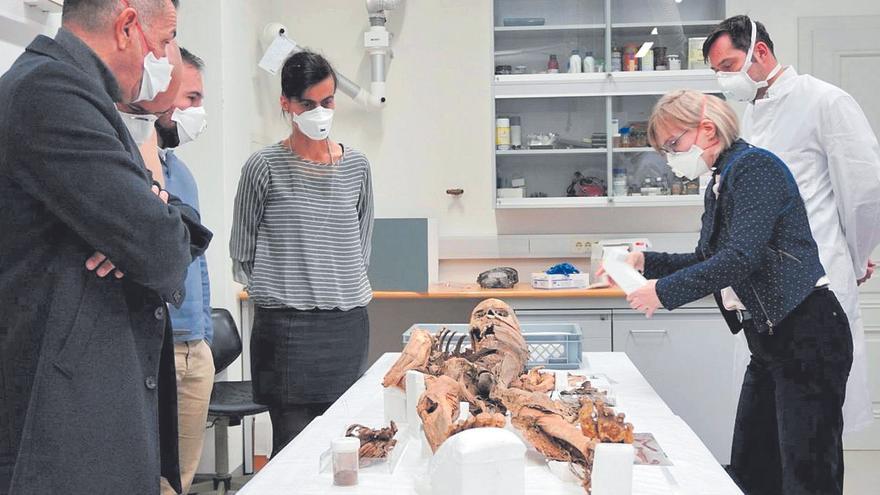
Vienna's Weltmuseum (Museum of World Cultures) holds a significant item linked to Tenerife's past: a Guanche mummy. Its record, number 32227, dates back to 1889. It describes a 168-centimeter-long mummified man, lying on his back with arms crossed and head turned right. The mummy was found in a cave on the coast of Guía, in southwest Tenerife. It was bought on September 15, 1889, from Dr. Manuel Macías Fuerte of San Sebastián de La Gomera, whose father had discovered it.
Now, 136 years after this ancient Guanche from Tenerife's Guía de Isora arrived in Austria, the Canary Islands Government is working to bring it home. Miguel Ángel Clavijo, the Director General of Cultural Heritage for the Canary Islands, recently launched this effort after visiting Vienna. During his trip, from Tuesday to Friday this week, he saw the mummy himself. Clavijo noted that the mummy is "guarded like a treasure" and there are no photos of it online. "It was exciting to see it for the first time," he shared, adding that "it still has remnants of the goat skin that once covered the body."
Beyond the Tenerife mummy, the Weltmuseum also stores an important collection of items from Gran Canaria's first inhabitants. These include pottery, necklace beads, ancient idols, and pintadera molds. Clavijo's department also aims to recover this collection, which he describes as having "great value." It contains over 200 well-preserved pieces.
The visit to Vienna and the discussions about these archaeological finds are part of a larger, ambitious program called "Dispersed Canarian Legacy," recently launched by the Directorate General of Cultural Heritage. The goal is to reclaim all the historical treasures from the Canary Islands' earliest populations, who arrived from North Africa possibly as far back as the 6th century BC. Many of these items are now scattered across the globe, not just in Vienna. This project, led by the Canary Islands Government in partnership with universities, museums, and research centers, seeks to find, document, study, and retrieve these valuable artifacts, most of which left the islands in the 19th and 20th centuries. It also fulfills a requirement of Law 11/2019, which calls for research, protection, and efforts to return or collaborate internationally on this heritage.
The first phase of this initiative began in Vienna. Clavijo held meetings with the University of Vienna, the Natural History Museum, and the Weltmuseum, where the Tenerife mummy and Gran Canaria collection are housed. Clavijo explained that these meetings will help establish scientific and institutional partnerships to document Canary Islands-related items in European institutions, and to create protocols for their study and sharing. "'Dispersed Canarian Legacy' is a crucial step towards symbolically and scientifically recovering Canarian cultural heritage on a global scale, strengthening ties between research, museums, and public efforts to preserve the Canary Islands' history and identity," he added.
Upon returning from Austria, Clavijo described the first experience of the plan as "very satisfactory." He praised the "excellent treatment" received from the historians and managers of the Vienna museums. "They showed us all the items related to the Islands' history, and we could see they care for them very professionally," he emphasized. Thanks to these connections, Canary Islands researchers will visit the Weltmuseum in the coming months to study the mummy and other objects. In turn, Austrian experts will travel to the Islands to see the collections at the Museum of Nature and Archaeology (MUNA) in Santa Cruz de Tenerife and the Canarian Museum in Las Palmas de Gran Canaria, which hold many surviving Guanche artifacts.
Meanwhile, the Directorate General of Cultural Heritage has started the process to determine how to formally request the return of these items to the Canary Islands. Clavijo noted that since the Weltmuseum is a public institution, the request will need to come from the Spanish Government to the Austrian Government. "We are currently finding out which ministry – Culture or Foreign Affairs – needs to submit the request to Austria," he clarified.
The program's next destination is the University of Cambridge in the United Kingdom. Clavijo will travel there (date to be confirmed) to inspect another Guanche mummy. This mummy is considered one of the best preserved, alongside one in Madrid's Museum of Anthropology, and the Canary Islands has been seeking its return for years. Its journey began in 1773 when English Captain George Young took it from Tenerife on his ship, the Weazle, and delivered it to Trinity College, Cambridge. The mummified body, believed to be a male no older than 45 who likely died from multiple facial blows, is now housed at the Leverhulme Centre for Evolutionary Studies at the University of Cambridge.
The story of the Vienna mummy mirrors that of many other Guanche bodies that ended up outside the Islands. This happened at a time when archaeology was not yet a formal field, and artifacts were often collected and traded. Canarian mummies, being rare, became highly valuable. These mummified remains of the aboriginal people have always fascinated both islanders and visitors, as well as local and international scientists. According to Conrado Rodríguez-Maffiotte, director of the Museum of Nature and Man in Santa Cruz de Tenerife, and Mercedes Martín, a bioanthropologist at the Archaeological Museum of Tenerife, this "fascination with mummies led many to end up in places where they should never have arrived, both within and outside Tenerife," soon after the Castilian conquest of the Canary Islands ended in the late 15th century. In an article titled 'Guanche Mummies in Exile,' they describe "a long history of plunder and looting" that continued until the 20th century, when laws were finally put in place to protect this invaluable heritage.
Oscar Simony (1852-1915), a Viennese professor of mathematics, physics, and mechanics, and an adventurer, was the one who took the mummy from Tenerife during his second trip to the island between July and October 1889. These details are revealed in 'The Journey of the Canarian Mummies,' a recent book coordinated by Antonio Tejera Gaspar, a Tenerife archaeology professor. The chapter on this specific mummy was written by Ángel Ignacio Eff-Darwich, a researcher at Museums of Tenerife and a collaborator on the 'Dispersed Canarian Legacy' project. It was Eff-Darwich who advised Miguel Ángel Clavijo to begin the repatriation efforts with this Guanche mummy from Vienna.
During his first trip to Tenerife, from July to October 1888, Simony spent much time camping in Las Cañadas del Teide for sun studies. A year later, on his second trip, among his many acquisitions on the island, he mentioned finding "an almost complete Guanche mummy." Simony deposited his collections from Tenerife – which included not only archaeological items but also zoological, mineralogical, geological, and paleontological specimens – at the Natural History Museum of Vienna. Besides the mummy, these included a skull and other bone fragments from La Palma, and some objects belonging to the Guanches of Tenerife.
According to 'The Journey of the Canarian Mummies,' in 1925, the Natural History Museum in Vienna promoted the mummified body from Guía de Isora as one of its main attractions. Two years later, the ethnography department housing it became a separate museum, moving to the Neue Burg, a wing of Vienna's old imperial palace. It remains there today, an institution renamed the Museum of World Cultures in 2013. Ángel Ignacio Eff-Darwich concludes in the book: "Fortunately, we do not have to speak of a lost specimen, as it is currently in excellent condition in the storerooms of the aforementioned museum, where it still retains inventory number 32227."
The artifacts from Gran Canaria's early inhabitants, also found at the Weltmuseum and sought by the Canary Islands Government, are part of the collection of Dominik Josef Wölfel (1888-1963). Wölfel was an Austrian historian recognized for his pioneering studies on pre-Hispanic Canary Islands and the languages of the indigenous Berber people. In 2018, the Canarian Museum in Las Palmas de Gran Canaria took charge of a large portion of the material Wölfel collected throughout his life. This scholar had returned a significant part of the islands' pre-Hispanic past by meticulously researching 15th and 16th-century archives.
The Weltmuseum's website displays some items from the Wölfel collection originating from Gran Canaria, including pottery fragments (some with decorative incisions), complete pieces, and pintadera molds. The museum reports that 205 such items are in its storerooms, also in perfect condition, according to the Director General of Cultural Heritage. Now begins a complex process to transfer the mummy to MUNA and the Gran Canarian objects to the Canarian Museum.
Dozens of Guanche mummies were scattered worldwide, mostly in the 19th and 20th centuries, and the whereabouts of many are now unknown.
Madrid: The best-preserved Guanche mummy is at the National Archaeological Museum. Three others, previously at the Complutense University's Museum of Medical Anthropology, were returned to the island in 2011.
Germany: At least two Guanche mummies are in Germany: one at the Anatomical Museum of Berlin and another at the University of Göttingen.
France: The Musée de l'Homme in Paris once held six Guanche mummies, though their specific characteristics or origins are not known.
United Kingdom: Various UK institutions have mummies in their collections, with the one at the University of Cambridge being the most famous.
Russia: In Saint Petersburg, the Peter the Great Museum of Anthropology and Ethnography houses one mummy and the two legs of another.
Austria: The Museum of World Cultures in Vienna holds a mummified Guanche body.
Denmark: The Zoological Museum of the University of Copenhagen preserves the remains of about 14 Guanches, some showing signs of mummification.
Canada: McGill University in Montreal has another mummy, which originated from Barranco de Santos in Santa Cruz.