
Canary Islands Launch Project Viera to Improve Reading After PISA Results
Following low PISA scores, the Canary Islands launched Project Viera to boost students' reading comprehension, critical thinking, and language skills across 143 schools.
The Canary Islands recently scored low in math, reading, and science on the international PISA report. In response, the regional Ministry of Education launched Project Viera. This project also follows a directive from Spain's Ministry of Education, which asked all regions to start programs to improve these scores, which have dropped significantly since 2012.
Project Viera aims to help students turn information into knowledge and build a new culture around reading. This fresh approach is already being used in hundreds of classrooms across the islands.
Started last September, the project now helps 43,437 students in 143 schools across all the Canary Islands. Around 400 teachers are involved, working as mentors, school coordinators, co-teachers, and reading support staff.
Ana Muñoz, who coordinates the project and promotes language skills for the Ministry of Education, explains that Project Viera focuses on improving students' language and communication through reading. It targets students in 3rd and 4th grade primary school, 2nd and 3rd year of compulsory secondary education (ESO), and the first year of basic vocational training.
While the project's methods are being used in classrooms, Muñoz stresses the "ambitious training" given to teachers. This training was crucial for them to then pass on this knowledge to students. The project emphasizes "reading mediation," a term Muñoz says acknowledges a problem with young people's reading comprehension. She notes that students often read little, and texts are usually short, preventing them from understanding deeper meanings.
Project Viera's training for teachers covers three main areas: reading as a core part of all learning, media and information literacy, and integrated language teaching. Beyond these formal programs, the project aims to give students tools to understand the world through reading, recognizing that reading now happens on many different platforms.
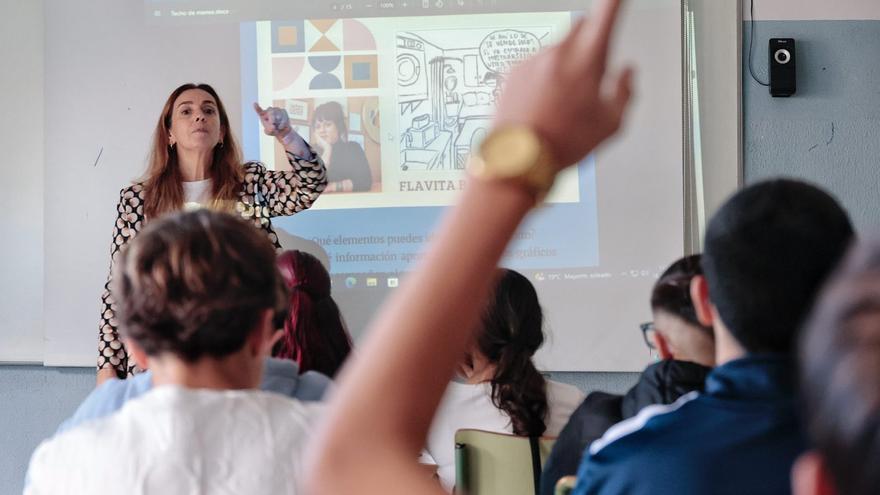
This approach is evident in schools like IES Mencey Bencomo in Los Realejos. Here, various types of texts are used to show students that understanding goes beyond traditional books. Activities include comic strips, social media posts, videos, word searches, and even fake news – all used to help students uncover the meanings hidden in words.
Project Viera uses "non-academic" texts. For example, when discussing the housing crisis in the Canary Islands, students might analyze cartoons or graphs. This means the project can be integrated into almost any subject taught in compulsory education.
Julio Santamaría, a mentor for the project, works with IES Mencey Bencomo and other schools in northern Tenerife. He helps teachers incorporate these reading sessions into their weekly lessons for almost any subject. Ana Muñoz states, "Our goal is for students to discover reality and develop critical thinking through reading." She adds that it's vital in these sessions "to let students speak, so they don't feel that what they say is right or wrong, allowing them to express themselves without limitations, without feeling the pressure of receiving a grade for it."
For students who need extra help, Project Viera offers additional reading hours in the afternoons. These mentorship sessions are similar to regular classes but allow teachers to work one-on-one with students who need it most.
Another goal of Project Viera is to promote Canarian Spanish and local literature in schools. A self-paced course called "Addressing Linguistic Diversity: Canarian Spanish in Our Educational and Heritage Context" was launched in March and has already been completed by 382 teachers and future teachers. The project is also working with the Canarian Academy of Language to bring back the "Lexican" teaching tool, re-publish "My First Dictionary of Canarianisms," and ensure more Canarian literature is available in schools.