
Canary Islands Demand Express Cranes to End Motorway Traffic Jams
Tenerife and Gran Canaria are jointly petitioning Spain's national traffic authority for dedicated quick-response crane services to swiftly clear motorway accidents and breakdowns, aiming to alleviate persistent, hours-long traffic jams.
Tenerife and Gran Canaria are joining forces to demand a special quick-response crane service from the national traffic authority (DGT). They want these cranes to rapidly remove crashed or broken-down vehicles from the islands' motorways, which will prevent traffic jams that can last for over two hours.
The island councils are frustrated with the lack of action from the DGT's local offices in Santa Cruz de Tenerife and Las Palmas. They plan to take their request to Madrid to speed up what they see as a crucial solution to avoidable traffic jams.
Eulalia García, the councilor in charge of mobility for Tenerife, said she's been talking to Gran Canaria's Island Council about tackling this issue together in Madrid. Both administrations share the same need for a dedicated service to quickly remove vehicles from motorways, and they both struggle to communicate effectively with the local DGT offices.
"We've discussed this with Gran Canaria's Mobility Department, and we're ready to go to Madrid together to finally get a solution after so many unsuccessful attempts," García stated.
She also mentioned that the local DGT office "doesn't respond to requests," despite her efforts over several months. "We need Traffic's approval to launch this much-needed crane service on the North and South motorways, as they have the authority in this area, but we've made no progress," she explained. "Gran Canaria is facing the same problem, so we have no choice but to go to the central headquarters of the General Directorate in Madrid to get their attention."
The express cranes are a key part of Tenerife Island Council President Rosa Dávila's plan to reduce traffic jams on the island's roads, especially the South (TF-1) and North (TF-5) motorways.
Last February, the council approved €350,000 for this service, aiming to remove crashed or broken-down vehicles within an average of 15 minutes.
This is particularly important because the narrow road shoulders on the TF-1 and TF-5 mean that vehicles can't be left there if they break down. This obstructs traffic until they can be removed.
This, combined with delays from the regular crane service (which is also affected by the traffic), causes significant traffic jams. These jams add to the usual rush-hour congestion, especially on the TF-5 between Santa Cruz and La Laguna, which is the island's busiest road. In areas like San Lázaro and Las Chumberas (La Laguna), daily traffic averages exceed 100,000 vehicles.
Eulalia García emphasized that the demand for express cranes isn't just coming from the island councils. "The Traffic Civil Guard themselves have raised this issue of the narrow shoulders and the need for specific cranes to speed up the process of clearing the motorways," she said.
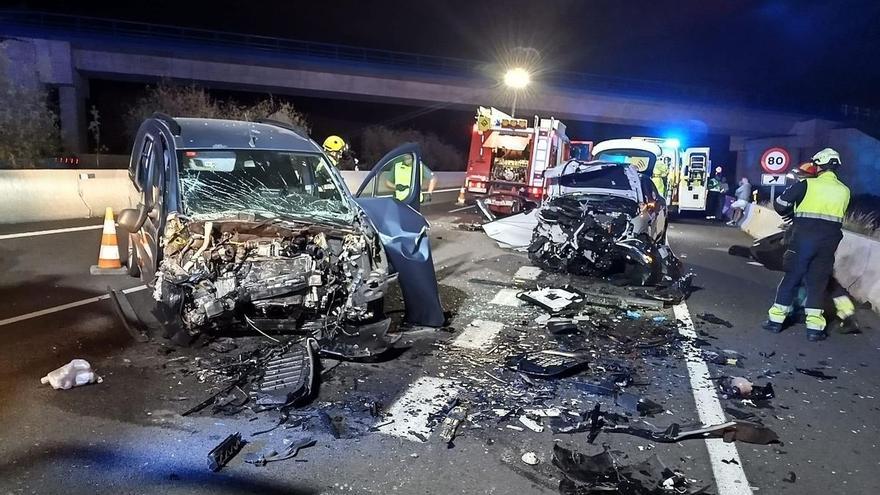
The Gran Canaria Island Council has increased pressure on the DGT after a recent incident. Last Monday, a five-vehicle collision on the GC-1 near Telde caused a major traffic jam and three minor injuries. It took conventional cranes over three hours to clear the road, trapping thousands of vehicles in the northbound lanes and creating a 10-kilometer tailback.
Last Tuesday, the president of the Gran Canaria Island Council, Antonio Morales, revealed that "in initial meetings, the Provincial Traffic Headquarters told us that the State was working on a protocol to allow for quicker action when accidents occur." However, he hasn't heard of any progress. "We don't know what happened to this protocol," Morales told the media.
Morales explained that the provincial head of Traffic for Las Palmas didn't attend the monthly meetings held to coordinate actions to improve traffic on the GC-1 in either September or October, claiming to have a busy schedule.
Similar incidents happen frequently on Tenerife's motorways. Just last Friday, a four-vehicle accident on the TF-1 near Arafo caused significant traffic jams heading south.
"We can't keep waiting for the local headquarters to respond after multiple requests," emphasized Eulalia García. "We need the document we've been requesting for months that provides legal support for the express crane service. This is a commitment we've made to the people of Tenerife and a need expressed by the Traffic Civil Guard itself."
Both island councils are now seeking a meeting with the DGT in Madrid to urgently address the issue and deploy these express cranes as soon as possible to finally end these traffic jams.