
Círculo de Amistad XII de Enero: Tenerife's Enduring Cultural Landmark
Recognized as an Asset of Cultural Interest, the Círculo de Amistad XII de Enero is a historic recreational society founded in 1868 in Santa Cruz de Tenerife, celebrated for its iconic building and diverse cultural, recreational, and sports programs.
The Círculo de Amistad recreational society began on March 13, 1868. It was formed when three other societies merged: "El Recreo," a patriotic and educational group for artisans in Santa Cruz de Tenerife, founded on August 2, 1855, on Caleta Street, and led by Cirilo Romero; "El Progreso," located on La Noria Street, with Gregorio Carta as president; and "Amigos de la Juventud La Aurora," established on September 13, 1855, on Tigre Street, and led by Rafael de Bethencourt.
The new Círculo de Amistad society, at 12 Plaza de la Iglesia, quickly became a key cultural hub in the city. It offered a reading room, a ballroom, and a theater, all adorned with paintings by Cirilo Romero.
A devastating fire destroyed their headquarters on July 14, 1892. The society then rented a place at 90 Castillo Street, but soon moved to 11 Clavel Street. Eventually, they bought a single-story house on San Felipe Neri Street (now Emilio Calzadilla, 17), opening it with dances during the May festivities of 1893.
The society got its current name, Círculo de Amistad XII de Enero, on October 30, 1903, after merging with the "Sociedad XII de Enero" from the El Toscal neighborhood.
To build its current headquarters, the society bought land on Ruiz de Padrón Street. They needed a loan of 30,000 pesetas, so they issued 500 bonds, each worth 30 pesetas, at a five percent interest rate. On December 1, 1904, the plans for the new building were submitted to the Santa Cruz City Council. These plans, designed by architect Mariano Estanga y Arias-Girón, showed a grand French-style property and were displayed for the public in the window of Droguería Espinosa.
The Building
Construction began in July 1905. The ballroom officially opened on December 31, 1919, marking a joyful celebration of the end of World War I and the start of the Roaring Twenties.
Teodomiro Robayna started the facade's sculptures in 1908. Eduardo Tarquis finished them in 1924, including the large griffins that stand beside the main allegorical figure.
In 1927, the main courtyard received a glass roof. A year later, the grand imperial staircase leading to the ballroom was covered in Carrara marble, ensuring the new building was fully equipped.
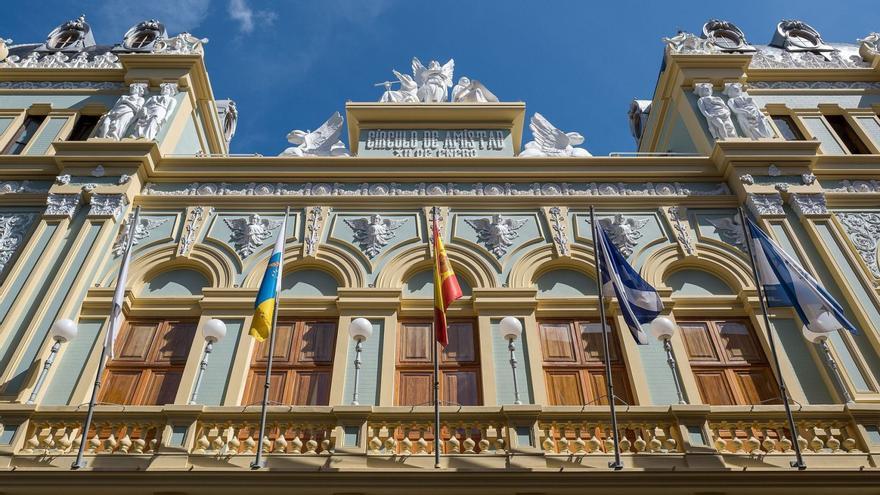
The building has three main floors and a wide, symmetrical front. An additional floor is formed by turrets at each end, featuring attics and mansard roofs. These turrets enclose a central, recessed terrace. The turret roofs are unique, designed to look like large, scaled caps.
The ground floor has subtle rustication (rough-hewn stone effect). The upper floors are highly decorative, with balustraded balconies holding fourteen cast-iron candelabras, made in Seville. There are also relief decorations featuring cherubs, caryatids, and telamons.
The building has undergone several renovations over the years. In 1934, architect José Enrique Marrero Regalado remodeled it, creating a single property with an entrance on Ruiz de Padrón Street. Architect Tomás Machado y Méndez Fernández de Lugo carried out further renovations and expansions in 1958. In 1963, a summer terrace and a 300-seat theater were added. The original interior staircase, with its wooden steps and beautiful Art Nouveau railing made of wrought iron and cast iron, is still wonderfully preserved.
Recreational Society
Over its history, the society's facilities have hosted countless cultural and recreational events. Many notable figures have given lectures, poets have shared their work, and famous painters, sculptors, and photographers have exhibited their art. The society has honored individuals from literature, music, theater, cinema, beauty, and fashion, and has welcomed visits from royalty, politicians, and other distinguished guests.
Its magnificent social hall has been the venue for various dances, including afternoon, evening, formal, and New Year's Eve dances, as well as costume parties and themed partner dances.
The theater has hosted concerts, zarzuelas (Spanish operettas), piano and vocal recitals, lecture series, and book presentations. The Amistad Theater Group also stages its plays there.
While many musical groups have been part of the society over the years (such as Tronco Verde and Coral de Cámara), the lyrical group La Zarzuela continues to perform and participate in various recreational and festive events.
The library, with over 15,000 books, newspapers, and magazines, attracts many visitors, particularly during exam times.
Since 1985, the society has also offered excellent sports facilities at its complex in Barranco Hondo (Candelaria). These include swimming pools, a gym, and courts for basketball, futsal, volleyball, bowls, pétanque, tennis, and squash. There are also rooms for board games, billiards, table tennis, and chess.
Over its long history, the Círculo de Amistad XII de Enero has received numerous accolades. It was declared an Asset of Cultural Interest (Monument category) on June 19, 2008. Other honors include the Gold Medal of the Canary Islands in 2005, the Gold Medal of the City of Santa Cruz de Tenerife in 1980, and the Tourist Merit Plaque from the Ministry of Information and Tourism in 1967. The society has also been recognized with the Opelio Rodríguez Peña Award at the 1991 Carnival, Master of Popularity in 1988, Famous Person of the Year 1999 by Peña Salamanca, the Golden Clown from the Ni-Fú Ni-Fa Philharmonic in 2007, and the Gold Insignia of the Comparsa Los Danzarines Canarios in 2007.