
Buenavista del Norte: 4-Month Bottled Water Ordeal Over Fluoride.
Over 400 residents across six villages in Buenavista del Norte have been dependent on council-provided bottled water for four months due to undrinkable tap water with high fluoride, leading to significant logistical and health challenges.
Fetching bottled water twice a week at the cultural center in El Palmar and Las Portelas, Buenavista del Norte, has become a regular routine. For four months now, residents haven't been able to drink tap water because it has too much fluoride. This means over 400 people make a regular trip to collect plastic water bottles.
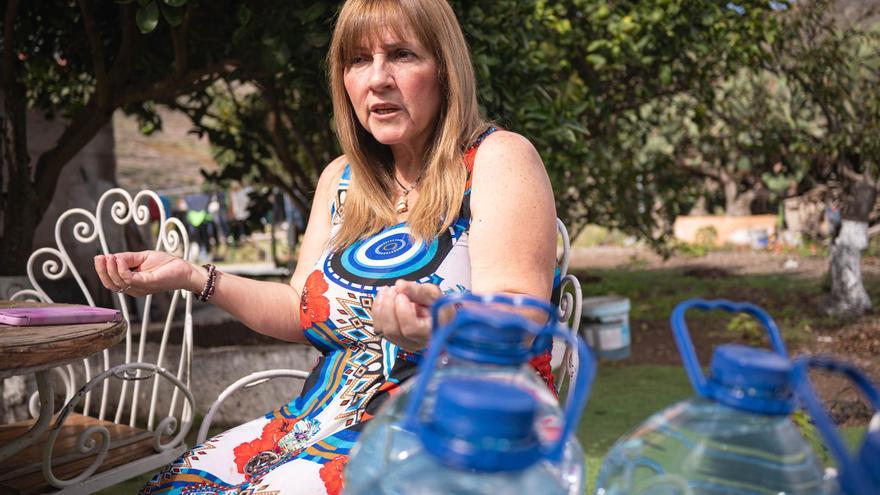
Lidia Rodríguez Acevedo, who lives in El Palmar, stores 96 liters (12 bottles) of water in her pantry. This amount covers her family's Wednesday and Friday distribution. She explains, "They give us six because three are for my daughter and three are for me." Normally, each household gets three large bottles, but Lidia's family receives six because there are seven people in her house, including three children.
The local council has handed out over 20,000 large bottles since the tap water restriction began in the summer. This is an estimated figure. At an average market price of €1.50 per bottle, this would cost over €30,000 in four months. This means almost 500 people have used more than 160,000 liters of water, according to municipal records. Although official data are not available – Mayor Eva García (PSOE) declined to provide them – it's known that about 240 large bottles are given out daily in Las Portelas and 400 in El Palmar. Besides these villages, Las Lagunetas, Barranco Las Palmas, La Sabina, and the upper part of Casablanca are also affected.
With November here and summer officially over, people hope the water distribution will end soon. A WhatsApp message circulating among El Palmar residents says that neighbors helped find a big leak in a reservoir. Because of this, water flow is improving, and tests will now be done to make sure the water is safe to drink again and has no excess fluoride.
However, Lidia Rodríguez Acevedo doesn't know if a solution is coming soon. "I still don't believe it," she says, "because if it was being fixed, they wouldn't keep giving us water. They haven't told us when the bottled water will stop." She confirmed she collected her family's allocated water that very morning. "I wish it were true," she added. "There are seven of us, and the children, especially, drink a lot of water. We also cook with it, and it's barely enough for us."
Lidia has lived in El Palmar for seven years. She's from Venezuela, and her husband's family is from the Buenavista neighborhood. She described their 120-day ordeal as "Horrible. It's terrible not to have normal drinking water because it's essential for everything."
Since Lidia doesn't have a car, she relies on neighbors to take her to the cultural center to get water. "I ask my neighbor to take me, or to bring me the large bottles that are allocated to me. My husband goes to work, and I have no way to get around," she explains.
She is grateful, saying, "At least we're thankful the City Council is giving us water; otherwise, I don't know what we'd do." Sometimes, her family has to buy extra water because "the water they give us isn't enough. There are many of us." A Buenavista official previously stated that "distributing and buying water is the council's responsibility. We must help families who can't afford water and ensure they have an alternative."
Even though the tap water isn't safe to drink, people in six villages in Buenavista del Norte still use it for showering and washing. Lidia says that after showering, "our skin itches." She adds, "One neighbor even got hives and went to the doctor, who said it was from the water." She also mentioned her skin becomes very dry after using the tap water.
The water collection process is straightforward. Residents arrive, state their full name and street, and their details are checked against the council's list before they receive their bottles. After months, there's a clear trust between the council staff and residents. Sometimes, staff even tell people that a family member has already collected their water, like telling a woman, "Your son came this morning." She was grateful not to have to carry the heavy bottles herself.
A man living near the El Palmar cultural center manages to carry two large bottles on his small white scooter. He balances 16 liters of water, gripping them with his feet. He then returns for his third bottle and smiles for a photo.