
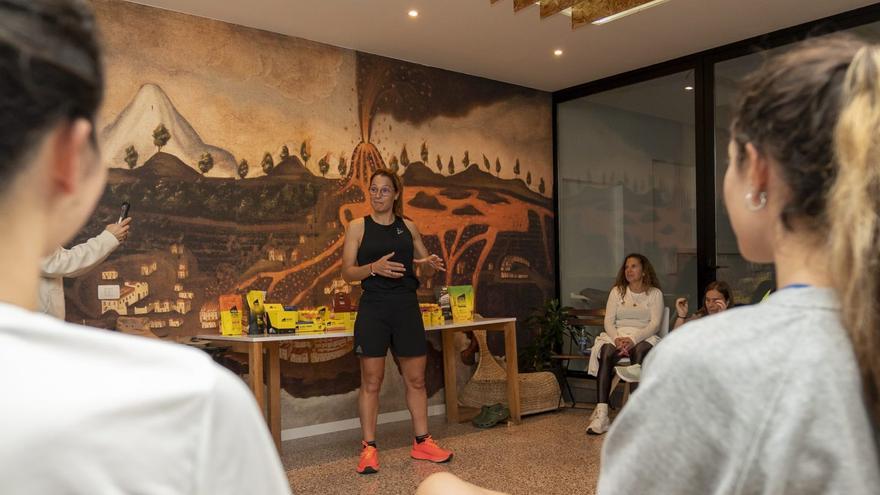
Asaltamontes Female: Global Women's Trail Running Movement Lands in Tenerife
Asaltamontes Female, a non-profit movement founded by professional trail runner Aroa Sío to empower women in trail running, has expanded to 43 cities across 11 countries and is currently hosting a camp in Tenerife.
If you see a group of women running, walking, or simply enjoying the mountain air in Garachico or on Teide this weekend, it's no accident. They are Asaltamontes Female. Behind this movement is Aroa Sío, a professional trail runner from Galicia. In 2022, Aroa, who inspires others to think differently, decided it was time for trail running to become less male-dominated.
Asaltamontes Female, a non-profit group that encourages women to get involved in trail running, started almost by chance, "in the silliest way." For years, Sío noticed the same pattern: race starting lines packed with men and very few women. One day, she posted an invitation on social media, unsure of the outcome. Her idea was to meet for mountain training – no competition, no pressure, just enjoying the outdoors at different paces. She didn't take attendance or require registration. That Sunday, 40 women appeared. "I was blown away," Aroa remembers. She was even more surprised to learn that a trail race was happening in a nearby town and a half marathon in her city that very day. Yet, these women chose to be there.
Two weeks later, it happened again. This time, Aroa, a true Galician, points out it wasn't just light rain; "it was raining cats and dogs." The result? 80 women training together. Clearly, something special was unfolding.
From that point, things really took off. First, a WhatsApp group formed. Then came more meet-ups, and women started reaching out, some saying they "hadn't heard about it" before, others expressing they "wanted to do it again." Aroa knew the group couldn't rely only on her, as her professional running career often took her away to places like California or Madeira.
Then came Arantxa, an energetic woman in the group, always encouraging others and suggesting activities. She became a crucial part of the project. Aroa messaged her privately, asking if she'd like to be the group's "captain." Over time, Arantxa not only took on that role but also became a co-founder of Asaltamontes Female – and even Aroa's personal nutritionist. These are the kinds of connections that form when you approach things with a human touch.
Starting in Vigo, the project soon spread to other parts of Spain, including Bilbao and Ibiza. They organized simultaneous meet-ups, all free and always ending with refreshments. Before they knew it, Asaltamontes had grown from a local idea into a vast network.
Today, the project operates in 43 cities across 11 countries, with 36 of those cities in Spain. Each city has its own WhatsApp group and unique activities. They've gained so much attention that even UTMB – the organization behind a whole trail running world, including the highly prestigious Chamonix ultramarathon – has reached out to collaborate for March 8th. Sío expects Tenerife will also host a March 8th meet-up, with direct support from Bluetrail.
So, why Tenerife this weekend? "Climate aside," Aroa says the routes were the main draw. She had run here before when the Bluetrail was the Spanish Championship. She wanted to host a camp on an island. She'd visited almost all of them, but Tenerife always captivated her. She spoke with Fernando Ordóñez, director of the Bluetrail, and the idea started to come to life. On the island, Garachico proved to be the perfect base. "I'm blown away by it, it's beautiful," Aroa admits, having never visited Garachico before, despite knowing other parts of Tenerife.
This weekend's schedule is quite active. The goal is to get moving, have fun, and learn. Yesterday's evening outing in Isla Baja covered 5.5 kilometers, starting from the Trevejo accommodation and exploring the coast and town, with an introductory talk. Today is dedicated to Teide. Tomorrow, participants will practice pole technique in Garachico and attend a strength class in the Town Hall square. Every activity is designed to ensure participants gain more than just miles on their legs.
When asked why fewer women participate in trail running, Aroa immediately points to a "mental" barrier. "Where am I going at my age?" is the question she hears most frequently. She always responds with the same example: her mother, who "started at 60 and had never done any sport," Aroa stresses, "never." Today, her mother walks and runs in the mountains. This real and relatable story helps break down many stereotypes.
Another significant barrier is the lack of company. Many women don't feel comfortable training with groups of men, whether because of different paces, insecurity, or past negative experiences. "Some women have experienced abuse or assaults, and going into the mountains with men can make them feel repulsed," Aroa explains. Asaltamontes Female was also created to be a "safe space." The numbers show its impact: in Galicia, female participation in trail running has jumped from 10% to 35% in just two years. In Vigo, the original group now has 300 active women who communicate and organize activities daily.
On social media, Asaltamontes Female maintains a clear approach. They don't focus on showing off impossible achievements, like 80-kilometer runs or 150-kilometer ultra-marathons. Aroa says that while such feats can be inspiring, they can also be demotivating. Instead, she prefers to feature her mother, everyday women, and neighbors who started running at 40. The message she wants to send is: "If she can do it, I can do it." That's why Aroa rarely appears on the project's Instagram. She wants real, everyday women to be the stars.
A key to Asaltamontes' success is how their training sessions are organized. For each outing, they form several groups: one for running, another for alternating running and walking, and a third for just walking. Aroa typically joins the running group, Arantxa stays with the last group, and another colleague is positioned in the middle. If someone slows down, they automatically move to a different group. No one is left behind. The best part, Aroa says, is "seeing the evolution. Women who started by walking now run sections." Women who "discover what they are capable of."