
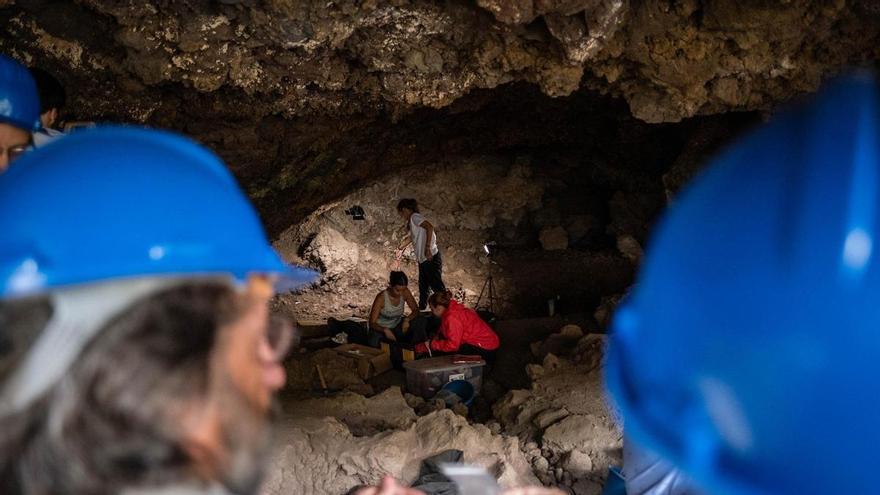
Archaeological Excavations Reveal Major Aboriginal Settlement in Tenerife’s Barranco de Agua de Dios
Archaeological excavations in Tegueste’s Barranco de Agua de Dios have revealed that the Cueva de Los Cabezazos was the center of a sophisticated aboriginal settlement occupied for nearly a millennium.
Archaeological research in the Barranco de Agua de Dios in Tegueste has reached a major milestone following the completion of its fifth excavation campaign. A scientific team led by the University of La Laguna, with support from the Canary Islands Government and the local council, has discovered that the Cueva de Los Cabezazos is not an isolated site, but the heart of an aboriginal settlement that spanned nearly 1,000 years. Researchers are now expanding their work to nearby caves to better understand how the island’s ancient inhabitants organized their society.
The site is particularly valuable because many of its soil layers remained intact even after excavations in the 1970s. By combining records from those earlier digs with new findings, researchers have built a more accurate timeline. Nearly 30 radiocarbon tests show the ravine was occupied between the 6th and 15th centuries. The team is now working to pinpoint exactly when the first groups arrived and how the population grew over time.
The project is also notable for its multidisciplinary approach. Experts from the University of Basel are using "traceology"—the study of microscopic wear patterns—to analyze basalt, obsidian, and bone tools. These findings suggest that the ancient inhabitants were more specialized in their daily work and domestic tasks than historians previously believed.
Additionally, scientists are studying organic remains, such as human and animal waste, to gather genetic evidence. This provides unique insights into the diet, health, and living conditions of the Guanches that traditional artifacts cannot reveal.
This project, which brings together specialists from the universities of La Laguna, Valencia, and the Autonomous University of Barcelona, serves as a vital training ground for history students. By supporting doctoral research and academic papers, the team is fundamentally changing our understanding of pre-Hispanic life in the Canary Islands. The ongoing excavations aim to create a complete picture of the ravine, offering a level of detail never before seen in Canarian archaeology.