
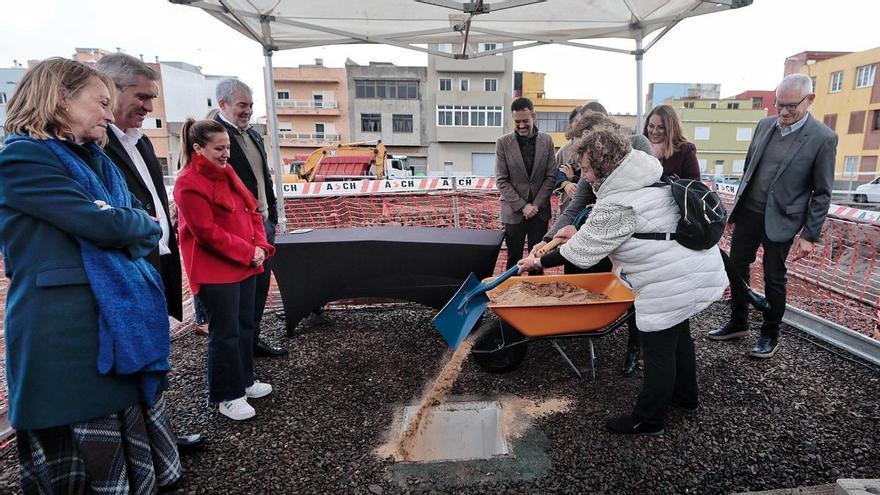
Apanate Breaks Ground on First ASD Residential Complex After 18-Year Wait
After an 18-year wait, the Canarian Association for Autism Spectrum Disorder (Apanate) has finally broken ground on its first residential complex in La Laguna, designed to help 20 people with ASD live more independently.
After an 18-year wait, held back by bureaucracy and financial hurdles, the Canarian Association for Autism Spectrum Disorder (Apanate) has finally broken ground on a new residential complex today. This is the organization's first residential facility of its kind, designed to help 20 people with Autism Spectrum Disorder (ASD) live more independently and develop their personal skills. The complex will be built in the Coromoto neighborhood of La Laguna.
Apanate first proposed the project in 2008 to various government bodies and city councils. But it took ten years for them to sign an agreement with the Cabildo de Tenerife (Tenerife Island Council) to make it happen. The plan was for construction to be finished within three years, by 2020. However, what seemed like a big step forward led to another delay. Two years past that deadline, both the Cabildo and the Canary Islands Government committed to building it. And today, with the project effectively turning 18 years old in 2026, construction has finally started.
The project has a budget of 3,007,134 euros and is expected to take 24 months to complete. This means it should be finished by January 2028, ready for residents to move in. Most of the funding comes from European Next Generation funds, and the Cabildo de Tenerife will provide additional financial support if needed. In fact, the Cabildo, through its Social and Socio-sanitary Institute, will oversee the construction and then hand it over to Apanate to manage.
The project aims to ease families' worries about their children's future. For years, they have been calling for a facility like this to help their children gain more independence. Cecilia Mendoza is one of those mothers who felt a great sense of relief seeing the groundbreaking. Her son has been involved with Apanate for about 30 years, almost since it started. "It was something we thought was very far off, and now it's finally happening for their well-being," she said, clearly emotional. For her, seeing construction begin has given her "peace of mind" for when she eventually passes away.
Apanate's president, María del Carmen Díaz, called the project "one that guarantees the future and peace of mind of families." She added that the fears she once shared have now turned into hope. "The residents will be neighbors in the district and will live alongside other people in the area," she noted. This groundbreaking model in the Canary Islands ensures the right to independent living, safety, and specialized care for people with ASD.
The building will have three floors and four separate homes. "The idea is for the building to function as a community with shared areas and four independent living spaces," explained project architect José Luis Barquín. Each home will feature double and single rooms (making up 75% of the units), accessible bathrooms, a living room, a kitchen, and even a private outdoor patio. The entrance will also house a reception for residents and an administrative office for Apanate staff.
On the main floor, besides the homes, residents will have access to a central outdoor area for activities. This floor will also include a dedicated space for workshops. For instance, there will be a large industrial kitchen for residents and other Apanate users, along with a laundry room. A physiotherapy and gymnastics room is also planned.
The basement will contain storage rooms, one for each home, and a garage with space for up to 25 vehicles. Water tanks and the service area will also be located on this level. Finally, 42 solar panels will be installed on the rooftop for energy independence and sustainability. Addressing families' concerns about the climate in this lagoon area, the architect reassured them: "there will be air conditioning for summer and internal heating for the winter months."
The groundbreaking ceremony was attended by Fernando Clavijo, President of the Government of the Canary Islands, and Rosa Dávila and Lope Afonso, President and Vice President of the Cabildo, respectively. Águeda Fumero, the Minister of Social Action, was also there, acknowledging the need for more residential spaces for people with ASD in the Canary Islands. Fumero, along with other officials, emphasized that this complex not only provides 20 new places but also signifies a shift in how people with ASD are cared for. María Leonor Cruz, the Councilor for Social Welfare of the La Laguna City Council, also attended.