
Antad Evolves: From Heroin to Screens, Tenerife Addiction Service Adapts to New Challenges
Founded in 1993 to combat heroin addiction, Antad now supports individuals with diverse dependencies, including screen addiction, across 25 towns in Tenerife, offering five care units and one residential facility.
When heroin was the main addiction and alcohol wasn't seen as a drug, Antad (North Tenerife Association for Drug Addiction Care) was founded. Today, with a wider range of substances people get addicted to, including screens, Antad is still here. It helps people with addictions in 25 towns across Tenerife, outside of Santa Cruz and La Laguna.
Antad, a non-profit organisation started in 1993, now has five fully staffed care units (UAD) and one residential unit (URAD). Marisa Martínez Moristerol, the president and a social worker at Antad, prefers not to limit the term "drug addiction" to just substances, as addiction can take many forms, which is very clear today. Marisa joined Antad in 1994 at Las Crucitas, the residential unit in Granadilla de Abona. She has been helping people with dependencies in Tenerife for over 30 years and has seen how substance use has changed on the island.
Antad's care units are located in Icod de los Vinos, Los Realejos, Puerto de la Cruz, La Matanza de Acentejo, and Granadilla de Abona. They also have two pharmacy and laboratory services (SFL) in Puerto de la Cruz and Granadilla. Anyone struggling with any kind of addiction can visit these centres. Each centre serves a specific area, but people can choose where to go for privacy or convenience.
For example, the care units in Granadilla de Abona and Puerto de la Cruz serve people from 27 and 25 towns respectively. La Matanza helps people from 23 towns, Los Realejos from 15, and Icod de los Vinos from 20 towns across Tenerife.
Antad also supports residents from other islands like La Gomera, La Palma, and Gran Canaria, which currently have limited addiction treatment services.
The association's reach in Tenerife is extensive. Marisa Martínez believes that Antad "plays a very important role in the northern and southern parts of Tenerife." She notes that while these areas are not neglected due to Antad's presence, they have a large population and limited resources. She mentions "very remote" areas like Guía de Isora or Santiago del Teide, where the population is spread out, making it difficult for residents to access addiction treatment centres on the island.
Martínez specifically highlights the south of Tenerife, describing "impressive patient care throughout the tourist area." She points out "a type of transient patient, from other countries, who arrive with problems of alcohol and cocaine addiction, often linked to leisure activities."
In 2020, Antad helped 1,983 people, and this number rose to 2,205 in 2024. Most of Antad's clients are men, making up almost 83%, while women represent between 16% and 18%. The largest age group seeking help is between 40 and 54 years old, though treatment often begins as early as 30. Last year, nearly 800 new admissions were recorded.
Antad's data shows that heroin is the most common drug among patients. However, they explain this is largely due to the Opioid Substitution Program (OPS), where individuals collect their treatment at the pharmacy and laboratory services. But the reality is more complex, with new types of drugs emerging and changing the profile of users. "People who use any type of drug or have any type of dependency change, but this happens because new addictions appear," explains president Marisa Martínez.
Martínez recalls that alcohol addiction became more prominent in the late 1990s, followed by cocaine, crack (a form of cocaine), and cannabis. Now, they are seeing cases involving synthetic drugs or designer drugs. "We are surprised by the number of new drugs that appear over time," she says.
Addiction rarely involves just one substance. Marisa Martínez explains, "We have patients who come because they are addicted to alcohol, but then we discover they also have problems with cocaine or something else." Similarly, this often goes hand-in-hand with mental health issues. It's common for "many patients with substance use problems to also suffer from some type of mental illness."
This is where anxiolytics or benzodiazepines come into the discussion. "People seek relief from their situation through this consumption, they abuse medication, and end up developing a dependency," states the Antad president.
Addiction is starting at younger ages and involving more complex patterns. Tobacco is often the first substance used, according to Martínez. "Then, they start with cannabis and alcohol," she adds. Currently, there are significant concerns about screen addiction, gambling, and pornography use at increasingly younger ages. Several towns where Antad operates have specific prevention programs for young people. Los Realejos has had a program for 10 years with municipal funding of 50,000 euros. Arona, Granadilla de Abona, and Guía de Isora have programs funded by the CajaCanarias Foundation, which are ending this November. In other areas of Tenerife, municipalities make "very small contributions to the association."
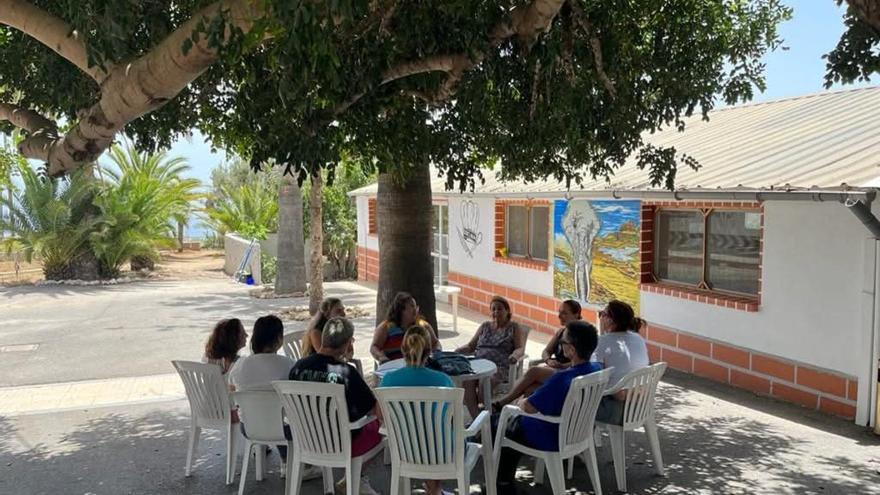
The Las Crucitas Residential Unit in Granadilla de Abona is a key part of Antad's work. It was established in 1994 under the ownership of the City Council and became Antad's property in 1996. It can house 27 people, 19 men and 8 women. Residents arrive after detoxifying and can stay for a maximum of five months. The centre offers individual and group therapy, with support from psychologists, a social educator, and a social worker. Those admitted are often homeless or have lost family support due to their addiction. Martínez notes that individuals without housing may be allowed to stay longer.
During their stay, residents work on reintegration. They start a savings plan, and efforts are made to find job opportunities or affordable housing, or they consider returning to their previous lives. Upon leaving, they are advised to continue follow-up at their local care unit (UAD). "They are not left to fend for themselves. After five months with all their comforts and needs met, they cannot be left alone," she explains. She also points out that women with addictions face a double stigma: "in addition to the stigma of being addicts, they also carry the stigma of being addicted women."