
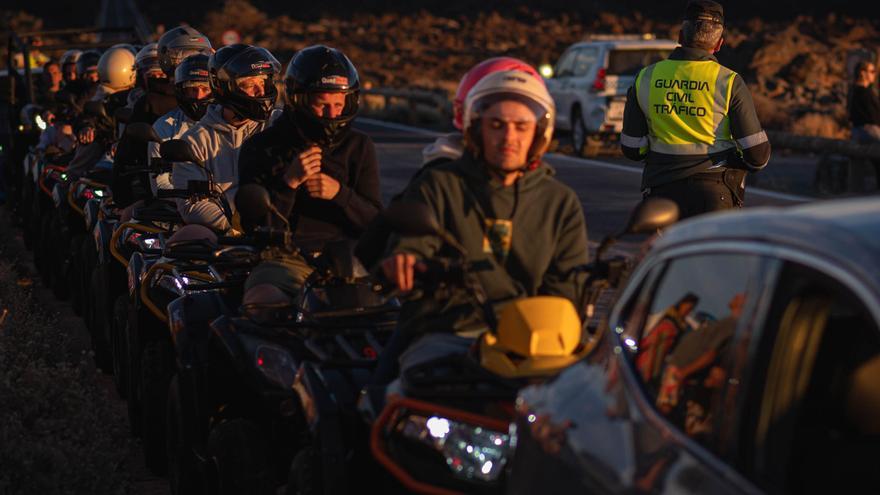
Teide: A marriage proposal under police surveillance and quad bike chaos in the national park
In Tenerife, the police have increased controls in Teide National Park due to the misuse of quad bikes and unauthorized excursions, which lead to rule violations and damage to nature.
A tourist decided to propose at a rather inopportune moment. He came with his girlfriend, family, and friends to the Las Narices del Teide viewpoint. They strayed from the permitted path to find a nice spot. It was very beautiful there: with Teide and Pico Viejo in the background, and the sun setting behind La Gomera, making everything around orange.
But that's when police cars appeared. They saw the tourists from afar and approached to warn them that it was forbidden to walk there. Of course, they did it carefully because they saw the guy was on his knees. They gave the girl time to say "yes" or "no."
It's just a funny incident. In reality, it's not lovers who cause the most damage to the nature of Teide Park, but those who don't think about the consequences. For example, when they ride quad bikes, often without permission, or when many cars fill up the viewpoints and park wherever they please. And also excursions without permits and people who stray from the paths to take a nice photo.
Antonio Barro, head of the environmental service of the Cabildo of Tenerife, coordinates the work of the police, who patrol the park several times a week.
Police warnings and videos on social media about the chaos in the park have forced the island's authorities to increase control.
There were many police officers here: environmentalists, forest rangers, police, civil guard – a total of 17 people with cars. They gathered at the Juan Evora viewpoint.
Some tourists on quad bikes initially greeted them joyfully, but then realized that these were not their friends, but the police, and immediately became serious. Antonio Barro gave the final instructions before sunset, which was scheduled for 7:59 PM.
He said to divide into groups and go to different viewpoints so that they wouldn't be expected. "It's difficult to control everything, but at least this way we can restrain the offenders," he said.
The group with which the journalist was traveling went to Las Narices del Teide, where there are always many people. They arrived at 7:31 PM. There were not as many people as usual, but still too many.
Two police officers stopped a column of five quad bikes. "Are you a guide?" the policeman asked the driver of the first quad bike. "I'm not a guide, I just brought them to see the sunset," he replied with an Italian accent.
"Show me the excursion permits." "They're with the company." "And you don't have them?" "No." "Then show me your documents." "Okay, now..." "And the documents for each quad bike." "Here they are." "But there are no documents for this quad bike here." "How is that possible?" "There aren't." "Wait..." "We'll check everything and call the company." "But everything is fine..." "We'll call them..."
The same thing happened with another group of quad bikes. Their driver, also Italian, had even fewer documents. He looked worried, and the tourists were uncomfortable: time was passing, and the sun was setting.
"You have no permits, no first aid kit, no technical inspection, nothing?" the policeman was surprised. "They're with the company." This is what those who drive these excursions, which cost up to 160 euros per person, always say. But often the company does not have all the necessary documents.
Blanca Pérez, the Councillor for Natural Environment of the Cabildo of Tenerife, said that quad bikes have become a big problem.
There have been more of them since the pandemic, and it turned out that many agencies are violating the rules. In fact, their permits to drive on the trails were not renewed. It is enough to go to the south of Teide or to the Corona Forestal at sunset to see quad bikes constantly driving around.
"We want to regulate the use of these machines in natural areas because it has become a problem," the councillor said. The violations are different: from the lack of documents to permits for tourist activities.
Some force tourists to take pictures in the middle of the road, pick them up from hotels without explaining that they are going to the mountains, drive on the roads, and even forge insurance policies to cover several quad bikes with one.
The police are responsible for permits related to tourism. One of their leaders explained that anyone working as a guide in the national park must have a permit and know Spanish well.
But not everyone follows this. For example, those who conduct astronomical observations. At the same Las Narices del Teide viewpoint, while about a hundred people were watching the sunset, a Czech man set up a telescope in the parking lot. The policeman asked him for permits, but he hardly spoke Spanish. He was saved by the fact that another guide was with him, who, although a foreigner, knew Spanish well.
Pietro Spirelli, also Italian, set up two telescopes at the Lomo Retamar viewpoint to show sunspots or Saturn to a group of young people. "I have no problems because we have a different permit: we look at the sky, not the ground," he said.
The policeman who approached him replied almost the same thing as to the quad bike drivers: "They're with the agency," and smiled ironically. He restrained himself, but when the check was over, he explained that he did not know whether it was deception or simply ignorance.
The permit required is the same, whether you are looking at the sky or at the lava. At least Spinelli admitted that these checks are "necessary." He himself knows why: "Too many people come and leave garbage, especially cigarettes, everywhere. In addition, they park badly, driving onto the road."
Already in the dark, the cars returned to the Juan Evora viewpoint. The police had to check all the data collected. But they knew there would be many fines, as in previous operations. They recalled various stories. The proposal was talked about the most. "Did she say 'yes' or 'no'?" one of the policemen was asked. "I don't know. I was more concerned about not interfering," he replied.