
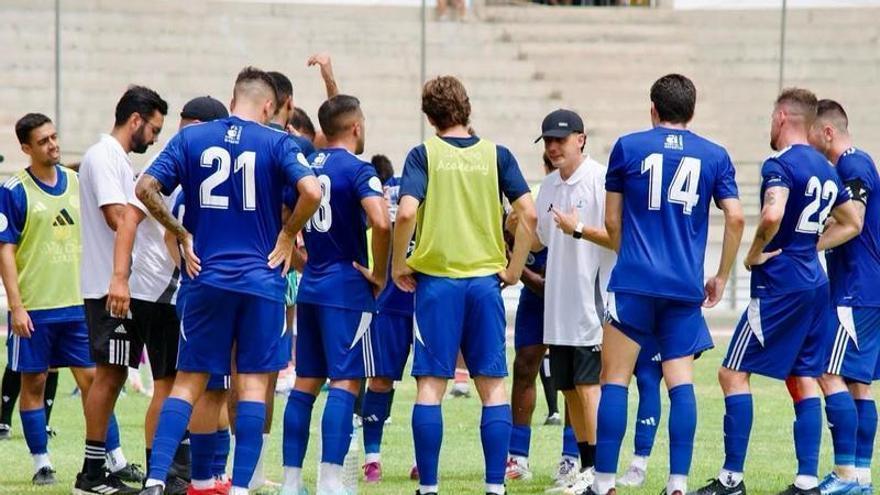
33-year-old coach of "Marino": the youngest manager of the historical club from Tenerife
Cristian Castelo, the 33-year-old and youngest coach of Marino, aims to create a recognizable team capable of competing with any opponent in the Canary Group of the Third Federation.
In football, experience has always been considered very important, almost mandatory for the coach of any team that wants to succeed. It is believed that years spent on or near the field provide knowledge that cannot be obtained in any other way. But sometimes there are people who prove that youth can also be an advantage. One such example is Cristian Castelo, the 33-year-old coach of Marino, a well-known team from Tenerife. He is the youngest coach in the Canary Group of the Third Federation.
To understand how important this is, you need to know what kind of club he coaches. Marino is a team with a great history. For example, it has played the most consecutive seasons in the Third Division in the province of Santa Cruz. And this is enough to understand the responsibility that lies with the coach of this team. Therefore, Castelo's appointment was not a random or ill-considered decision. The team's management believes in his vision, his methods of work, and recognizes his achievements during his short but eventful career. Prior to this, he returned the Las Americas youth team to the National League.
Castelo grew up in El Médano. There, at the Granadilla de Abona school, he began coaching children's and youth teams. He then worked for CD Tenerife for two years, where he prepared young players for the first team. After that, he worked on various youth projects, where he continued to develop his coaching skills. One such place was Armepalmas, where he coached a newly formed youth team. He then joined Buzanada, a club that became an important stage in his career. There he met Enrique Bata, a coordinator who later nominated him to the Marino management.
At Marino, he achieved significant success when he coached the youth team. He had to create a team almost from scratch, as it had just been relegated from the Division of Honor. This was not easy, as only three players remained from the previous season. He had to invite young players and a few players from Buzanada, with whom he had already worked. As a result, the team returned to the top division ahead of schedule, five rounds before the end.
He did not immediately become the coach of the Marino first team. At the end of the previous season, he assisted Willy Barroso when he decided to leave the position. When Barroso announced his final departure, Marino, despite having more experienced coaches, decided to entrust the team to the young Castelo. "I know there were coaches with more experience and better resumes, but the club decided to give me a chance because they liked my work," said Castelo. With the support of sporting director Alejandro González Lea, he began the most important stage of his career.
Leading a historic team could have been a difficult task, but Castelo handled it with surprising calm. He says he doesn't get too excited about victories and doesn't get too upset about defeats. And it is on this calmness that his leadership is based. "We don't impose anything, we just explain what we think will help us win, and we do it based on knowledge," he says. Since he is almost the same age as many of his players, he could have problems with authority. But Castelo chooses a different path. He tries to convince and explain, not to command. It is not surprising that when talking about role models, he mentions Eder Sarabia.
As for the pressure, Castelo tries not to dramatize the situation and remains pragmatic. "I'm calm, I know that everything depends on victories and results, and if I don't achieve them, I'll have to leave, as in any other team," he says. His goal is to create a Marino with its own style of play, which will be recognizable and allow the team to compete with any opponent.
When asked about the goals for the season, Castelo answers cautiously but ambitiously. He understands that there are many strong teams in this league that train almost like professionals and have larger budgets. Therefore, he wants to teach his players to "compete every week" and see "how far they can go in February or March." He doesn't talk about direct promotion or play-offs, but he wants to create a team that can put up a fight against anyone. So far, the season has started with a home defeat to San Fernando (0:1) and an away win over San Bartolomé (2:3).